


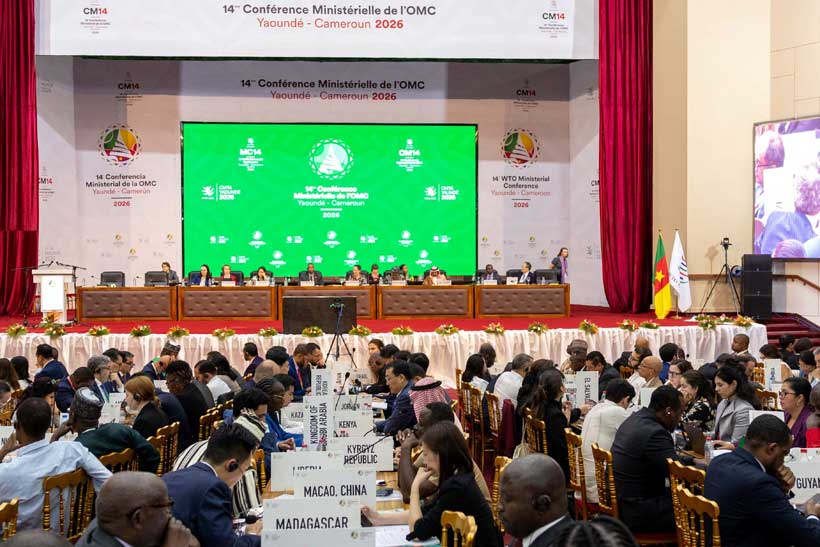
The WTO’s 14th Ministerial Conference being held in Yaoundé Cameroon this week broke up in acrimony and disarray in the small hours of yesterday.
Slated to end at noon on Sunday, weary delegates slogged it out until one in the morning to try to cobble together the semblance of a Ministerial declaration, one that would set a path for future reform of the organisation, relaunch negotiations on agriculture and update the WTO rule book to include digital trade. It failed on all counts.
It was embarrassing to see the hapless Director General Ngozi Okono Nweala (a West African herself) putting on a brave face and calling the meet a success. Your correspondent was reminded of the Black Knight in the film Monty Python and the Holy Grail who, having just had his arms and legs cut off by a sword, lunges around on the stump of his torso crying “It’s just a flesh wound!”.
Unusual for Ministerial Conferences, several Ministers left early. The US minister Jamieson Greer pulled out of Yaoundé already on Saturday. The EU Delegation was at the airport on Sunday evening catching flights back to Brussels as the Conference was still on. Like rats leaving a sinking ship they knew nothing could be retrieved.
Stay ahead of the geopolitical week.
MD Briefing delivers expert analysis across five global fronts — the Indo-Pacific, energy, geoeconomics, European security, and the Middle East — every Monday morning. Free.
The Thrill Is Gone
So what went wrong? Several things.
First, the US especially under Trump has demonstrated near-contempt for the multilateral system. His series of “reciprocal” tariff agreements with Japan, EU, UK and a dozen others are blatantly illegal under WTO rules (they breach the non-discrimination principle of WTO and raise US tariffs to their highest levels since the 1930’s). The US came to Yaoundé not in peace but in order to frustrate progress on the bulk of issues on the table.
This Ministerial was dubbed “the Reform Ministerial”, aiming to modernise the rules of the WTO and its rights and obligations.
As part of its ideas on “reform” the US had earlier tabled a proposal to deny developing countries certain rights they have under WTO, and to abolish non discrimination as the foundational principle of WTO. Backed up in this by the EU in a tactically foolish submission of last month, the rest of the WTO membership was in no mood to accommodate the US (and EU’s) cack-handed ideas on how to reform ie diminish most members’ rights in the WTO.
The bulk of members – who are developing countries – therefore resisted any detailed mandate to negotiate a reform of WTO rules, given no incentive to do so. The USA for its part, seeing pushback on its own self-centred and controversial reform ideas, refused in turn to endorse any meaningful outcome. The result? Just an agreement to continue talking about that chimera WTO reform but with little guidance on the content or ambition. The subject now risks getting bogged down even further.
Inside the Pig Pen
This resentment against the US’s spoiling tactics spilled over into the discussions on agricultural reform, which have been rumbling on unsuccessfully for two decades. In the green corner the EU, that wants to rollback distorting farm subsidies but is not willing to reduce its agricultural tariffs. In the blue corner the US that wants to hang on to its subsidies (that have grown massively under Trump following the closure of China’s market to US farm exports). In the saffron corner India who too wants to maintain its enormous and distortive farmer subsidies – its subsidised rice and wheat mountains stocked purportedly for food security purposes. And in the red corner Brazil and other big agricultural exporters who demand satisfaction on the twenty year old mandate to reform agriculture, both subsidies and tariffs. It was, as always, impossible to square the circle and the Conference ended with a limp declaration that the Members of WTO will continue to talk about agriculture and report back in two years’ time. This is a serious setback.
Moratorium Mortis
A third big piece at Yaoundé was the hoped-for agreement to extend, possibly make permanent, a moratorium on levying customs duties on electronic deliveries (books, data, Netflix, music delivered electronically etc). This failed and the moratorium has now expired, possibly never to be revived. It may not matter in practice because very few countries intend to levy e-commerce duties but some – Indonesia, India, South Africa come to mind – want to preserve the policy space to do so in future, not least as US big data platforms increasingly invade their economies.
Alongside this failed attempt to extend the customs moratorium, a sub-group of members sought to incorporate in the WTO framework a draft agreement on digital trade, the E-Commerce Agreement or ECA. The ECA among other things enshrines the permanent moratorium on duties, along with some other sensible disciplines on transparency of regimes, data privacy rules, source code access and other features of modern digital exchanges.
This attempt fell also. India formally objected to incorporating the ECA as a WTO agreement, on the grounds that it was not ripe for inclusion and that safeguards would need to be negotiated to ensure it met the interests of developing countries. This was not wholly expected as India had earlier been giving signals that it might not object to the ECA, but India was sending a signal that it was not going to compromise here if others did not meet it at least half way on reform and agriculture.
I Got My Kicks on Route 66
As a fallback 66 members of the organisation – counting the EU as 27 – adopted the Agreement on an interim basis but explicitly outside the WTO framework. They will implement it independently in their own jurisdictions.
DG Ngozi hailed this agreement between the 66 as the big success of MC14. Views are mixed on this. Some commentators with reason make the point that it needed a WTO Ministerial and a meeting of the members to actually push the decision to adopt the ECA so that is a positive step. Others on the other hand – including your author – regret that the ECA had to be adopted outside of the WTO. If countries go elsewhere to sell their wares this can only weaken the WTO as the prime forum for multilateral trade cooperation. Time will tell: the signatories hope to use the WTO as a forum to persuade recalcitrant countries over time to accept the ECA as a legitimate addition to the rule book.
Significantly, the US is not amongst the 66, leading to speculation that it no longer cares about the e-commerce moratorium when it can wrest this bilaterally out of weaker trading partners.
Boulevard of Broken Dreams?
So MC14 ended in ignominy. But it would be wrong to blame “the WTO” for the collapse. The WTO is no more than a set of commitments reflecting the will of countries to bind their policies for the global good of trade stability. In an article written last week (link: https://www.euractiv.com/opinion/the-wto-doesnt-need-reforming-but-its-members-do/ I argued that in fact it is the big four powers – the US, China, India and the EU – who need to reform. The four need to start some serious introspection and understand that unless they reform their own trade policies, and remember the value of a binding set of stable trade rules, the WTO will become irrelevant
Because the WTO, like all international treaties, is only as strong as the readiness of its members to follow its rules.
