


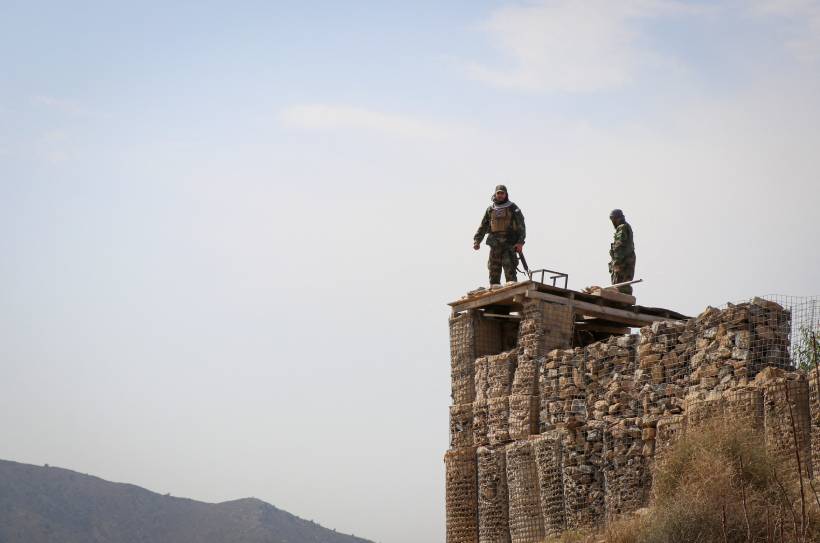
For years, Pakistan was widely seen as having influence over the Taliban, particularly during the U.S. war in Afghanistan when Taliban leaders found refuge across the border.
However, since the Taliban returned to power in 2021, relations with Pakistan have steadily deteriorated. What was once viewed as a strategic partnership has evolved into a security liability for Islamabad.
The current conflict, formally declared shortly before the wider Iran war escalated, has remained largely overshadowed internationally but signals a major shift in regional dynamics.
The Core Issue: The Pakistani Taliban
At the heart of the conflict is the Tehrik-i-Taliban Pakistan (TTP), a militant group distinct from but ideologically aligned with the Afghan Taliban.
Stay ahead of the geopolitical week.
MD Briefing delivers expert analysis across five global fronts — the Indo-Pacific, energy, geoeconomics, European security, and the Middle East — every Monday morning. Free.
The TTP has intensified attacks inside Pakistan and now openly aligns itself with the Taliban’s broader ideological project, aiming to expand its model of governance into Pakistan.
Crucially, the Afghan Taliban have provided safe haven to TTP fighters, mirroring the sanctuary they once received in Pakistan. This has become the central point of friction, with Pakistan viewing it as a direct threat to its internal security.
Taliban Strategy: Legitimacy Through Conflict
For the Taliban leadership, confrontation with Pakistan serves both domestic and ideological purposes.
By framing the conflict as a defense of national sovereignty, the Taliban position themselves as protectors of Afghanistan against external pressure. Their messaging draws on historical narratives of resisting foreign powers, reinforcing recruitment and internal cohesion.
Militarily, the Taliban rely on guerrilla tactics and decentralized forces, believing these methods give them an advantage against Pakistan’s conventional military operations.
Accumulated Grievances
The breakdown in relations is also rooted in long-standing mistrust.
After the September 11 attacks, Pakistan cooperated with the United States, leading to the arrest or killing of several Taliban leaders. Figures within the Taliban leadership continue to blame Pakistan for these losses.
When the Taliban regained power in 2021, these grievances shaped policy decisions. The group moved to reduce Pakistan’s influence by:
- Pressuring Taliban members to relocate families and assets out of Pakistan
- Redirecting trade toward Iran
- Expanding economic ties with India
These steps signaled a deliberate shift away from dependence on Pakistan.
Escalation Dynamics
The current conflict has evolved in stages.
Initially, Pakistan targeted TTP positions inside Afghanistan through airstrikes. However, as tensions escalated, strikes expanded to include Taliban-linked targets, effectively turning a counterterrorism campaign into a state-to-state confrontation.
In response, the Taliban have begun deploying fighters across the border, marking a significant escalation and blurring the line between insurgency and conventional conflict.
Regional Dimensions
The conflict is further complicated by broader geopolitical interests.
- India has cautiously expanded its engagement with the Taliban, partly to counter Pakistan’s influence.
- China is attempting to balance its strategic partnership with Pakistan while maintaining limited ties with the Taliban.
This creates a complex regional environment where no major power has full alignment with either side.
Analysis: A Strategic Miscalculation Unfolding
The conflict reveals a fundamental miscalculation in Pakistan’s long-term strategy.
Islamabad once viewed the Taliban as a means of securing influence in Afghanistan. Instead, the group has emerged as an independent actor with its own ideological goals, unwilling to align with Pakistan’s security priorities.
By sheltering the TTP, the Taliban have effectively turned Afghanistan into a base for anti-Pakistan militancy. Pakistan’s military response, meanwhile, risks escalating into a broader conflict without a clear path to victory.
Regime change in Afghanistan is not a viable option due to the absence of a credible alternative to the Taliban. At the same time, limited airstrikes have failed to alter Taliban behavior.
This leaves Pakistan in a strategic dilemma: escalate further and risk a prolonged conflict, or accept a hostile government on its western border.
In essence, the war is not just about security it reflects the collapse of a decades-old policy framework and the emergence of a more unpredictable regional order.
With information from Reuters.
