


Authors: Muhammad Rauhan Rasheed and Asif Al Hasan*
In an interesting development, the Spanish Prime Minister, Pedro Sanchez, refused to be a part of the war against Iran after a few days of Madrid’s refusal to allow Washington to use its Rota and Moron bases to attack Iran and the withdrawal of 15 U.S. planes from southern Spain. This diplomatic inconvenience for the United States signalled a broader reality, which has consequences far beyond Spain, i.e., the old system of American bases as an insurance policy is no longer reassuring. Gulf states long assumed that a massive American military presence would deter enemies and stabilize the region. The preliminary stage of this war has already shown the fallibility of that assumption at its very core. Rather than U.S. bases keeping the Gulf out of the conflict, they have pulled the Gulf states deeper in. Therefore, what were intended to be ironclad shields have been turned into lightning rods.
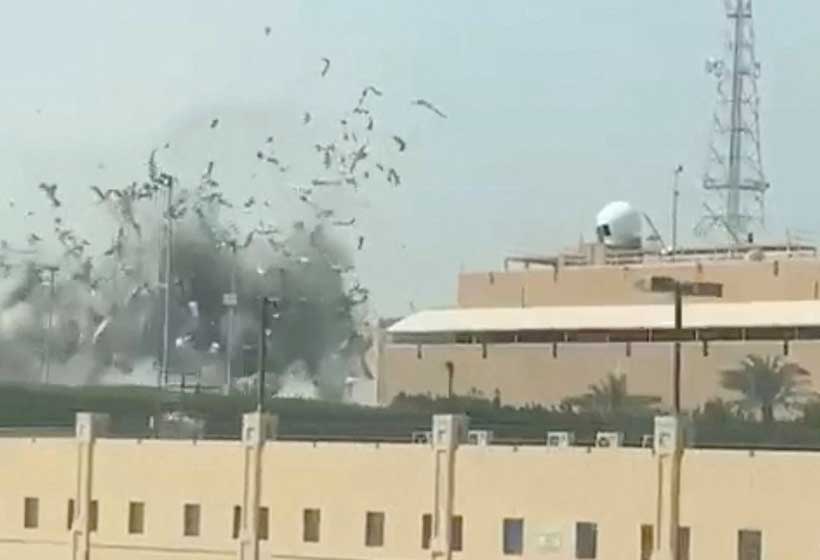
With U.S. and Israeli attacks on Iran that had started on February 28, Tehran reacted as most Gulf governments always thought it would; by turning the geography of American power into a target map. The Islamic Revolutionary Guard Corps of Iran claimed to have struck U.S. targets in Bahrain, Qatar, and the United Arab Emirates, as American defenses were forced to shoot down missiles aimed at installations such as the Al Udeid base in Qatar, the headquarters of the Fifth Fleet in Bahrain, and Ali Salem in Kuwait and Al Dhafra in the UAE. The scale itself should solely bury the old talking points. By March 8, the UAE reported that 1,422 drones and 246 missiles had been fired at its territory. While Kuwait recorded 406 drones and 219 missiles, and Qatar reported 63 drones, 129 missiles, and two aircraft. Moreover, Bahrain claimed to have intercepted 164 drones and 95 missiles. These attacks are not clearly symbolic; rather, they indicate an organized and sustained retaliation by Iran on the Gulf states that made a strategic error of hosting U.S. military installations.
This is precisely where the comforting fiction begins to fall apart, as the very existence of the U.S. bases made Gulf states a direct battleground for the war rather than protecting them. This political miscalculation also has technical drawbacks, considering that Iranian missiles have reportedly destroyed key radar systems in the U.S. regional missile-defense architecture, including the AN/FPS-132 early-warning radar in Qatar, which was reported to cost approximately 1.1 billion and could take years to replace. Supposing that Tehran could pick off and cripple precisely the sort of system that assists in early warning and interception, then this war has had more than its share of revelations. It has revealed a force multiplier for further strikes.
Stay ahead of the geopolitical week.
MD Briefing delivers expert analysis across five global fronts — the Indo-Pacific, energy, geoeconomics, European security, and the Middle East — every Monday morning. Free.
That is the actual strategic lesson of the war thus far: the idea of deterrence is not merely about possessing more resources. The question is whether the military set of assets can alter an adversary’s calculations. They obviously do not in the Gulf nowadays.Besides, the lesson extends beyond the Gulf, as the wider strategic promise of American power, especially with NATO, starts to appear hollow if it is incapable of defending the states in which it is hosted. The suspicion was already mounting as disputes with NATO allies have expanded to include issues related to policies and sovereignty. The current backdrop in the Gulf, therefore, clearly does not instil confidence among NATO allies; it could unsettle them. As the U.S. presence ceases to assure security in the Gulf, NATO members will wonder precisely what it will assure them when the crisis draws nearer to home.
The spillover of civilian casualties and the economic crisis are just making matters worse. For instance, residents who lived near the U.S. Embassy in Doha were evacuated as a precaution. The idea of proximity to an American facility becoming a danger may have started a trend that could continue throughout the region, as similar attacks on the U.S. diplomatic facilities are reported in Saudi Arabia, Kuwait, and Dubai. In addition, insecurity is creeping in as flight cancellations by major airlines and the tourism sector are resulting in significant losses, which collectively are transforming the security architecture that used to safeguard embassies, airports, and commercial centers into collateral stress points.
Of course, this does not imply that alliances are useless or that the United States’ influence will soon vanish in the region. However, it signifies the loss of the old Middle East model in plain sight. There is no longer a comfortable assurance of protection when the U.S. bases are hosted. In contrast, it serves the reverse purpose, exposing states more and rendering them dependent on a protector who cannot entirely shield them from the repercussions of its own wars. In that regard, Spain might have understood something early. The symbolic prestige of accommodating American power is not the true assurance to the states, but their own strengths, their judgment, and their ability to refrain from becoming the front line of someone else’s conflict. The question now is whether states will continue to hold onto outdated assumptions or develop a security model that responds appropriately to the complexities of the 21st century.
*Asif Al Hasan is an Erasmus Mundus Master’s scholar in the Religious Diversity in a Globalised World (ReD Global) program at the University of Groningen, Netherlands and the University of Córdoba, Spain. He holds Master’s degree in International Relations from Jahangirnagar University and Bachelor’s in World Religions and Culture from the University of Dhaka, Bangladesh.
