


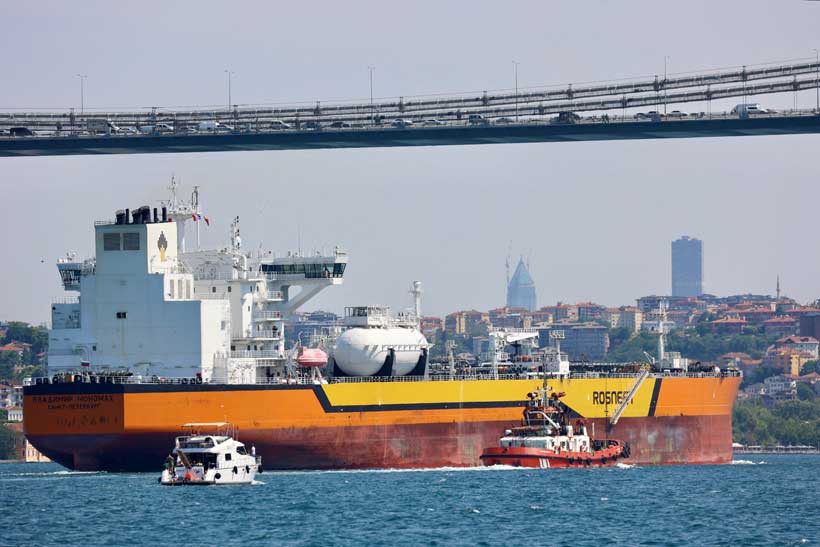
Russia is preparing to redirect crude oil shipments to India to offset supply disruptions caused by the ongoing conflict in the Middle East, according to an industry source with direct knowledge. Approximately 9.5 million barrels of Russian crude are currently on vessels near Indian waters and could reach the country within weeks, offering rapid relief to Indian refiners facing severe shortages.
Vulnerability of India’s Energy Supply
India, the world’s third-largest oil consumer, relies heavily on Middle Eastern imports, with about 40% of its crude moving through the Strait of Hormuz, a chokepoint now effectively closed due to Iranian attacks on shipping following U.S. and Israeli strikes on Iranian targets. Indian crude stocks cover roughly 25 days of demand, while inventories of refined fuels like gasoil, gasoline, and liquefied petroleum gas are similarly limited.
With refiners processing around 5.6 million barrels per day, the near-closure of the Strait has forced New Delhi to urgently seek alternative suppliers. An Indian government source confirmed that the country is exploring options to secure supplies beyond the next 10–15 days, anticipating a prolonged regional conflict.
Russia Steps In
The source said Russia is prepared to supply India with up to 40% of its crude needs, providing a critical lifeline in a volatile market. While Indian imports of Russian oil fell to about 1.1 million barrels per day in January down from previous levels due to U.S. tariffs February saw the share climb back to roughly 30%.
Stay ahead of the geopolitical week.
MD Briefing delivers expert analysis across five global fronts — the Indo-Pacific, energy, geoeconomics, European security, and the Middle East — every Monday morning. Free.
Indian refiners are in regular contact with Russian traders, but any increase in purchases will depend on government guidance, particularly as trade talks with the United States continue. Last month, U.S. President Donald Trump agreed to lift punitive tariffs on Indian imports after New Delhi reportedly committed to reducing Russian oil purchases. India, however, has not fully complied, citing the need to diversify supply amid evolving global energy dynamics.
Market Implications
The conflict has intensified global market volatility, making oil a “seller’s market,” according to the industry source. Russian crude, previously discounted due to Western sanctions following the 2022 invasion of Ukraine, may now command higher prices as buyers scramble to secure alternative sources.
Russia is also reportedly ready to supply liquefied natural gas to India after Qatar, a top supplier, halted production. Indian companies have already rationed gas to some industrial customers to manage shortfalls, highlighting the broader economic impact of energy disruptions.
Regional Energy Context
Both China and India depend on Middle Eastern oil for roughly half of their imports, but India is more exposed due to lower storage capacity and limited strategic reserves. The Middle East conflict, therefore, threatens to tighten supply across Asia, with energy-intensive sectors facing immediate constraints.
In response, the U.S. has taken steps to mitigate disruptions. President Trump authorized the Navy to escort oil tankers through the Strait of Hormuz and instructed the U.S. International Development Finance Corporation to provide political risk insurance for Gulf shipping, though the effectiveness of these measures remains uncertain.
Analysis
India’s energy vulnerability has become starkly apparent amid the Middle East crisis. With limited stockpiles and heavy reliance on a geopolitically unstable region, rapid diversification is essential. Russia’s willingness to redirect oil and gas provides a temporary buffer, but comes with diplomatic and economic risks, particularly in balancing U.S. pressure with strategic energy needs.
This situation underscores the fragility of global energy networks, where regional conflicts can rapidly disrupt supply chains, spike prices, and force nations to pivot toward alternative partners. For India, navigating between geopolitical obligations and energy security priorities will be critical in the coming weeks, with implications for domestic fuel costs, industrial output, and broader economic stability.
With information from Reuters.
