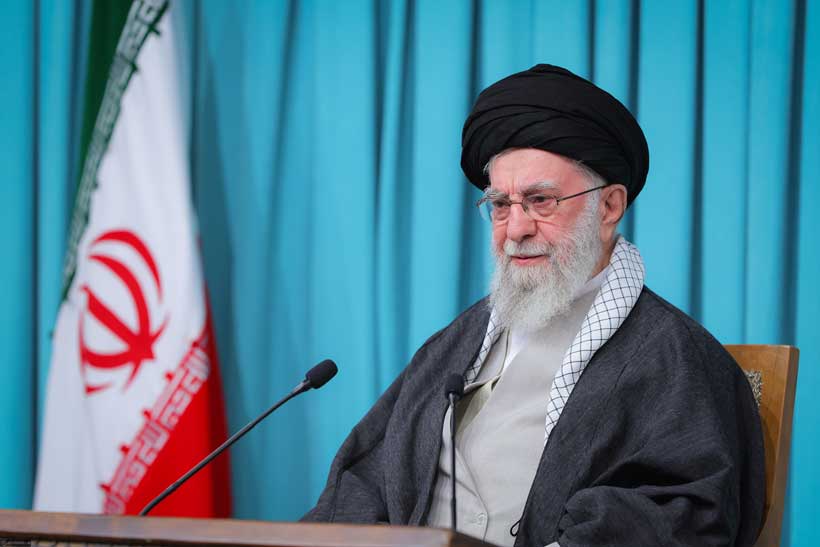
Ayatollah Ali Khamenei, who ruled Iran for 36 years, transformed the country into a formidable anti-U.S. presence in the Middle East while suppressing domestic unrest with an authoritarian approach. He was reported dead at age 86 after air strikes by Israel and the U.S. targeted his Tehran compound, following unsuccessful diplomatic efforts to address Iran’s nuclear program.
Initially perceived as weak and indecisive, Khamenei became an influential figure after succeeding Ayatollah Ruhollah Khomeini, the founder of the Islamic Republic of Iran. His trajectory from a lesser president to one of Iran’s most powerful leaders, according to experts like Karim Sadjadpour from the Carnegie Endowment for International Peace, exemplified an “accident of history.”
Throughout his tenure, Khamenei maintained a hostile stance toward Washington, especially evident during Donald Trump’s presidency beginning in 2025. As protests erupted in Iran accompanied by chants like “Death to the dictator,” Khamenei remained defiant, proclaiming the nation would not “yield to the enemy.” His hardline approach, akin to that of Khomeini, thwarted moderate presidential efforts advocating greater openness, contributing to Iran’s isolation.
Khamenei consistently refuted claims that Iran’s nuclear ambitions were weapon-related. In 2015, he cautiously endorsed a nuclear agreement facilitating a partial lifting of sanctions in exchange for curbs on Iran’s program. Nonetheless, his enmity towards the U.S. escalated after Trump’s administration withdrew from the deal in 2018, prompting renewed sanctions that crippled Iran’s oil sector. Khamenei backed hardliners and criticized past strategies of engaging with the West, rejecting Trump’s proposals for a new nuclear agreement in 2025 with harsh condemnations of U.S. leadership.
His anti-U.S. rhetoric was central to his governance, echoing sentiments from the 1979 revolution that led to the ousting of the last Shah of Iran. Khamenei faced significant challenges during his rule, notably during the protests after the disputed 2009 presidential election that questioned his legitimacy. He was also confronted with intense demonstrations in 2022 following the death of Mahsa Amini, which led to a brutal crackdown involving executions and public displays of violence aimed at quelling unrest.
Khamenei wielded extensive power, controlling the armed forces and appointing key figures across various national institutions. His rigid control of Iran’s political landscape stymied any potential rival factions, further solidifying his authority as the ultimate decision-maker within the clerical state framework. Scholars depicted him as an insecure ideologue, driven by a fear of betrayal, a sentiment intensified by a previous assassination attempt that left him with a paralyzed arm.
Human rights organizations frequently criticized Iran under Khamenei for systemic abuses, while the government claimed a positive human rights record compared to other Muslim-majority nations.
Born in Mashhad in April 1939, Khamenei’s religious Path began at age 11 when he became a cleric. He studied in Iraq and Iran’s Qom, diverging from his father, a traditionalist cleric against political Islam. Khamenei first faced imprisonment for political activism at 24, enduring torture during his detentions.
Following the 1979 revolution, he held multiple positions within the Islamic Republic, including deputy defense minister during the devastating Iran-Iraq war. His ascendancy to the presidency—backed by Khomeini—and later as Khomeini’s successor surprised many due to his lack of Khomeini’s charisma and clerical stature, raising questions regarding his rise in a transformative era in Iranian politics.
Expanding Iran’s Influence
Khamenei’s connections to the powerful Revolutionary Guards were evident in 2009 when they quelled protests following President Ahmadinejad’s controversial re-election. He managed a considerable financial empire through Setad, originally established by Khomeini but significantly expanded under Khamenei’s leadership, boasting assets in the tens of billions. Khamenei strategically enhanced Iranian influence, supporting Shi’ite militias in Iraq, Lebanon, and military efforts in Syria to uphold Assad’s regime. His efforts resulted in significant financial and military backing to allies within the “Axis of Resistance,” which opposed U.S. and Israeli dominance in the region, including groups like Hamas and Yemen’s Houthis.
However, by 2024, this influence began to wane as Assad was ousted and both Hezbollah and Hamas faced severe setbacks against Israel, losing key leaders in the process. Under Khamenei, Iran engaged in a prolonged shadow war with Israel, which included assassinations of Iranian nuclear scientists. This conflict escalated during the Israel-Hamas war in 2023, with Iran retaliating against Israeli airstrikes on its interests in Damascus.
The conflict reached a boiling point in June 2025 with a coordinated military assault by Israel on Iranian targets, initiating a full-scale war, with U.S. forces joining the operation over a 12-day period. Talks between U.S. and Iranian representatives failed due to Iran’s unwillingness to relinquish uranium enrichment capabilities, which the U.S. viewed as a pathway to nuclear weapon development.
Khamenei’s rejection of normalization with the U.S. stemmed from a belief that the U.S. supported extremist factions to fuel sectarian strife. Despite formally denying aspirations for nuclear weapons, he also upheld a fatwa commanding violence against Salman Rushdie, reaffirmed as recently as 2017, with implications following the 2022 attack on Rushdie.
As Khamenei passed, Iran found itself under escalating external pressures from Israel and the U.S. and faced rising internal dissent, particularly from disillusioned youth. Many Iranians, like a 25-year-old university graduate, criticized the regime’s priorities, advocating for a focus on peace and normalcy rather than military confrontations and nuclear ambitions, reflecting a significant generational shift in perspectives on governance since the 1979 revolution.
With information from Reuters
Stay ahead of the geopolitical week.
MD Briefing delivers expert analysis across five global fronts — the Indo-Pacific, energy, geoeconomics, European security, and the Middle East — every Monday morning. Free.