


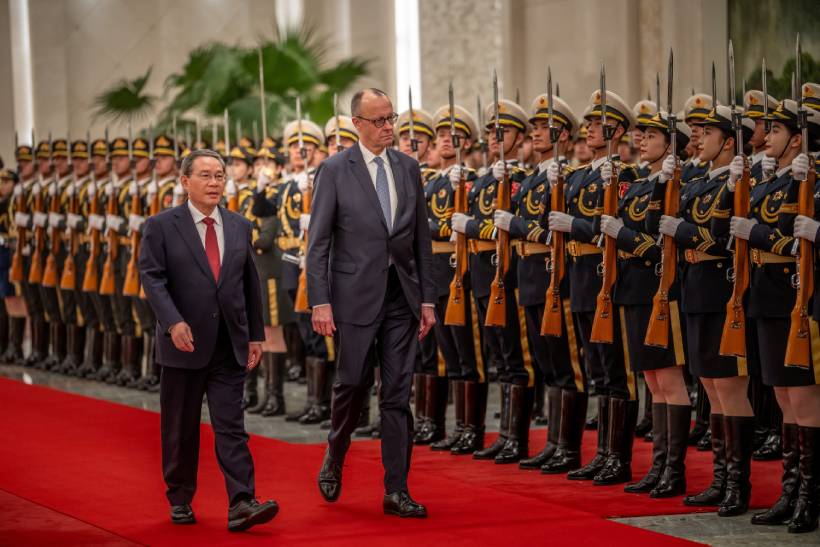
Friedrich Merz, Germany’s chancellor, visited Xi Jinping in Beijing this week, underscoring Europe’s growing role in China’s global trade strategy amid tensions with the United States. With EU-China trade deals frozen over uncertainty around U.S. tariffs, Europe is pressing Beijing on a core demand: allow the yuan to rise against the euro to level the playing field.
Trade Ties and Surpluses
China is Germany’s largest trade partner, and ties between the two have grown sharply since the COVID-19 pandemic, even as U.S.-China trade declines. China’s trade surplus reached a record $1.2 trillion in 2025. Yet European officials see any further expansion as distorted by a yuan that remains undervalued against the euro, giving Chinese exporters a price advantage.
At a Sino-German business event, Merz encouraged Chinese investment in Europe but emphasized that a moderate yuan appreciation would make trade fairer. Discussions with Premier Li Qiang highlighted Europe’s “very specific concerns” about subsidies, dumping, and currency manipulation.
The Currency Gap
While the yuan has appreciated against the U.S. dollar this year — up about 5.5% over the past 12 months — its value against the euro has barely changed, leaving the real effective exchange rate highly favorable for Chinese exporters. European producers, by contrast, have faced rising input costs of 35-40% since the pandemic, effectively amplifying the euro’s strength against the yuan in real terms.
Stay ahead of the geopolitical week.
MD Briefing delivers expert analysis across five global fronts — the Indo-Pacific, energy, geoeconomics, European security, and the Middle East — every Monday morning. Free.
According to Juergen Matthes of the IW German Economic Institute, Germany’s goods trade deficit with China has nearly quadrupled since 2020, largely driven by a “40% real appreciation of the euro against the yuan.” He also cites evidence suggesting significant currency intervention by Beijing to suppress yuan gains.
Economic and Geopolitical Pressures
China’s reluctance to allow the yuan to rise reflects its dependence on exports to meet ambitious growth targets, amid weak domestic demand, a property slump, and demographic challenges. For Europe, balancing closer economic engagement with China while safeguarding its own industries requires pressing Beijing on currency policy, much as the United States has done.
Europe’s message is clear: if China wants deeper trade and investment ties, it must allow a stronger yuan to reduce the competitive advantage created by an undervalued currency. Without such a move, Beijing has little incentive to adjust, leaving the EU to weigh both economic opportunity and strategic leverage in dealings with the world’s second-largest economy.
With information from Reuters.
