


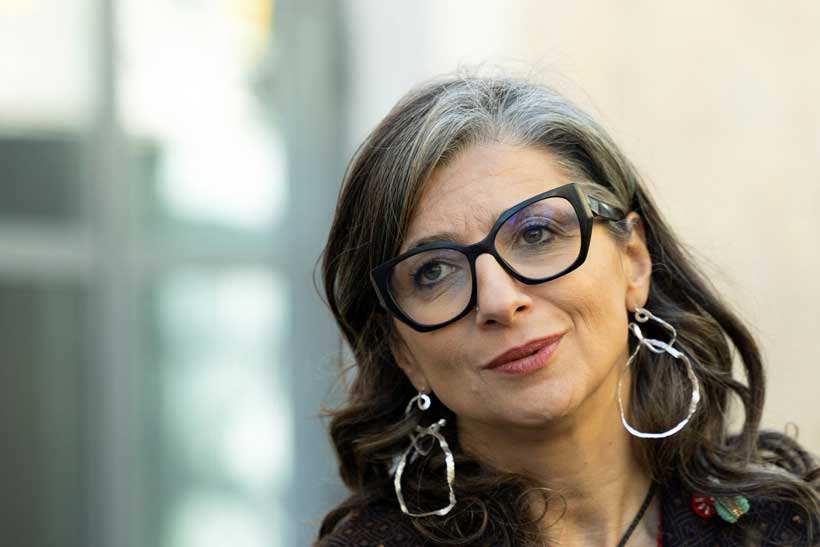
Francesca Albanese’s children, ages 12 and 9, can no longer run freely around their Tunisia neighborhood. Her U.S. bank account is closed. Her $700,000 Washington D.C. condo sits frozen. European banks won’t touch her. She borrows credit cards from friends to travel. And she sits on the U.S. Treasury’s Specially Designated Nationals list, alongside al-Qaeda terrorists, drug traffickers, and arms dealers.
Her crime? Writing letters to American corporations.
A Reuters special investigation reveals how the Trump administration weaponized terrorism-grade sanctions against the United Nations special rapporteur for Palestine and eight of the International Criminal Court’s 18 judges—not for actual terrorism, but for investigating alleged war crimes by Israel in Gaza and potential future prosecution of U.S. personnel. The story that emerges isn’t just about punishing critics. It’s about systematically dismantling the international justice infrastructure that could one day hold Trump or American corporations accountable.
Corporate Complaints, Terrorism Sanctions
In spring 2025, Albanese sent confidential letters to more than a dozen major U.S. companies—Alphabet, Amazon, Caterpillar, Chevron, Hewlett Packard, IBM, Lockheed Martin, Microsoft, Palantir, warning they might be named in her upcoming UN report for “contributing to gross violations of human rights” by Israel in Gaza and the West Bank.
Stay ahead of the geopolitical week.
MD Briefing delivers expert analysis across five global fronts — the Indo-Pacific, energy, geoeconomics, European security, and the Middle East — every Monday morning. Free.
The letters accused some firms of aiding Israeli military operations and urged them to cut ties with Israel, warning executives they could be violating international law and face prosecution at the ICC.
At least two companies were alarmed enough to seek White House help, complaining to Trump’s National Energy Dominance Council. Within months, the U.S. sanctioned Albanese, officially for “writing threatening letters” to corporations.
Think about that framing for a moment. A UN-mandated human rights expert warns companies about potential complicity in what she calls genocide. The companies complain to the White House. The White House responds by putting her on a terrorism sanctions list.
“This is unjust, unfair, and persecutorial,” Albanese told Reuters from her home in Italy. “I’m being punished because of my human rights work.“
The State Department’s justification? Albanese made “extreme and unfounded accusations” and the U.S. “will not tolerate these campaigns of political and economic warfare.”
But here’s what makes this revealing: The UN insisted Albanese had diplomatic immunity as an independent expert. The U.S. sanctioned her anyway, dismissing immunity protections that form the bedrock of how international human rights monitoring functions.
“If you get rid of diplomatic immunity, you get rid of a fundamental principle of how the international system works,” said Agnes Callamard, former UN special rapporteur on extrajudicial executions who now leads Amnesty International.
Trump’s Confession: Fear of Future Prosecution
Reuters uncovered the actual motivation driving Trump’s assault on the ICC: fear of future prosecution.
A senior U.S. official told Reuters that Trump is concerned the ICC could one day seek to prosecute him or senior members of his administration. The official said the administration would impose additional sanctions if the court didn’t explicitly bar investigations targeting Trump or his top aides.
This isn’t speculation, it’s a stated policy.
Consider what Trump has done recently that might worry him about international courts: arrested Venezuela’s president and jailed him in New York, threatened military strikes on Iran, ordered lethal operations against purported drug traffickers in the Caribbean. Some lawyers and diplomats say these actions may violate international law.
The ICC was already investigating alleged U.S. torture in Afghanistan and issued arrest warrants for Israeli Prime Minister Benjamin Netanyahu and his former defense minister for war crimes in Gaza. Trump’s sanctions weren’t reactive punishment, they were pre-emptive strikes against institutions that could judge American actions.
“U.S. sanctions against the ICC are clearly an effort to really kneecap an institution that the Trump administration has always been opposed to,” said Nancy Combs, international law professor at William & Mary. “It’s a component of the Trump administration’s much larger worldview that Americans benefit when not constrained by a bunch of namby-pamby international norms.”
The timing is revealing. The ICC issued warrants for Netanyahu, Trump’s ally, in November 2024, the same month Trump was re-elected. The plan to sanction ICC staff was hatched immediately. By February 2025, Trump issued his executive order authorizing sanctions. By July, Albanese was on the terrorism list. By August, more ICC judges for decisions made five years ago on investigations that are now dormant.
When Defense Contractors Call the White House
What Reuters reveals about corporate influence is striking. The timeline suggests Trump didn’t sanction Albanese for her Gaza reporting; he sanctioned her because American companies complained about letters threatening their business interests and potential criminal liability.
Palantir, which provides AI and data analytics to the Israeli military, claimed Albanese disregarded evidence showing her claims were “categorically false.” Albanese told Reuters that Palantir’s response challenged none of the facts in her final report.
This exposes how corporate interests shape foreign policy. Defense contractors and tech companies complained to the White House. The White House deployed terrorism sanctions, tools for existential threats—against a UN human rights expert.
According to Reuters, deep divisions existed within the government over sanctions. At a March meeting, some State officials advocated diplomatic pressure. David Milstein, senior advisor to Ambassador Mike Huckabee, urged sanctioning the entire court regardless of European blowback.
Career diplomats urged restraint. Trump appointees pressed for maximum pressure and the appointees won.
Frozen Condos and Borrowed Credit Cards
U.S. sanctions don’t just freeze American assets, but rather they cut individuals off from the global financial system. European banks that deal with sanctioned people risk being barred from U.S. dollars, devastating their business.
Albanese can’t open a bank account anywhere, even in Italy. She’s declined offers from “tax havens” on ethical grounds. Her family receives threats. Her children can’t play outside freely anymore.
Canadian ICC Judge Kimberly Prost was sanctioned for a 2020 decision on Afghanistan, though that investigation was deprioritized in 2021. “I was surprised I would be sanctioned for something five years ago,” she told Reuters, “particularly because sanctions are about changing conduct. None of that applies” since the investigation is dormant.
Being listed with terrorists was “really psychologically difficult,” she said.
U.S. Ambassador Mike Waltz at a Hanukkah celebration: “I’m glad she can’t get a credit card.”
Half the Court on a Terrorism List
Eight of 18 judges sanctioned means nearly half the court is on a terrorism list. Chief prosecutor Karim Khan, sanctioned before going on leave amid sexual misconduct allegations he denies, can’t access banking.
“Judges and prosecutors were soft targets for a big state with all that power,” Khan told Reuters.
Oleksandra Matviichuk, whose Ukrainian group won a Nobel Prize for documenting abuses, said sanctions pose a “huge problem” for ICC investigations into Russian war crimes. Limited capacity has delayed inquiries into abuse of Ukrainians in Russian-run prisons.
Three Palestinian human rights groups providing ICC evidence were sanctioned in September, halting payments to 45 staff.
Margaret Satterthwaite, UN special rapporteur on judicial independence, called the sanctions a dangerous precedent. “It’s shocking that human rights work could be seen as so dangerous they’d be thought of as akin to a terrorist.“
Meanwhile, the U.S. owes $2.1 billion in UN dues. Secretary General Guterres warned of “imminent financial collapse.” Trump withdrew from or cut funding for the Human Rights Council, WHO, and World Food Program.
And Trump created his own “Board of Peace”—with himself as chairman for life, challenging the UN’s diplomatic role. Twenty countries joined, none major Western powers.
Our Take: Pre-Emptive Destruction
What you’re watching is a deliberate campaign to destroy international accountability before it can be used against American power.
The sequence: ICC warrants for Netanyahu in November 2024. Trump re-elected. By February, he’s sanctioning ICC prosecutors. July: the UN rapporteur. August: more judges for five-year-old decisions. This is systematic demolition.
The corporate angle reveals everything. When Lockheed, Palantir, and Microsoft complain about a UN expert’s letters and get her sanctioned months later, you’re watching corporate interests shape the destruction of accountability mechanisms.
The consequences extend beyond frozen condos. When half the ICC’s judges are sanctioned, the court can’t investigate Russian war crimes in Ukraine. When Palestinian groups lose funding, Gaza documentation suffers. When UN experts know criticizing U.S. corporations gets you labeled a terrorist, fewer will risk it.
This is how accountability dies: through financial strangulation. Cut funding. Sanction staff. Create alternative bodies you control. Wait for collapse.
What makes this dangerous isn’t just Trump protecting himself, though Reuters confirms that’s the calculus. It’s the precedent: the world’s most powerful country can destroy any institution threatening to constrain its actions.
The U.S. has always been selective about international law. But there’s a difference between non-participation and active demolition. Trump isn’t refusing to join the ICC. He’s making it impossible for the ICC to exist.
The bitter irony: this happens when international justice is most needed—Russia in Ukraine, Gaza, potential U.S. actions in Iran. These are exactly the scenarios international courts were designed to address.
Instead, those courts are being dismantled by the country that helped create them, using terrorism tools against judges whose real crime was threatening corporate profits and powerful people’s freedom from accountability.
Albanese is still working, banned from the U.S. but addressing the UN remotely. “I will not stop,” she told Reuters.
The question isn’t whether she’ll keep speaking. It’s whether institutions translating documentation into accountability will still exist when she’s done.
Right now, that looks grim. And the precedent matters beyond Trump. Once you’ve established the U.S. can sanction international judges, what stops China from doing the same for Uyghur investigations? Russia for Ukrainian deaths?
That’s the world Trump is creating. Not one where international law doesn’t apply to America, that’s always been true. But one where international law can’t function at all, because institutions enforcing it have been destroyed by countries with the most to hide.
Freedom requires accountability, justice requires functioning institutions. And those institutions are being systematically strangled, one terrorism sanction at a time.
