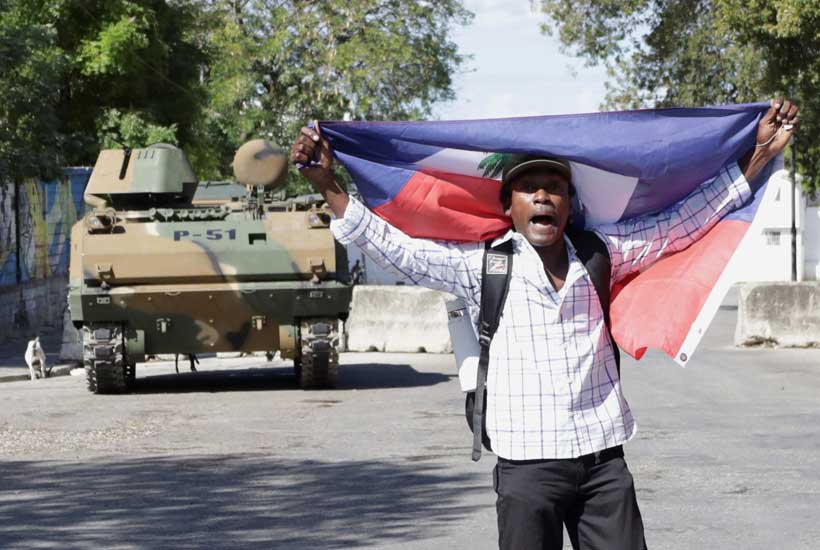
Haiti, often labelled and dismissed as the “Failed State” of the Caribbean, remains one of our international bureaucracy’s most visible failures. Nearly two decades after the 2010 earthquake that devastated the nation’s infrastructure, Haiti has yet to recover from its subsequent political, economic, and institutional collapse. Instead, in recent years the nation has confronted several crises, such as parliamentary dissolution, systemic corruption, and the violent expansion of armed groups. Recent developments have additionally underscored this trajectory, such as the development and deployment of international gang suppression, suggesting that global forces are once again attempting to stabilize the nation through external pressure, rather than reestablishing and reviving internal empowerment within Haiti.
These contemporary cases are sadly the byproducts of Haiti’s long history of foreign domination. From the crippling nineteenth-century French indemnity to the expanding United States occupation, each intervention has hollowed out the Haitian state and its structures while entrenching external control. Today, the rise of international non-profit organizations has pushed Haiti to become an NGO-ized state—a modern iteration of colonial-era repression, representing a repression back into its history of colonialism. As Jean Casimir notes in The Haitians: A Decolonial History, Haiti is an independent state without sovereign people. Thus, to contextualize such modern impasse, we must view modern aid through the lens of neocolonialism, a system that powerful states use to exercise control over formerly colonized countries through economic, political, and cultural pressure—not entirely direct rule.
The NGO Paradox
The established humanitarian complexes in Haiti are not sufficient in supporting the systems for rebuilding public authority; instead, they replace it. In the aftermath of the 2010 earthquake, the majority of the humanitarian aid did not reach Haitian public systems; instead, only a small share was channeled through the government’s public financial management and procurement systems. This pattern of funding is what scholars title as “brain drain,” an effect where local public leaders and civil servants are sidelined in favor of international organizations with larger capacities for budgeting and global influence.
Stay ahead of the geopolitical week.
MD Briefing delivers expert analysis across five global fronts — the Indo-Pacific, energy, geoeconomics, European security, and the Middle East — every Monday morning. Free.
The effect becomes a paradox, where local ministries remain underfunded and understaffed while these NGOs come to operate with comparative financial and labor advantages, cementing their role as the de facto providers and furthering the ‘neo-colonialist’ aid ideals. When these organizations move beyond immediate relief in areas such as democracy and economic policy, they become an extension of the state without the accountability of elected government. Thus, begging the question:
‘Is Haiti ever capable of being a true democracy through international humanitarian aid?’
If the sovereign people lose the ability to hold the state accountable because of its formation through international aid, then rather than strengthening institutions, the “NGO-ization” of the country has made it impossible for the Haitian state to develop the infrastructure and capabilities truly necessary for independence. Foreign agencies operate according to their own priorities and donor cycles, leaving the local governments of Haiti incapable of establishing their own democratic agendas.
The Failure of the International Models
Foreign aid itself reflects the priorities of donor countries rather than the real needs of Haiti. Although talked about, it is still not taken into account. Programs align with initiatives from the donors’ foreign policy goals, security concerns, and/or public image, not entirely long-term development for Haiti. The Hispaniola counterpart, the Dominican Republic, has experienced significant growth. This is not only due to the state capacity of both countries but also the level of foreign relations available. Most long-term plans for Haiti capture the state’s needs but do not tie into how heavily foreign affairs weigh. Instead, Haiti is still ruled under indirect geopolitical colonialism. Such consequences of this system are evident in both their fragility and civic disengagement. NGOs continue to grow within Haiti, but the citizens are relying on parallel structures for their basic needs. Political responsibility is shifted from Haiti to its international counterparts instead. The dynamic keeps perpetuating a cycle where Haiti’s dependence is normalized in a political environment and introduces an erosion in democracy.
The truth is that Haiti’s persistent instability is rooted in this neo-colonial architecture. The NGO-ization of Haiti acts as a parallel governing body that is appealing to foreign affairs, not the rebuilding of the state. Current NGOs and practices are not sufficient if the globe wants to revive an already dead state. There is no possibility of bringing back a failed colonized nation through more colonization. Thus, the way the globe and foreign aid approaches aid must be reconsidered altogether through a system that restores institutional authority to the Haitian state itself.
For example, during the post-2010 earthquake in Haiti, the United Nations sent a ‘present patrol’ in Port-au-Prince, which was designed to deter violence in the area and reassure the population. However, this had the opposite effect. Many Haitians instead reported feeling anxious or threatened by the heavily armed forces and troops veering in. Similarly, during the 2010 cholera outbreak, the Nepalese peacekeepers were blamed for spreading the disease. This showcases the heavy distrust that Haiti has always had for its foreign aid.
Haitian Authority
Historical instances have illustrated that when aid or security initiatives bypass institutions, they destroy confidence in public authority. Thus, channeling aid through Haitian-led ministries and local governance should be pushed. There needs to be a collective resolve against neo-colonialist powers and instead the reconstruction of national democracy without aid.
Haiti’s persistence is not the result of inherent national failure. Rather, this is the reality of decades of neocolonialist intervention that has destroyed national security and local institutions. It is a system that perpetuates a stateless Haiti. The solution lies in abandoning this structure entirely and shifting to a Haitian-targeted model, where international resources are instead channeled through local institutions and long-term reform. Ultimately, Haiti’s revival falls not on external packages but on the rejection of neo-colonialist models entirely. The failure of the international community lies in its inability to deliver non-colonialist foreign aid, and instead, it keeps contributing to patterns of colonial control. Perhaps, if abandoning foreign aid means abandoning neocolonialist rhetoric, then Haiti should forget about international intervention.