


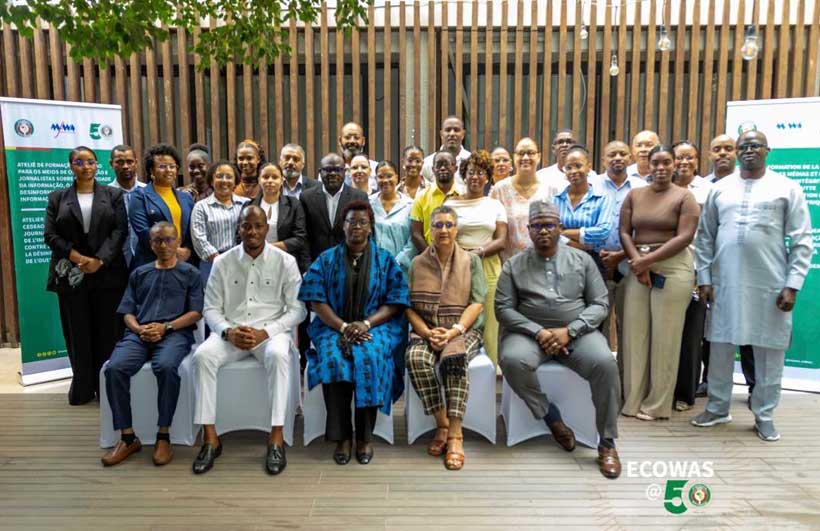
The Economic Community of West African States (ECOWAS) Commission, through its Directorate of Communication, has taken diverse measures to counter disinformation while further sustaining an integrity in the information sphere in the West African region. In late January 2026, it convened a two-day regional training program for journalists and media practitioners in Cabo Verde to strengthen information integrity and counter disinformation, misinformation, and harmful narratives in West Africa.
This training aims to equip media professionals with the knowledge, tools, and techniques necessary to detect, counter, and report on disinformation while respecting the principles of ethical and fact-based journalism. In doing so, ECOWAS seeks to strengthen democratic governance and promote informed public discourse in West Africa.
Presiding over the opening ceremony, Deputy Coordinator of the ECOWAS national office, Mamadou Moustapha Seck, emphasized the importance of the training, stating that it was specifically designed to enable journalists to tackle disinformation and promote responsible journalism based on verified facts.
Seck emphasized the essential role of media professionals in implementing ECOWAS’ Vision 2050, adopted in 2022, whose first pillar is peace, security, and stability in the region. “The first step in getting back to basics, in my view, is to ensure the integrity of information, wherever it may come from and whatever interest it may hold for different parties. This means that everyone must exercise self-restraint, rise above partisan contingencies and clamour, and uphold the principles of ethics and professional conduct in order to analyze, verify, corroborate, and even experiment before disseminating information,” he stressed during interaction with participants.
Stay ahead of the geopolitical week.
MD Briefing delivers expert analysis across five global fronts — the Indo-Pacific, energy, geoeconomics, European security, and the Middle East — every Monday morning. Free.
The training program was organized by the Acting Director of Communications at the ECOWAS Commission, Joël Ahofodji, and supported by Jonas Tylewski, Director of Communications at the Embassy of the Federal Republic of Germany in Senegal, and Dr. Impraim Kojo, Director of Programs at the Media Foundation for West Africa (MFWA).
Dr. Impraim Kojo made reference to organizers for their fruitful collaboration in implementing the training, the ultimate goal of which is to strengthen democracy, counter the spread of fake news, and safeguard peace in the region.
Jonas Tylewski emphasized the need for collective action against the rising tide of disinformation and underlined the fact that dissemination of unverified information is dangerous. Tylewski concluded by reaffirming Germany and GIZ’s commitment to working hand in hand with ECOWAS and Senegal to disseminate accurate and verified information as a fundamental pillar of peace and democracy in West Africa.
Organized by the ECOWAS Commission in collaboration with the Media Foundation for West Africa (MFWA) and with the support of the Government of the Federal Republic of Germany, through the Deutsche Gesellschaft für Internationale Zusammenarbeit (GIZ), the training’s primary aim was to enhance participants’ capacities in media and information literacy, fact-checking, responsible use of digital tools, and ethical journalism, while contributing to the promotion of democracy and good governance in the region.
Mrs. Kelly Lopes, ECOWAS Resident Representative in Cabo Verde, underscored the strategic importance of the media as a pillar of democratic governance and social cohesion, stressing that information integrity is essential to sustaining public trust and regional stability.
Earlier, Joël Ahofodji highlighted that the training seeks to strengthen journalists’ ability to deliver responsible, investigative, and fact-based reporting, capable of countering disinformation and supporting peace and democratic values in West Africa.
Representatives of the Deutsche Gesellschaft für Internationale Zusammenarbeit (GIZ) and the Media Foundation for West Africa, represented by Dr. Kojo Impraim, reaffirmed their commitment to supporting ECOWAS in building a resilient, professional, and ethical media ecosystem, aligned with the organization’s Vision 2050, which aspires to a peaceful, integrated, and prosperous West Africa.
Through this initiative, ECOWAS seeks to institutionalize information integrity as a strategic pillar of democratic governance and regional stability by equipping journalists with the skills, ethical standards, and digital tools required to effectively counter information disorder. The training reflects the organization’s broader commitment to strengthening professional and resilient media systems, fostering informed public discourse, and supporting peace, social cohesion, and regional integration, in full alignment with ECOWAS Vision 2050.
