Ethiopia is secretly training thousands of fighters for the Rapid Support Forces (RSF) paramilitary group, which is involved in Sudan’s civil war. This marks the first direct evidence of Ethiopia’s role in the conflict, providing the RSF with a significant number of new soldiers amid escalating violence in southern Sudan. Reports indicate that the United Arab Emirates (UAE) financed the construction of this training camp and supplied military trainers and other support, though the UAE denied any involvement in the hostilities.
The Sudanese civil war began in 2023 due to a power struggle between the Sudanese Armed Forces and the RSF, leading to widespread famine and atrocities, and millions have fled to neighboring countries like Egypt, Chad, Libya, and South Sudan. Both warring sides receive backing from external supporters, which increases the risk of the conflict spreading to other countries.
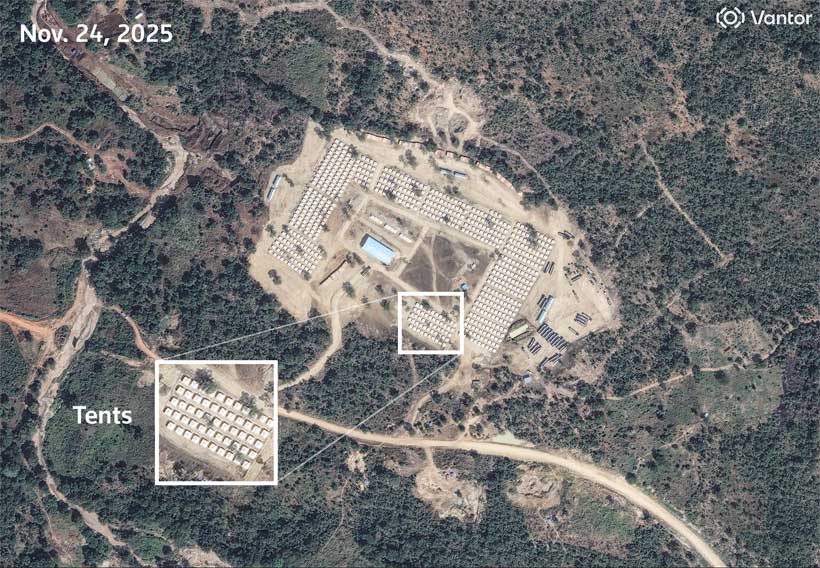
Reports state that as many as 4,300 RSF fighters are currently receiving training at the camp in Ethiopia’s Benishangul-Gumuz region, near the Sudanese border, with logistical and military supplies coming from the UAE. This information comes from various official sources and is supported by satellite imagery indicating recent construction activity at the camp, including a drone ground control station.
The recruits at the camp mostly consist of Ethiopians, as well as individuals from South Sudan and Sudan, including members of the SPLM-N rebel group. It is reported that some recruits have already crossed into Sudan to fight alongside the RSF. The Ethiopian National Defense Force’s Chief of Defense Intelligence, General Getachew Gudina, is said to have overseen the establishment of the camp.
The situation is further complicated by a joint statement from the UAE and Ethiopia calling for a ceasefire in Sudan, while Sudanese army officials have accused the UAE of supplying weapons to the RSF, a claim that U. N. experts and U. S. lawmakers have found credible.
Construction of the camp
The camp is located in Menge, about 20 miles from the border, at a key point between two countries and South Sudan. Activity began in April with forest clearing and the building of metal-roofed structures. In October, the construction of tents started, leading to a facility with a capacity for 10,000 fighters, according to a diplomatic cable from November. The source of the cable remains unnamed.
During October, officials noted trucks from Gorica Group, an Emirati logistics company, heading towards the camp. Satellite images confirm the timeline and show clearing activities followed by the placement of tents starting in early November. An analysis indicated that the camp could hold at least 2,500 people, based on the number of tents observed. However, the analysis could not confirm the military nature of the site.
By mid-November, new recruits were seen arriving at the camp, with significant truck convoys transporting trainees. On November 17, a column of 56 trucks with fighters was witnessed, followed by another convoy a few days later. An image from November 24 showed large trucks at the site, typically used by the Ethiopian military, but it remains unverified what they were carrying.
Construction continued into late January, with new developments noted in satellite images, including ongoing excavation work and the arrival of construction machinery through Asosa. A senior Ethiopian government official confirmed that work on the camp was still ongoing but did not disclose future plans.
Asosa airport, located 33 miles from the camp, has seen new construction since August 2025, including a new hangar and UAV ground control station. The Ethiopian military plans to make the airport a drone operation center among other drone facilities across Ethiopia. This move is part of a strategy to strengthen defenses along the western border with Sudan and to protect critical infrastructure like the Grand Ethiopian Renaissance Dam (GERD).
Concerns have been raised about the camp’s proximity to the dam, which is Africa’s largest hydroelectric project, as it could be at risk if conflicts arise nearby. The camp is roughly 63 miles from the dam. Experts believe that the airport’s upgrades are linked to the increased presence of the Rapid Support Forces (RSF) in the region, aiding their supply lines from Sudan.
Funding for the airport refurbishment is believed to have come from the UAE, although this has not been independently verified. Following Abiy’s rise to power, the UAE has offered $3 billion in aid and investments to Ethiopia, including funds aimed at alleviating the country’s foreign currency crisis. In 2025, a memorandum of understanding was signed between the UAE and Ethiopian air forces to enhance both nations’ air and defense capabilities.
With information from Reuters
Stay ahead of the geopolitical week.
MD Briefing delivers expert analysis across five global fronts — the Indo-Pacific, energy, geoeconomics, European security, and the Middle East — every Monday morning. Free.