


Hong Kong media tycoon Jimmy Lai, the city’s most prominent critic of China’s Communist Party, was sentenced on Monday to 20 years in prison, concluding the biggest national security trial since Beijing imposed its sweeping security law on the city in 2020.
Lai, the founder of the now-defunct Apple Daily newspaper, was convicted on two counts of conspiracy to collude with foreign forces and one count of publishing seditious materials. His sentencing brings to an end a legal saga spanning nearly five years, during which the case became a focal point of international concern over the erosion of Hong Kong’s freedoms and judicial independence.
First arrested in August 2020, Lai was convicted last year following a prolonged trial conducted by three designated national security judges.
The Sentence
The court handed Lai a 20-year jail term, placing his punishment within the harshest sentencing “band” for offences deemed to be of a “grave nature.” Judges said the sentence was the most severe imposed to date under the national security law.
Stay ahead of the geopolitical week.
MD Briefing delivers expert analysis across five global fronts — the Indo-Pacific, energy, geoeconomics, European security, and the Middle East — every Monday morning. Free.
In their ruling, the judges described Lai as the “mastermind” and driving force behind “persistent” conspiracies to collude with foreign forces. They cited prosecution evidence alleging that Lai sought sanctions, blockades and other hostile actions from the United States and other countries, and that the conspiracies involved a network of Apple Daily staff, activists and foreign individuals.
Six former senior Apple Daily executives, along with an activist and a paralegal, received prison sentences ranging from six to 10 years.
Judges said they found it difficult to distinguish the relative culpability of the co-defendants but ruled that Lai warranted a heavier sentence due to his central role.
Lai’s Defence and Personal Circumstances
Lai, 78, who holds British citizenship, denied all charges, describing himself in court as a “political prisoner” facing persecution by Beijing.
Supporters say Lai is in frail health, suffering from diabetes and high blood pressure. Judges declined to grant a reduction based on his age, medical condition or time spent in solitary confinement, though they acknowledged his sentence would be “more burdensome” than for other inmates. The court ultimately reduced his sentence slightly, cutting one month from the sedition count and one year from each collusion charge.
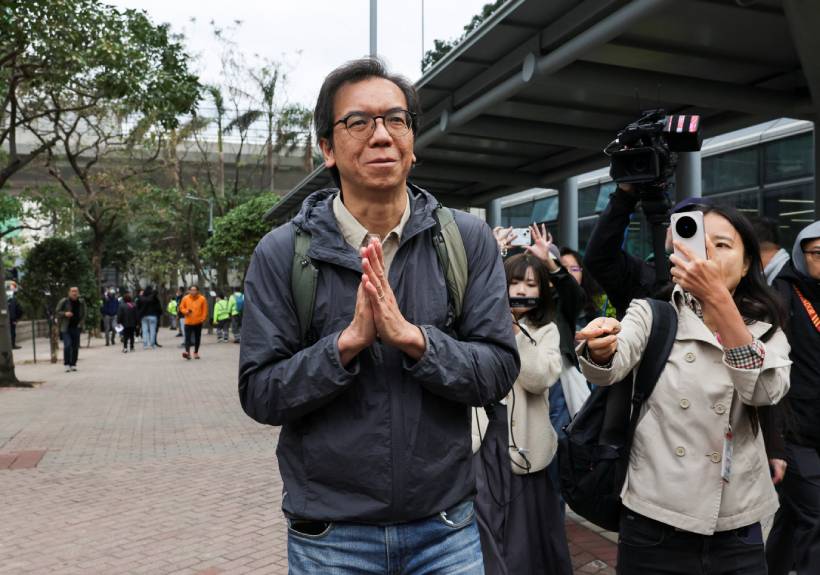
Lai arrived at court wearing a white jacket, holding his hands together in a prayer gesture, smiling and waving to supporters.
Official Reaction
China’s Hong Kong and Macau Affairs Office said the sentence was a “solemn and powerful declaration” that anyone challenging national security laws would be severely punished.
Hong Kong leader John Lee said the ruling upheld the rule of law and reflected public sentiment, calling Lai’s crimes “heinous and utterly unforgivable.”
Hong Kong police dismissed concerns about Lai’s health, with the head of the national security department saying such worries had been exaggerated and that Lai deserved his sentence.
Authorities in Beijing and Hong Kong have repeatedly said Lai received a fair trial and that the national security law has been essential to restoring stability following mass pro-democracy protests in 2019.
International Reaction
The case has drawn sustained criticism from Western governments and human rights groups. U.S. President Donald Trump and British Prime Minister Keir Starmer have both publicly raised Lai’s case with Chinese leader Xi Jinping.
Starmer discussed Lai’s detention during a meeting with Xi in Beijing last month, according to people briefed on the talks, while Trump raised the issue during an October meeting with Xi.
Human Rights Watch described the sentence as “cruel and profoundly unjust,” while Lai’s son, Sebastien, said the ruling was “life-threatening” and marked the “total destruction” of Hong Kong’s legal system.
Western diplomats told Reuters that negotiations aimed at securing Lai’s release are expected to intensify now that sentencing has been completed.
Security Clampdown Context
Lai’s prosecution follows the imposition of the national security law in 2020, which Beijing said was necessary to restore order after months of protests, some of which turned violent. Critics say the law has been used to silence dissent, dismantle independent media and criminalise political opposition.
Lai’s high profile as a vocal critic of Beijing, a devout Catholic and a figure with longstanding ties to U.S. politicians, particularly Republicans made his case emblematic of the broader crackdown. Prosecutors highlighted meetings Lai held in 2019 with then-U.S. Vice President Mike Pence and then-Secretary of State Mike Pompeo.
Analysis
Jimmy Lai’s 20-year sentence marks a decisive moment in Hong Kong’s post-2019 political transformation. As the most severe punishment handed down under the national security law, it sends a clear signal that prominence, international connections and global attention offer no protection under the current legal framework.
By branding Lai the “mastermind” of foreign collusion, the court reinforced Beijing’s narrative that external forces played a central role in Hong Kong’s unrest. The ruling also underscores the broad reach of the security law, criminalising political advocacy, media activity and international engagement once considered part of Hong Kong’s open civic culture.
The case is likely to deepen scepticism abroad over Hong Kong’s autonomy and judicial independence, particularly as Western leaders frame Lai as a political prisoner. At the same time, the completion of sentencing may open a narrow diplomatic window, with foreign governments now able to pursue negotiations without the complication of an ongoing trial.
Domestically, the verdict further consolidates the post-protest order in Hong Kong, where dissent has largely been neutralised and independent media dismantled. Lai’s imprisonment closes a chapter on one of the city’s most outspoken voices and cements the national security law as the defining instrument of governance in China’s financial hub.
With information from Reuters.
