


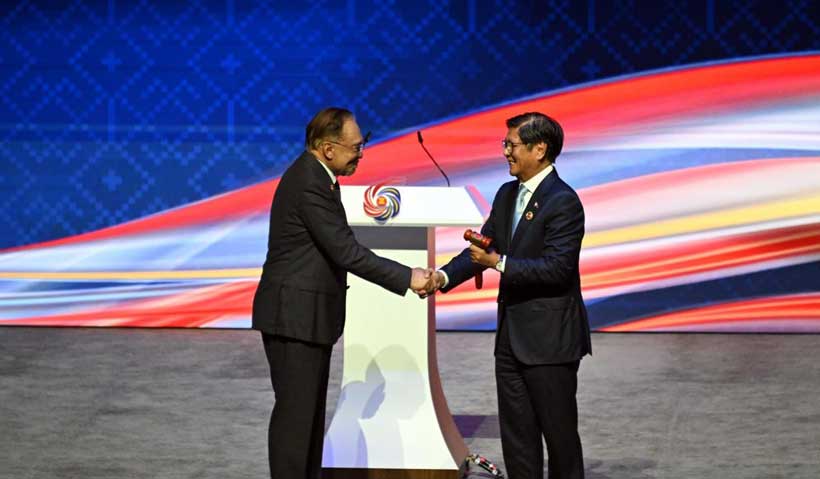
As the Philippines assumes the ASEAN 2026 Chair, Manila faces a stark leadership test, manifested through intra- and extra-regional challenges. Can it translate national urgency over the South China Sea into a regional strategy that rejuvenates ASEAN cohesion rather than fostering fragmentation? The organization’s foundation was inherently shaped to navigate common understanding amidst differences of culture and stances among member states. Through perpetually changing dynamics in leadership and common ownership of ASEAN, it has substantially moved toward strategic trust through people-centered values, vis-à-vis an institution-centered backbone, in comparison to the premature dynamics of ASEAN that were full of conflict and paranoia during the Cold War period.
The gradual shift toward a people-centered ASEAN was not without obstacles. The narrative of ASEAN Centrality has now been questioned, cumulatively fueling doubts about ASEAN’s ability to act collectively and avoid fragility. Perceiving inwards, ASEAN has faced multiple accounts of issues, not least in the last two decades, including the Cambodia–Thailand clash in 2008–2011, the failure to form a Joint Communiqué for the first time in 2012, the Myanmar coup in 2021, and the recent 2025 border conflict between Cambodia and Thailand. These episodes point to a persistent lack of proactive leadership of ASEAN member states. Simultaneously, the contest also manifests through the extra-regional domain, most starkly with regard to the South China Sea. Within ASEAN, member states, including the Philippines, Malaysia, and Vietnam, also have disputes against Beijing’s claim on the nine-dash line. The Philippines, for instance, pursued an aggressive and assertive approach to counter China, which brought a formal case to the Permanent Court of Arbitration, and Manila won the case in 2016.
Faced with complex and multidimensional issues, what the region needs as a sine qua non is the proactive leadership of ASEAN member states, which has been seemingly absent, or at least obscure, throughout these years. The Philippines must try to find the equilibrium between navigating regional harmony and pursuing national disputes.
There are agendas for the Philippines likely to be discussed and developed for the 2026 ASEAN meeting, including facilitating the newly admitted Timor-Leste integration into the community and the constructive development of Myanmar’s junta; however, the top priority Manila would likely bring concerns the South China Sea. The foreign policy of the Philippines has been assertively dynamic in terms of ‘confronting’ China. The current president, Ferdinand “Bongbong” Marcos, has adopted a more assertive posture in responding to China’s threat compared to Duterte’s administration, which preferred a cooperative manner. Such assertiveness, however, has faced criticism from other ASEAN countries, marking the fragmented approach in responding to extra-regional issues.
Stay ahead of the geopolitical week.
MD Briefing delivers expert analysis across five global fronts — the Indo-Pacific, energy, geoeconomics, European security, and the Middle East — every Monday morning. Free.
PM Anwar Ibrahim, for example, during Malaysia’s tenure as ASEAN Chair in 2025, contrasted Marcos for pursuing a confrontational approach toward China, which he believes to be a counterproductive policy. Anwar believes that in managing the South China Sea, the Philippines should be aggressively diplomatic rather than engage in blatant confrontation, as Malaysia has been doing in navigating its sovereignty vis-à-vis China’s claims. Singapore, on the other hand, also poses a similar stance to Malaysia, where former PM Lee Hsien Loong warned Filipinos not to raise the sword at Beijing, noting, “Are you sure you want to get into a fight where you will be the battleground?” despite acknowledging the cautious feelings felt by Filipinos. Neighboring countries critiquing Manila’s approach could be best described as “strategic gaslighting,” a term noted by Filipino political scientist Richard Heydarian. Such an engagement, where ASEAN nations are reluctant to publicly support Manila’s approach and where there is no common strategy to handle major powers, underlines the lack of solidarity within the institution. This phenomenon occurred because the ‘permissive’ countries perceive Beijing as a beneficial trade partner rather than an open threat.
Departing from the stances and criticism of its neighboring nations, however, it is still highly predictable that Marcos will capitalize on the ASEAN Chairmanship to finalize the South China Sea Code of Conduct, bringing the national outlook in front of the regional institution. Bringing such an agenda into multifaceted and contrasting stances signals the difficulty of reaching a consensus for the ASEAN 2026 annual meeting. The Philippines, thus, must succeed in leveraging and accommodating each nation’s interests, and a common understanding and consensus shall occur if it possesses strong leadership and upholds the principle of ASEAN Centrality.
Retrospectively, the notion of ASEAN Centrality has been considerably contested throughout these years. The inability of ASEAN nations to produce synergic stances is not only manifested through the South China Sea dispute; the Preah Vihear conflict between Cambodia and Thailand in 2025 serves as a recent alarm for ASEAN that wounds must be treated meticulously and not undermined in their treatment. The border conflict stands as one of the most severe clashes for ASEAN in modern times. The last time the conflict escalated was in 2011, when Indonesia—as the ‘big brother’ and ASEAN Chair at that time—acted in a timely manner through what is called ‘shuttle diplomacy.’ Former Indonesian Foreign Minister Marty Natalegawa felt that if the conflict were not mediated promptly, it could escalate to the point we have seen today. Fortunately, Indonesia succeeded in creating peaceful negotiations to stop the conflict between the two countries. Even in 2012, when ASEAN nations failed to form a consensus on “blaming China” over the South China Sea, Indonesia then, despite no longer being the ASEAN Chair, showed its leadership capacity by proactively conducting visitations to ASEAN countries’ capitals to build consensus, saving ASEAN’s reputation. Such an instance serves as a model of how strong leadership is leveraged in maintaining ASEAN Centrality, a character that has not been very apparent in today’s ASEAN dynamics.
Reflecting on the Philippines’ 2026 Chairmanship, faced with unresolved issues and differences, it would be best if Marcos could navigate ASEAN fragility and demonstrate the leadership needed for ASEAN by pursuing the ASEAN Centrality agenda. This is not suggesting that bringing forth the Philippines’ bilateral issue with China is wrong, but rather that Manila should bridge the gap between its South China Sea issue and the interests of other ASEAN nations.
