


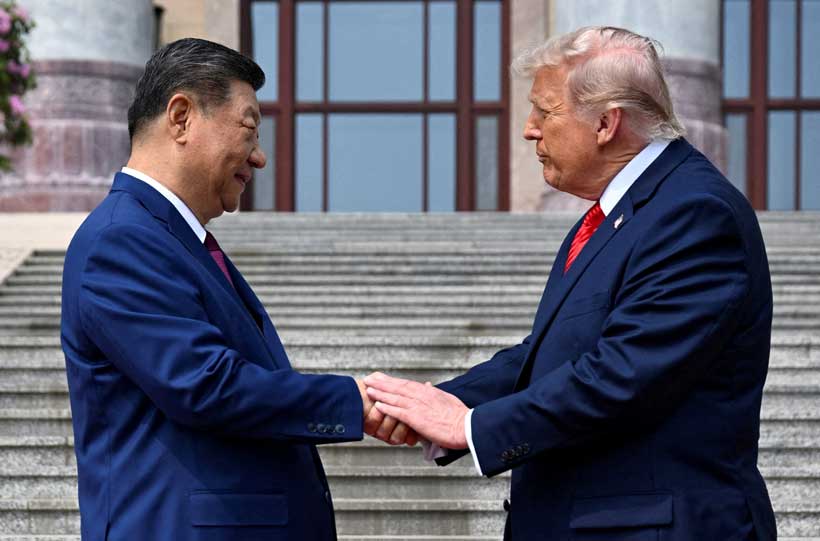
In the marble halls of Beijing’s Great Hall of the People this week, President Donald Trump and President Xi Jinping concluded a summit many had presented as decisive for the future of the world’s most consequential bilateral relationship. What emerged was revealing something subtle – and perhaps consequential: the gradual acceptance by both powers that rivalry must now be managed within deep economic interdependence rather than through outright separation.
Leading international media largely converged on the view that the summit produced no decisive breakthrough on the central geopolitical fault lines, yet still marked a deliberate effort to prevent further deterioration in relations. The Financial Times, in particular, described the outcome as a “fragile sense of stability and mutual non-aggression”[1] – a formulation that captures the paradox at the heart of the meeting: not resolution of rivalry, but its institutionalisation within carefully managed limits, as both Washington and Beijing appear increasingly intent on containing competition rather than transforming it.
The announcements themselves were significant. Chinese purchases of hundreds of Boeing aircraft,[2] multi-billion-dollar commitments to American agricultural imports and the creation of new bilateral mechanisms such as a US – China Board of Trade signal that Washington and Beijing[3] are quietly rebuilding channels of economic stabilisation after years dominated by tariffs, sanctions and technological confrontation. Discussions over investment facilitation and the extension of rare earth export arrangements reinforce the same reality: despite the rhetoric of decoupling, neither side can absorb the costs of full disengagement.
Yet press coverage across multiple outlets also pointed to a striking dissonance in how the summit was narrated on either side of the Pacific. Chinese officials emphasised renewed discussions on tariffs and the prospect of extending the fragile trade truce, while Trump flatly insisted that tariffs had not been part of the conversation at all. The gap was a reflection of a deeper shift in diplomatic practice itself – where interpretation is increasingly shaped for domestic political audiences as much as for the negotiating table, and where coherence gives way to calibrated ambiguity in the management of great-power relations.
Stay ahead of the geopolitical week.
MD Briefing delivers expert analysis across five global fronts — the Indo-Pacific, energy, geoeconomics, European security, and the Middle East — every Monday morning. Free.
Yet the true importance of the summit lies elsewhere.
Beneath the transactional agreements, the old post-1945 liberal international order is being progressively renegotiated between the two powers best positioned to shape the twenty-first century. What is emerging is neither the optimistic globalisation of the 1990s nor a return to the ideological blocs of the Cold War. It is a far more fluid system organised around managed competition, selective cooperation and spheres of influence negotiated pragmatically rather than governed universally.
In parallel, reporting from multiple outlets pointed to a notable expansion of the negotiation agenda into more politically sensitive terrain, including discussions on the possible easing of sanctions linked to Chinese purchases of Iranian energy.[4] The issue surfaced in the broader context of efforts to stabilise global energy flows amid heightened Middle Eastern volatility. Such signals, if confirmed, would mark a clear departure from the peak decoupling phase, suggesting that the US-China relationship is gradually shifting towards a more pragmatic form of geopolitical bargaining – one in which sanctions, energy security and financial pressure are no longer instruments of linear confrontation, but variables in a wider search for managed equilibrium between strategic competitors.
For Europe, this moment carries particular historical resonance.
French Foreign Minister Jean-Noël Barrot may have offered the most insightful interpretation of the summit – through the logic of history. Much commentary surrounding the Trump-Xi meeting focused on the now familiar notion of the “Thucydides Trap”[5]: the theory that conflict becomes increasingly likely when a rising power challenges an established one.
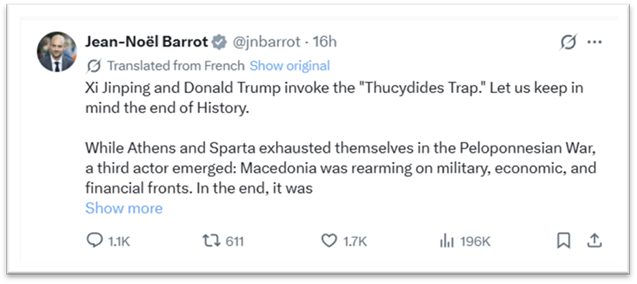
Washington and Beijing themselves increasingly appear trapped inside this narrative. The United States fears strategic displacement; China believes history is correcting itself after a century of humiliation.
But Barrot invoked another historical parallel for Europeans.
While Athens and Sparta exhausted themselves during the Peloponnesian War – militarily, financially and psychologically – a third actor quietly transformed itself at the margins of the Greek world. Macedonia did not initially possess the cultural sophistication of Athens nor the military prestige of Sparta. What it possessed was strategic patience. It reorganised its army, consolidated political authority, strengthened its economic foundations and prepared systematically while the dominant powers depleted themselves in a struggle neither could truly resolve.
Eventually, Macedonia inherited the geopolitical space their exhaustion created.
Barrot’s suggestion was a warning disguised as ambition. Europe, he implied, still possesses a narrow historical opportunity to emerge as an autonomous strategic pole in an increasingly bipolar world – but only if it recognises how profoundly the international system has already changed.
The Trump-Xi summit illustrated precisely that transformation.
At first glance, the results appeared limited. No historic treaty emerged. The fundamental disputes remain unresolved: Taiwan, semiconductors, military positioning in the Indo-Pacific, export controls, sanctions and technological rivalry. Yet the tone and political psychology of the summit mattered far more than any final communiqué.
Trump described the discussions as “extremely positive and productive” and characterised the US-China relationship as “one of the most consequential relationships in world history.” [6] Xi responded by declaring that China’s “great rejuvenation” and the MAGA movement “can go hand in hand.” That statement deserves closer attention than it initially received.[7]
Beyond the rhetoric, the exchange pointed less to any ideological rapprochement than to a convergence in strategic mindset. Both leaderships are increasingly grounding political legitimacy in narratives of sovereignty, national revival and civilisational affirmation, while reframing economic interdependence – once celebrated as a stabilising glue of globalisation – as a potential point of exposure to be hedged, reduced or selectively weaponised in line with national interest.
Xi was recognising a deeper convergence in political method between major powers entering a post-globalisation era. Both leaderships increasingly frame legitimacy through sovereignty, national revival and civilisational identity rather than through universalist political ideals. Both view economic dependence as a strategic vulnerability. Both prioritise industrial resilience, technological dominance and political control over the liberal assumptions that shaped the post-Cold War order.
This does not mean confrontation disappears. On the contrary, rivalry between Washington and Beijing is likely to intensify structurally. But both powers increasingly understand that complete rupture would generate catastrophic economic consequences not only for themselves, but for the entire global system.
What is emerging is a form of managed antagonism.
The proposed US-China Board of Trade and Board of Investment are revealing in this respect. Their significance is less technical than geopolitical. After years of decoupling rhetoric, both capitals are institutionalising mechanisms designed not to eliminate interdependence, but to govern it more strategically. The same logic applies to negotiations over rare earth exports, where China understands its control over critical minerals constitutes a geopolitical instrument as important as military leverage.
Taiwan remains the central fault line within this fragile equilibrium.
Trump’s refusal to clarify future commitments regarding arms sales, combined with his remarks questioning whether the United States should fight a war “9,500 miles away,” [8] introduced a new level of uncertainty into American strategic messaging. Traditional strategic ambiguity toward Taiwan functioned because all parties broadly understood the limits of escalation. Trump’s language reflects something different: the growing influence of transactional nationalism inside American foreign policy thinking.
Trump’s emphasis on the sheer geographic distance of Taiwan, coupled with his refusal to set out clear parameters for future US commitments, was broadly read as adding a fresh layer of uncertainty to American deterrence posture in the Indo-Pacific. Unlike the calibrated “strategic ambiguity” that has historically underpinned US policy – designed to deter Beijing while preserving reassurance for regional partners – this newer, more transactional ambiguity risks blurring both effects at once, diluting deterrence signalling to China while at the same time eroding confidence among allies who rely on its predictability.
Meanwhile, Secretary of State Marco Rubio attempted to reassure allies by reaffirming opposition to any “forced change in the status quo.” [9] Yet the contradiction is increasingly visible. Washington seeks economic accommodation with Beijing while simultaneously maintaining military deterrence and technological containment.
This dual-track posture reveals a more fundamental structural tension at the heart of US strategy: the attempt to pursue economic stabilisation with China while at the same time sustaining military deterrence and tightening technological containment. Rather than coalescing into a single strategic doctrine, these objectives increasingly operate on parallel and sometimes competing logics, generating a managed form of strategic dissonance – a relationship in which contradiction is institutionalised as an enduring condition of engagement.
For Europe, this evolution is profoundly destabilising because it exposes a structural weakness long obscured by the assumptions of the liberal order.
For European policymakers, the more fundamental concern is no longer the specific substance of US – China negotiations, but the prospect that a working, even if fragile, bilateral understanding could gradually take shape outside any meaningful European input. A stabilised “G2 logic” would quietly reposition the European Union as an economic heavyweight without strategic agency – present in the system, yet increasingly peripheral to the core decisions that define its direction.
For decades, the European Union believed economic integration, regulatory influence and multilateral governance could gradually replace classical power politics. In many respects, that strategy succeeded. Brussels became a regulatory superpower capable of shaping global norms in competition policy, privacy, digital governance and environmental standards.
But the international system is no longer organised primarily around rules. It is increasingly organised around leverage.
Supply chains have become instruments of pressure. Energy has become geopolitical weaponry. Semiconductors have become strategic assets. Artificial intelligence, quantum technologies and critical minerals are no longer merely economic sectors; they are components of national power.[10]
Trump accelerates this transformation because he strips away the moral language traditionally accompanying American leadership. Alliances become transactional. Security guarantees appear conditional. Trade policy becomes a tool of coercive bargaining rather than liberal integration.[11]
This shift opens a more structural question about the evolving hierarchy of American foreign policy priorities. If economic stabilisation and commercial engagement with China increasingly operate alongside – and at times compete with – the imperatives of alliance management, Europe may be moving into a strategic environment where long-standing assumptions begin to lose their automatic character. What was once treated as an unconditional and strategically insulated transatlantic guarantee risks becoming more contingent, more conditional, and more exposed to the transactional rhythms now shaping great-power diplomacy.[12]
China has adapted to this world faster than Europe.
Beijing no longer seeks integration into a Western-led liberal order. It seeks coexistence on terms reflecting its own civilisational scale, strategic weight and political model. Xi’s language in Beijing reflected that confidence. China no longer presents itself as a state attempting to join the existing order; it increasingly behaves like a power preparing to co-design the next one.[13]
Europe therefore confronts a deeply uncomfortable reality: the era in which it could rely simultaneously on American security, Chinese markets and stable multilateralism may be ending.
This is why Barrot’s Macedonian analogy resonates so strongly.
In this emerging configuration, Europe risks less the fate of absence than that of partial relevance – present in the system, but increasingly treated as a dependent variable in calculations made elsewhere. Economically intertwined with both Washington and Beijing, it nevertheless finds itself with diminishing capacity to shape the terms of either relationship, reduced to reacting to strategic bargains whose architecture is being designed beyond its reach.
Macedonia succeeded not because Athens and Sparta disappeared, but because they became absorbed by their own rivalry. Historical transitions create opportunities for actors capable of combining patience with strategic preparation. Europe still possesses extraordinary assets: scientific excellence, industrial depth, financial capacity, advanced infrastructure and a market of continental scale. Yet these strengths remain politically fragmented and strategically underutilised.
Strategic autonomy, therefore, cannot remain a slogan repeated at Brussels conferences. It requires industrial policy at scale, defence integration, technological sovereignty in AI and semiconductors, energy resilience and political cohesion capable of defining European interests independently when necessary.[14]
The greatest danger for Europe is geopolitical irrelevance – remaining wealthy, regulated and stable, yet ultimately peripheral in decisions determining the architecture of the emerging world order.
The Trump-Xi summit may ultimately be remembered less for the agreements signed than for the historical transition it symbolised: the gradual emergence of a world shaped by selective great-power coordination, transactional diplomacy and negotiated spheres of influence.[15]
Athens and Sparta believed they alone were determining the future of the Greek world even as their rivalry prepared the conditions for another power’s rise.
Europe’s challenge today is to decide whether it intends to shape the century emerging around it – or merely adapt to arrangements designed by others.
[1] James Politi, Joe Leahy and Edward White What did Donald Trump achieve in talks with Xi Jinping? Available at: https://www.ft.com/content/7ae6a01d-df8d-4148-8424-27272e63939d?syn-25a6b1a6=1
[2]Trevor Hunnicutt, Dan Catchpole and Shivansh Tiwary, “ Trump says China to buy 200 Boeing jets, order could rise up to 750” available at https://www.reuters.com/business/aerospace-defense/trump-says-china-potentially-buy-750-boeing-planes-2026-05-15/
[3] Gregory Svirnovskiy, “Bessent discusses investment board, expanding US-China trade with Trump in Beijing” available at: https://www.politico.com/news/2026/05/14/bessent-trade-china-beijing-00921177
[4] “Trump saying he is considering removing some sanctions from China”, available at:
https://www.bloomberg.com/news/articles/2026-05-15/trump-says-he-may-remove-some-iran-linked-sanctions-on-china?embedded-checkout=true
[5] https://x.com/jnbarrot/status/2055378440082379057?s=20
[6] CNN Trump and Xi Toast Each Other at State Banquet; Trump and Xi Speak Before State Banquet in China; President Trump Delivers Toast During State Banquet. May 14, 2026, available at: https://transcripts.cnn.com/show/ctmo/date/2026-05-14/segment/03
[7] “After Xi’s Warning on Taiwan, He and Trump Strike Positive Tone”, May 15, 2026, available at: https://www.nytimes.com/live/2026/05/13/world/trump-xi-summit-china
[8] “Trump warns Taiwan against declaring independence from China after meeting Xi” available at: https://www.france24.com/en/asia-pacific/20260515-trump-warns-taiwan-against-declaring-independence-from-china-after-meeting-xi
[9] Read the full transcript: Secretary of State Marco Rubio interviewed by ‘NBC Nightly News’ anchor Tom Llamas available at: https://www.nbcnews.com/politics/trump-administration/rubio-interview-nbc-news-extend-transcript-tom-llamas-beijing-summit-rcna345248
[10] EU Economic Security Strategy (2023–2025), Critical Raw Materials Act, and European Chips Act; also IISS Strategic Survey 2025–2026.
[11] Analyses of Trump’s second-term foreign policy (e.g., “America First 2.0”), conditional NATO rhetoric, and tariff threats.
[12] Recent commentary on US-China engagement vs. alliance management (e.g., post-2025 Trump administration signals).
[13] Xi Jinping’s speeches on “community of shared future for mankind,” dual circulation strategy, and China’s Global Security Initiative/Global Development Initiative.
[14] Macron’s strategic autonomy agenda (Sorbonne 2017 onward), EU Strategic Compass, Versailles Declaration (2022), and recent Franco-German defence initiatives.
[15] Coverage of the May 2026 Trump-Xi summit and European reactions (Euronews, Financial Times, Politico Europe).
