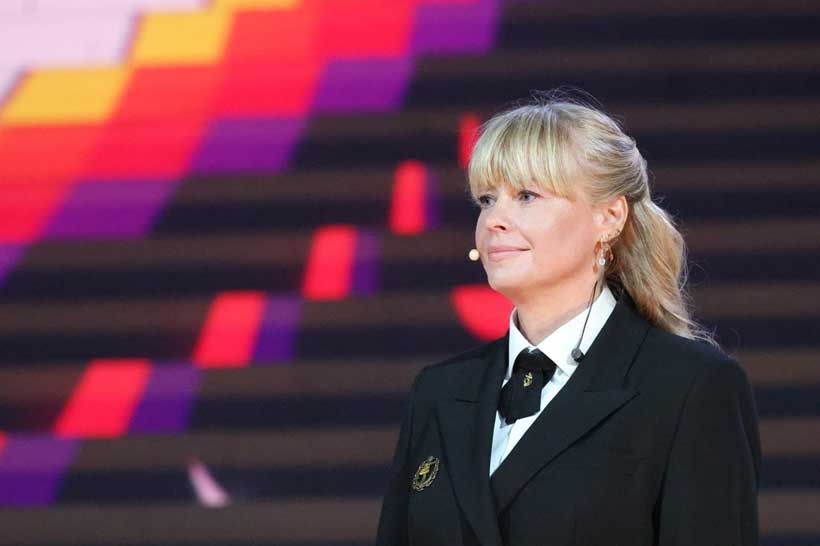
She started as a school teacher. Now she commands one of the most powerful vessels on Earth. Marina Starovoitova answered Modern Diplomacy’s questions after completing her first voyage as captain of the nuclear icebreaker Yamal.
On August 20, 2025, Marina Starovoitova made history as the first woman ever appointed captain of a nuclear icebreaker. The appointment ceremony took place during the “Era of Dreamers” gala concert in Nizhny Novgorod, which opened the jubilee events for the 80th anniversary of Russia’s nuclear industry. Before a crowd of tens of thousands, Alexander Barinov, President Emeritus of the Atomflot veteran organization, presented Starovoitova with the Captain’s badge, a moment that marked not just a personal milestone, but a turning point for an entire industry.
Now, months later, Starovoitova has returned from her first voyage in command. The ice has been broken in more ways than one.
From the Classroom to the Arctic
Stay ahead of the geopolitical week.
MD Briefing delivers expert analysis across five global fronts — the Indo-Pacific, energy, geoeconomics, European security, and the Middle East — every Monday morning. Free.
Starovoitova’s path to the helm was anything but conventional. A graduate of Bryansk State University, she was teaching Russian language and literature in a rural school when friends from the Arctic region told her about job openings at the Murmansk Shipping Company. She joined the fleet – but not yet as a navigator, and not yet on the bridge.
“My path in the maritime profession started with the position of orderly,” Starovoitova told Modern Diplomacy. “Keeping the crew’s daily life in order is important work, but I wanted to become a direct participant – to steer the ship myself. So I decided to study.”
She enrolled at the Admiral Makarov State Maritime Academy, specializing as a navigation engineer, and went on to work at sea for more than 20 years, including six years in the nuclear fleet, rising from sailor to Senior Assistant Captain.
“When I entered the maritime academy, I dreamed of working at sea as a navigator,” she said. “My main goal wasn’t a title; it was immersion in the profession. I was drawn by sea life itself. I simply absorbed this environment: tried to understand every nuance, how everything was structured, learned from senior colleagues, and grew as a specialist. Step by step, from sailor to navigator. I wasn’t rushing to the top; I was gaining experience, and my career developed on its own.”
The turning point came when she was serving as Senior Assistant Captain in the merchant fleet. “Our ships often had to work under the escort of nuclear icebreakers. I was struck by the power of the icebreakers, the professionalism of their navigators, their understanding of the Arctic. I managed to transfer to the nuclear icebreaker fleet but at a lower rank. I joined as Second Officer. I had to acquire new experience and knowledge, pass exams, before they would trust me to command a nuclear vessel. My appointment as captain was the logical conclusion of the path I chose and sincerely love.”
Commanding the Yamal
Starovoitova has taken command of the Yamal, one of Atomflot’s eight nuclear-powered icebreakers, a fleet that plays a key role in ensuring safe navigation along the Northern Sea Route, the shortest navigable artery connecting Europe and Asia. Russia is the only country in the world that operates such a fleet. It is a responsibility that extends far beyond navigation: in an era of widespread global volatility and disruptions to international supply chains, the Route’s role as a stabilising artery for global trade and logistics is becoming ever more apparent – and the captains who keep it open carry that weight with every voyage.
Asked at her appointment ceremony what captaincy means to her, Starovoitova said: “To be a captain is to carry on the nuclear fleet traditions, to cherish the crew and the icebreaker. That’s where I see my biggest mission. I’ll undertake it every day.”
Answering Modern Diplomacy‘s questions after her first voyage, she described the relationship between ship and crew in characteristically poetic terms: “For me, during a voyage, the crew and the nuclear icebreaker are one whole – a single organism. Metal is brought to life by people’s work, and it responds. Work in the Arctic tolerates no falseness. Only complete dedication from both people and machines.”
Leading Across the Ice
Managing a crew of trained professionals through four-month rotations in the isolation of the Arctic is a challenge that goes far beyond navigation. Starovoitova’s approach to leadership is deliberate and adaptive.
“I have no single, clearly chosen management style,” she explained. “I am convinced that one must master a whole spectrum of approaches and apply them depending on the situation. Where clear commands and rapid decisions are needed, the style will be authoritative. In normal conditions – when planning operations or resolving day-to-day matters – I prefer a democratic, collegial approach, because the experience and ideas of every crew member are very important. My style is dictated by the circumstances, the task, and the team’s level of preparation. The goal is always the same: the safety of the crew and the icebreaker.”
She was quick to add another dimension: “At sea, a captain must also be an excellent psychologist. You need to know not only professional questions, but also why, say, the ship’s cook oversalted the soup.”
On the psychological demands of long voyages, she noted: “A voyage or rotation usually lasts four months. All this time, people are in a confined space. Of course, you can call home or message via an app, but that doesn’t replace live contact. I love playing volleyball. We have our own team and in our free time we play with pleasure. And if you want to be alone, you can put on headphones, play your favourite music and walk on the open deck.”
Her Hardest Call
When asked to name her most difficult moment as captain, Starovoitova didn’t have to think long.
“My first voyage in the position of captain. We needed to ensure the escort of one vessel. The ice conditions did not allow towing the tanker by leading; we had to provide a tight tow. That’s when the bow of the escorted vessel is brought into the stern recess of the nuclear icebreaker and secured with a towline. But this particular vessel was not designed to be towed by a nuclear icebreaker of our project. When preparing for the tow, we encountered a non-standard situation: the high bow of the towed vessel created an unacceptably dangerous angle for the towline.”
Her solution was unconventional but decisive. “I proposed to the captain of the escorted vessel that he change his ship’s trim – flood the bow section and achieve a safe angle for rigging and securing the towline. Only this could ensure the tight tow. The captain agreed. The result was excellent joint work. In the Arctic, nothing is standard. Every escort is individual in its own way.”
Women in the Nuclear Fleet
Starovoitova’s appointment has drawn global attention, but she is careful to frame it within a broader trend rather than as an isolated event.
“In the nuclear icebreaker fleet, the number of women grows every year,” she said. “This isn’t just domestic service: orderlies and cooks. Women work as navigators, nuclear power plant operator engineers, electrical engineers, radiation safety engineers. I wouldn’t be surprised if in a few years the nuclear icebreaker fleet sees its first female Chief Engineer.”
She acknowledged that when she first arrived on the fleet, the climate was very different. “Everything was used to the idea that a woman could work predominantly in domestic service. So my appearance in the crew, especially in the role of sailor, initially caused surprise and bewilderment. ‘This isn’t women’s work, why do you need this?’ – such questions were asked quite often.”
Her answer was not argument, but action. “When I worked for hours on the open deck in –30°C frost alongside the sailors, I confirmed my right to equality through deeds. Authority built on action, competence, and responsibility is the most reliable foundation in the maritime profession.”
She cited key legislative changes that have helped open the fleet to women: a 2019 update to Russia’s list of restricted occupations removed barriers to many maritime positions for women, and since 2021 there has been a marked increase in women joining the fleet in command roles. Today, 25 women hold command positions across Russia’s nuclear icebreakers, out of 95 women working on the fleet in total – in roles ranging from Second and Third Officer to radiation safety engineer and electrical engineer.
Technology in the Service of Safety
The idea of navigating a vessel through shifting Arctic pack ice may seem not just improbable, but reckless. Yet humans have been doing exactly this – in one form or another – for five centuries. What has changed beyond all recognition is the technology that makes it safe.
Today’s nuclear-powered icebreakers are among the most well-equipped vessels in the industry. Starovoitova described the technological systems that underpin every voyage. “Arctic ice is a very dynamic system in which ridges, cracks, and fractures arise. One of the key elements for improving the efficiency and safety of icebreaker escort is having current information about the ice situation in the immediate operating radius of the icebreaker.”
Nuclear icebreakers carry specialised radar systems with dedicated ice modules that map conditions on screen across a radius of up to six nautical miles. A unified digital services portal aggregates real-time data from on-board measurement complexes tracking ice compression, concentration, and ridging, and cross-references it with radar imagery recorded and uploaded continuously across the entire nuclear fleet. The result is a live, fleet-wide picture of Arctic conditions, enabling navigators to select optimal routes and safe speeds based not just on what lies ahead of their own vessel, but on what every other icebreaker in the region is encountering simultaneously.
Safety considerations extend beyond navigation. The nuclear propulsion systems aboard Russia’s icebreakers operate under strict radiation safety regimes, with dedicated radiation safety engineers monitoring compliance throughout every voyage. It is this combination of human expertise and technological depth that has allowed Arctic shipping to grow from a handful of seasonal transits to 1,565 voyages in 2025 alone, carrying 37.02 million tonnes of cargo, a volume that would have been unimaginable to the navigators who first charted these waters.
A Message to the Next Generation
For young women who might see themselves in Starovoitova’s story, her advice is measured but firm.
“I would advise thinking carefully and weighing all the pros and cons. But if the choice is conscious and your heart is racing toward the sea, go all the way, and don’t retreat.”
She speaks, too, of the personal cost: “When you work at sea, you value more the opportunity to be near your loved ones. So when I’m on leave, I try to spend as much time as possible with my son. It’s not just about ‘spending time’, it’s about making up for, and sharing with him, those moments of growing up, joy, and difficulty that passed without me, when I was at sea.”
Starovoitova is a recipient of several professional awards. She now adds to them something no amount of ceremony can fully capture: the distinction of having opened a door that, for the entire history of nuclear navigation, had never been opened before.
The ice, it seems, was always waiting for her.