


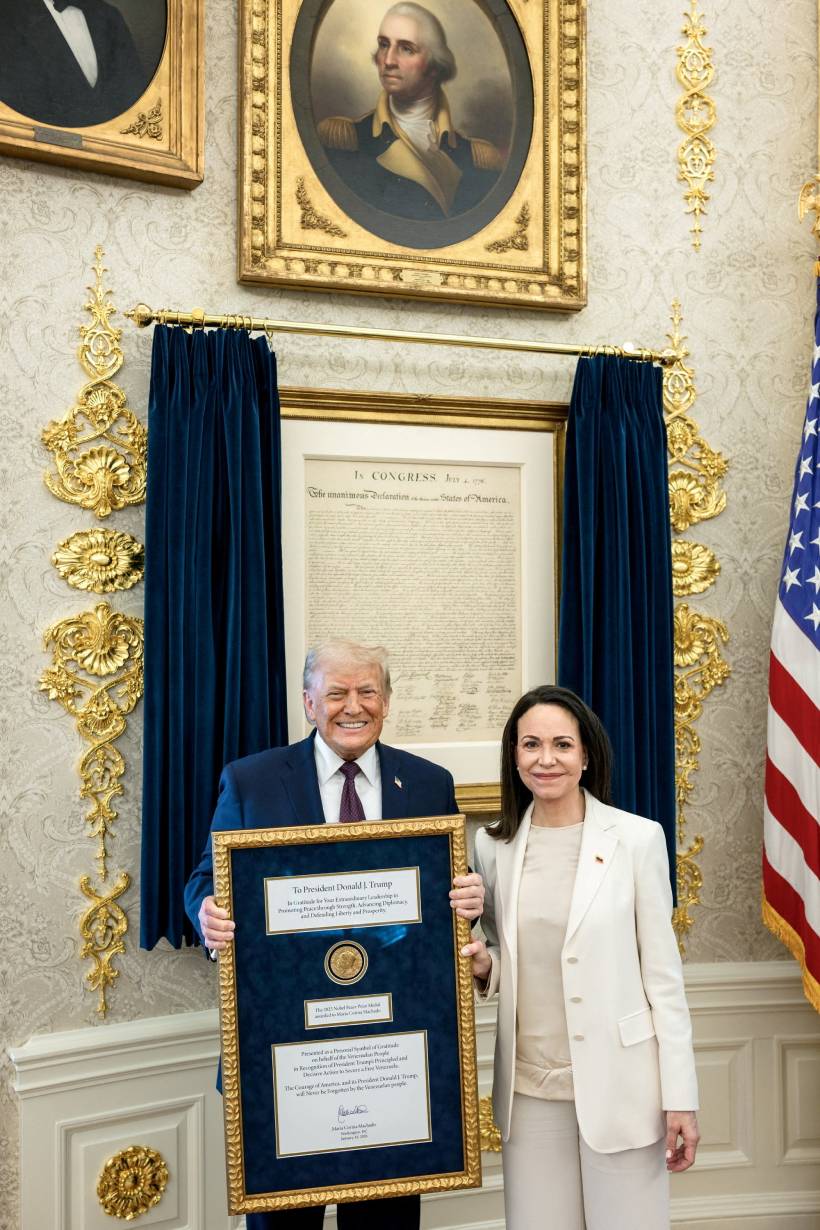
Venezuelan opposition leader Maria Corina Machado presented her Nobel Peace Prize medal to U.S. President Donald Trump during a White House meeting, describing the gesture as a sign of gratitude for his role in promoting the freedom of the Venezuelan people. A White House official confirmed that Trump intends to keep the medal, and the administration later released a photograph of the president holding a framed display of it. Trump publicly thanked Machado on social media, calling the act a “wonderful gesture of mutual respect,” while emphasizing that she remained the official Nobel laureate.
Background: Venezuela’s Political Crisis
Venezuela has faced prolonged political instability marked by authoritarian governance, disputed elections, and economic collapse. In the 2024 presidential election, opposition-backed candidate Edmundo Gonzalez was widely believed by international observers to have won by a substantial margin, yet Nicolas Maduro declared victory and remained in power. Machado, a leading opposition figure, was barred from running by a court aligned with Maduro’s allies and later fled the country in December through a dramatic seaborne escape. These developments further deepened Venezuela’s democratic crisis and intensified international scrutiny.
The Nobel Medal Gesture
Machado’s presentation of the Nobel medal was framed as a personal and symbolic expression of gratitude rather than a transfer of the prize itself. The Norwegian Nobel Institute clarified that Nobel Peace Prizes cannot be transferred, shared, or revoked, and that the honor legally and formally remains Machado’s. The framed inscription presented to Trump praised his leadership in promoting “peace through strength,” highlighting the political symbolism of the act rather than its legal standing. The gesture drew attention both to Machado’s efforts to maintain relevance in U.S. policymaking circles and to Trump’s long-standing interest in the Nobel Prize.
Trump’s Position on Venezuelan Leadership
Despite the cordial meeting, Trump has openly dismissed the idea of installing Machado as Venezuela’s leader in the near term, citing a lack of sufficient domestic political support. White House officials described Trump’s assessment as pragmatic and realistic, emphasizing that symbolic legitimacy does not automatically translate into governing capacity. Trump has repeatedly stated that his primary focus remains on strategic outcomes rather than personal alliances, signaling limited willingness to endorse opposition leadership without clear internal consolidation.
Stay ahead of the geopolitical week.
MD Briefing delivers expert analysis across five global fronts — the Indo-Pacific, energy, geoeconomics, European security, and the Middle East — every Monday morning. Free.
Interim Leadership and U.S. Engagement
Following the U.S. capture of Nicolas Maduro earlier this month, Delcy Rodriguez, Maduro’s former deputy, assumed leadership as interim president. Trump has spoken favorably of Rodriguez, describing her as cooperative and effective in negotiations, particularly regarding economic and energy matters. Rodriguez has called for renewed diplomacy with Washington and proposed reforms to Venezuela’s oil industry aimed at increasing foreign investment. While the government has released some political prisoners, international observers argue that these actions fall short of meaningful democratic reform.
Reaction from U.S. Lawmakers
Machado’s visit to Washington included meetings with more than a dozen U.S. senators from both political parties, where she sought to build congressional support for democratic transition in Venezuela. However, skepticism remains strong, particularly among Democrats. Senator Chris Murphy stated that political repression continues at levels comparable to Maduro’s rule and warned that Rodriguez is becoming increasingly entrenched due to U.S. engagement. He expressed doubts about the likelihood of free and fair elections in the near future despite official assurances.
Analysis: Symbolism vs. Strategy
Machado’s decision to give Trump her Nobel medal highlights the growing gap between symbolic legitimacy and strategic power in Venezuelan politics. While the gesture reinforces her moral authority and international recognition, it carries limited weight in shaping U.S. policy, which under Trump remains firmly guided by realist calculations such as energy security and regional influence. Trump’s willingness to work with Rodriguez reflects a transactional approach that prioritizes stability and economic interests over democratic ideals. As a result, Venezuela’s political future appears increasingly determined by strategic bargaining rather than normative commitments, leaving democracy as an uncertain and conditional outcome rather than an assured objective.
With information from Reuters,
