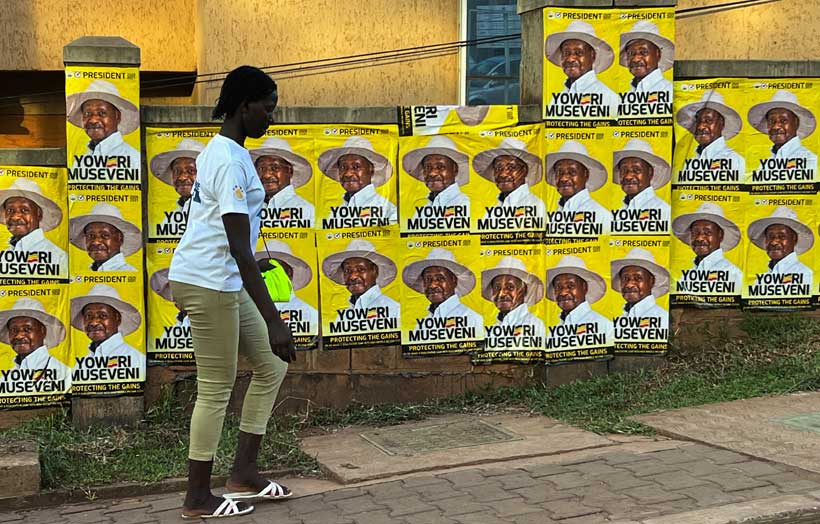
Uganda’s upcoming presidential election is unlikely to produce surprises. President Yoweri Museveni, now 81 and in power since 1986, is expected to secure yet another term, extending one of Africa’s longest-running presidencies into a fifth decade. Elections in Uganda have long followed a familiar script: fragmented opposition, heavy-handed security forces, and a political environment tilted so sharply in favor of the ruling National Resistance Movement (NRM) that meaningful competition is nearly impossible.
Yet while the outcome itself seems predetermined, the context surrounding this election makes it more politically revealing than usual. This vote is less about who will win and more about what kind of political system Uganda is becoming, and how long Museveni’s dominance can be sustained without cracking under generational, economic, and institutional pressure.
Museveni’s Seemingly Permanent Power:
Museveni’s political longevity rests on three pillars: control of the security apparatus, dominance over state institutions, and a carefully cultivated image as the guarantor of stability. Since taking power through armed rebellion in 1986, he has framed his rule as the foundation of Uganda’s post-conflict order. In official narratives, Museveni is not merely a president but the custodian of national stability, economic progress, and regional security. Elections serve more as ritual affirmations of this narrative than as genuine contests for power.
His main challenger, Bobi Wine, is emblematic of a different Uganda, Wine is young, urban, digitally connected, and increasingly impatient with a political system that offers little room for dissent. Wine’s 35% showing in the 2021 election demonstrated that a substantial segment of the population, particularly youth, is willing to challenge the status quo. But popularity alone does not translate into power in a system where the ruling party controls the electoral machinery, security forces, and much of the media landscape.
Stay ahead of the geopolitical week.
MD Briefing delivers expert analysis across five global fronts — the Indo-Pacific, energy, geoeconomics, European security, and the Middle East — every Monday morning. Free.
The opposition remains structurally disadvantaged. Campaign restrictions, arrests, intimidation, and limits on protest have become routine features of Uganda’s electoral cycle. Security forces killed more than 50 people during unrest surrounding the 2021 vote, and hundreds of opposition supporters have been detained in the lead-up to this election. Last week’s ban on live broadcasts of riots and “unlawful processions” further underscores how tightly the state manages political optics. Stability, in Uganda’s current political lexicon, often means the suppression of visible dissent.
What “Protecting The Gains” signals:
Museveni’s campaign message, “protecting the gains” is telling. It signals continuity rather than reform, preservation rather than transformation. His economic agenda focuses on industrialization, agricultural value addition, and the long-awaited start of oil production. These goals are not inherently controversial, but they are framed within a broader promise that Uganda’s progress depends on Museveni’s continued leadership. In effect, the president presents himself as both the architect and the sole reliable steward of national development.
Bobi Wine, by contrast, has focused on restoring political freedoms, curbing corruption, and addressing youth unemployment. His rhetoric reflects genuine frustrations among younger Ugandans who see limited economic opportunity, rising living costs, and a political system dominated by aging elites. However, Wine’s reformist message collides with the reality of a state apparatus designed to protect incumbent power. Uganda’s elections may feature opposition candidates, but they rarely offer opposition pathways to victory.
The Succession Question Looms:
What makes this election more interesting, if not more competitive, is the shadow of succession hanging over Museveni’s campaign. After nearly 40 years in office, the question is no longer whether Museveni can win an election, but what happens after him. His son, Muhoozi Kainerugaba, the current military chief, has openly discussed his political ambitions, fueling speculation about dynastic succession. While Museveni denies grooming his son, Kainerugaba’s visibility, military influence, and public statements suggest otherwise.
This potential transfer of power within a single family introduces new tensions within the ruling party itself. The NRM is not a monolith; it is a coalition of elites who have benefited from Museveni’s rule and who now have their own succession calculations. A son inheriting the presidency would disrupt established patronage networks and sideline powerful figures who have waited decades for their turn. The real political contest in Uganda may not be between Museveni and the opposition, but within the ruling elite over who controls the post-Museveni future.
Despite The Probable Conclusion, the Margin Still Matters:
Museveni’s margin of victory will therefore be closely watched. In 2021, he received 58% of the vote, his lowest ever. Any further decline would not threaten his immediate grip on power, but it would signal weakening legitimacy at a critical moment. A shrinking mandate complicates succession planning and emboldens internal rivals. Even in a managed political system, numbers matter. They shape perceptions, influence elite behavior, and affect how confidently a leader can dictate the terms of their own exit.
Strategic Implications:
Regional and international dynamics also add layers of complexity. Uganda remains a key Western security partner, particularly in Somalia, where its troops have been central to fighting al Shabaab. It also hosts the largest refugee population in Africa, a fact that bolsters its international standing. Yet Western enthusiasm for Uganda’s democratic credentials has cooled. The United States criticized the 2021 election as neither free nor fair and imposed visa bans on some officials, though Washington is now less vocal about election integrity abroad.
At the same time, Uganda has expanded ties with China, Russia, and the United Arab Emirates. Chinese firms play a major role in Uganda’s oil sector, and the government has actively diversified its diplomatic partnerships. This reduces Uganda’s vulnerability to Western pressure and gives Museveni greater geopolitical flexibility. In an era where global norms around democracy are increasingly fragmented, Uganda’s leadership can afford to be less concerned about international criticism.
The oil sector adds another strategic dimension. Commercial production from the Lake Albert fields is expected to begin later this year, potentially transforming Uganda’s economy. Oil revenue could strengthen the state’s fiscal position, fund infrastructure projects, and, crucially, reinforce the political power of whoever controls it. Museveni’s promise to oversee Uganda’s entry into the oil era reinforces the argument that stability requires continuity. For the ruling elite, oil is not just an economic opportunity; it is a political asset.
Meanwhile, demographic pressure continues to build. Uganda is one of the youngest countries in the world, with a large youth population facing limited job prospects and rising frustration. Recent protests in Kenya and Tanzania show how quickly youth discontent can spill into the streets. Uganda’s security-first approach may suppress unrest in the short term, but it does little to address the underlying grievances driving political alienation.
Conclusion:
In this sense, Uganda’s election is less a democratic exercise than a temperature check. It measures how much public frustration can be contained, how unified the ruling party remains, and how confidently Museveni can shape the succession narrative. The vote is not about choosing a new leader; it is about maintaining a political system built around one man.
Cynically, the election resembles a performance where the ending is known, but the subtext keeps shifting. Museveni will likely win. The opposition will likely protest. Security forces will likely restore “order.” And Uganda will move forward under the same leadership it has known for nearly four decades.
What makes this election “interesting” is not the prospect of change, but the growing tension between permanence and inevitability. Museveni’s rule has lasted long enough that the question is no longer whether he can govern, but whether the system he built can outlive him without fracturing. Uganda’s future will not be decided at the ballot box this week, but the signs of what comes next are becoming harder to ignore.