


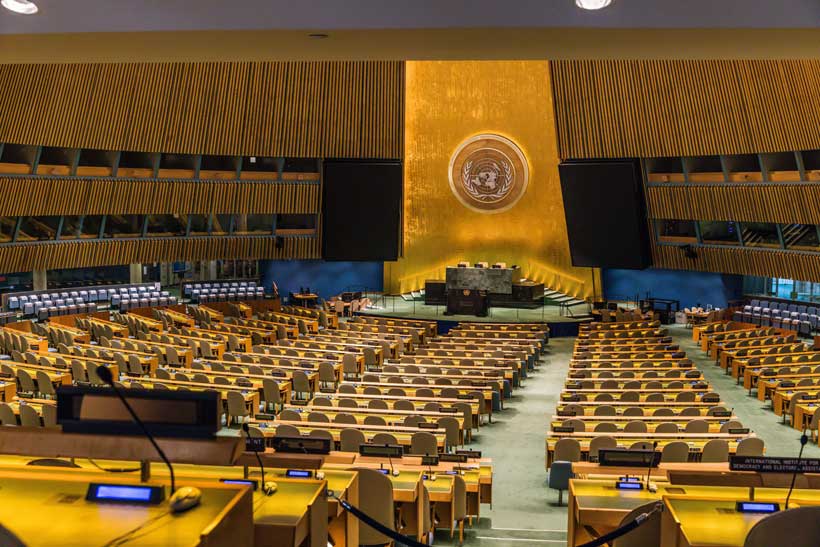
UN member states in New York kicked off the process for nominations for candidates for the new Secretary-General on 25 November. A defining news story for international relations throughout 2026 now unfolds, foretelling who will be the individual (will it finally be the first woman) to take a five-year term (2027-2031) at the helm of the world’s preeminent multilateral body.
The moment calls for a Secretary-General who is pragmatic and communicates a vision grounded in results. This means a candidate who constrains a few priorities at the top of their agenda, out of the many issues rightfully deliberated at the UN. Communicating priorities that broadly resonate is needed to win support from UN-skeptics, particularly the veto-wielding Trump administration.
In line with the opening words of the UN Charter “to save succeeding generations from the scourge of war,” the campaign for a Secretary-General in 2026 calls for a candidate who champions and complements conflict mediation.
Why is mediation a unifying vision for a Secretary-General? Across global conflicts, there is broad understanding that there is no alternative to negotiated outcomes in some form. A common refrain from podiums at the UN is “there is no military solution to X conflict.” But what benefit does the UN add to mediation when individual states are delivering mediation effectively and flexibly? A Secretary-General should complement mediation efforts by adding gravitas to the arduous process of implementation, bringing reputational costs to bear when parties are failing to fulfill their own commitments.
Stay ahead of the geopolitical week.
MD Briefing delivers expert analysis across five global fronts — the Indo-Pacific, energy, geoeconomics, European security, and the Middle East — every Monday morning. Free.
The Secretary-General should speak out forcefully on the risks of agreements falling apart, particularly those outside of the spotlight. A litmus test for candidates for Secretary-General should be their vision for galvanizing moral attention to the conflict in Sudan, where global commitment has fallen far short.
Mediation is by no means low-risk. Qatar experienced this when Israel attacked Hamas negotiators on Qatari soil. There are other cases where mediators have faced backlash for their role, such as Norway facing criticism from human rights activists for hosting talks with the Taliban in 2022. The moment calls for a Secretary-General who shows courage in backing up mediators for the risks they take and pressuring parties to meaningfully engage at the negotiating table and follow-through on their commitments, from Gaza to Sudan.
A Secretary-General should build on the foundation of the normative support the UN has built for mediation and its infrastructure to track implementation of peace agreements. The Security Council has shown that support for mediators is an area for consensus – the Council has repeatedly issued statements to support mediation by Qatar, the U.S., and African Union in response to the conflict in eastern Democratic Republic of Congo.
The Security Council reviews threats to international peace and security particularly based on UN reporting. Recent authorizations of new forces require that written reports be sent to the Security Council, including resolution 2803 endorsing Trump’s Gaza ceasefire plan and resolution 2793 authorizing a Gang Suppression Force for Haiti.
In 2024, the Secretary-General delivered 84 reports to the Security Council, many of which documented the progress towards peace in states where UN peacekeeping or special political missions are operating. This shows the UN’s experience at analyzing the implementation of peace processes, which in turn, should provide the roadmaps for what is needed to sustain agreements over the long run, beyond the spotlight of the initial high-level signing of papers.
It is important for a candidate for Secretary-General to both express rigorous ambition to pressure conflict parties and pragmatism for getting agreements over the finish line. The non-profit coalition One for Eight Billion, which is focused on supporting an “open, fair, inclusive recruitment process” for the Secretary-General highlighted the early nominations of Michelle Bachelet by Chile and Rebeca Grynspan by Costa Rica. Both states emphasized that their candidates are proven leaders as a former president and vice-president, respectively. According to the practice of regional rotation for the Secretary-General, Latin America and the Caribbean is up. Now that the campaign process formally started on 25 November, all candidates entering the race will be competing to prove they can win consensus, especially among the veto-wielding permanent members.
Conflict mediation should receive additional focus in the Security Council in 2026, given the priorities of its new membership. Three incoming members of the Security Council have significant experience with conflict resolution, including with UN missions in their countries: Colombia, the DRC, and Liberia. Additionally, three members that are going into their second year on the Council – Somalia, Pakistan, Greece – bring direct and recent experience of participating in mediation.
Success in getting peace agreements to stick demonstrates where the UN offers a comparative advantage for member states, whereas descriptions of revitalizing multilateralism with poorly enumerated priorities will not break through with those who are UN skeptics. The moment calls for a Secretary-General who prioritizes complementarity with conflict mediators and, thus, bridges needed ambition and realism.
