


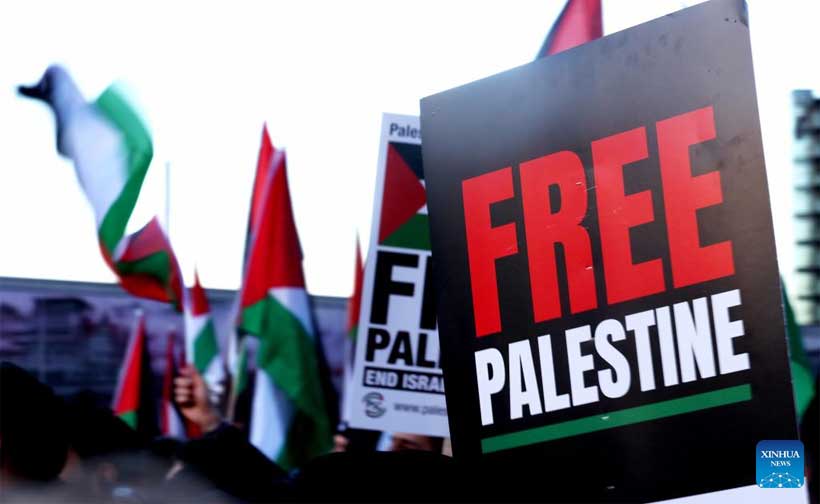
The British government’s decision to designate the pro-Palestinian activist network Palestine Action as a terrorist organisation is being challenged in London’s High Court. The group was proscribed in July, placing it on the same legal footing as organisations like Islamic State and making membership punishable by up to 14 years in prison. The Home Office moved to ban the group after a series of increasingly disruptive actions targeting businesses linked to Israel, including blocking entrances, vandalism, and a June break-in at RAF Brize Norton, where activists caused damage to two military aircraft. Founded in 2020, Palestine Action has focused on Israeli defence firms such as Elbit Systems, escalating its activities throughout the Gaza war.
WHY IT MATTERS
The court challenge goes to the heart of how the UK defines terrorism and how far the government can go in restricting protest movements. Lawyers for co-founder Huda Ammori argue that while Palestine Action’s tactics are often unlawful, they do not meet the threshold of terrorism and that the proscription is being used to suppress political dissent. Critics, including Amnesty International and Liberty, say the ban risks criminalising protest more broadly, pointing to the large number of arrests of people who merely displayed signs expressing support for the group. The case has also raised concerns about the proportionality of state power, especially as protest-related prosecutions have surged since the proscription.
Palestine Action and its supporters are directly exposed, with more than 200 people already charged for expressing support for a banned organisation. The Home Office argues the designation was necessary due to escalating criminal damage and what it calls threats to national security infrastructure, citing intimidation and serious injuries linked to some incidents. Human rights and civil liberties groups view the ban as a dangerous precedent that expands terrorism laws into the realm of political activism. The High Court’s ruling will be closely watched by police and prosecutors who have relied on the proscription to pursue charges, as well as by other protest movements concerned about potential overreach.
WHAT’S NEXT
If Ammori’s challenge succeeds, dozens possibly hundreds of ongoing or pending prosecutions could be undermined, as defendants would be able to argue that the underlying proscription was unlawful. The court will examine whether the Home Office applied terrorism laws correctly and whether acts of property damage and disruption warrant such a designation. A ruling is expected to shape future policing of pro-Palestinian demonstrations, which have already seen participants questioned or detained even when not explicitly supporting Palestine Action. The outcome could either reinforce the government’s hard-line stance or force a recalibration of how national security laws are applied to protest groups.
Stay ahead of the geopolitical week.
MD Briefing delivers expert analysis across five global fronts — the Indo-Pacific, energy, geoeconomics, European security, and the Middle East — every Monday morning. Free.
With information from Reuters.
