


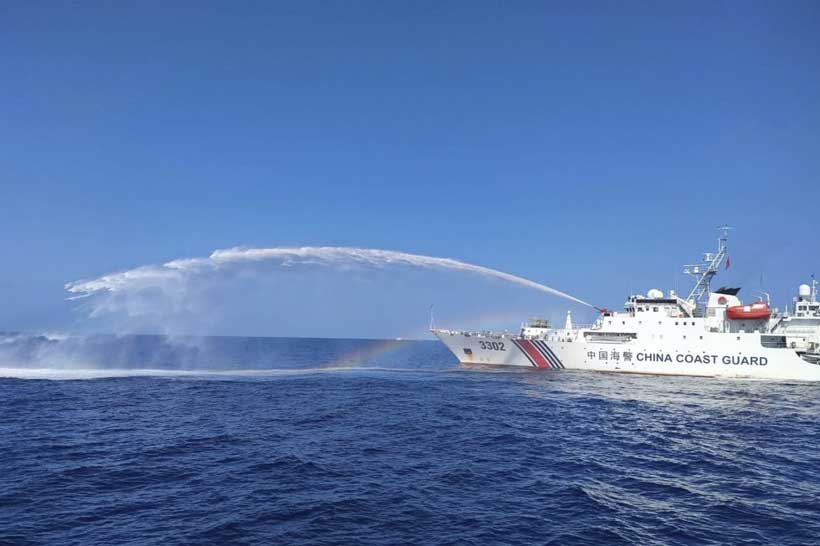
Tensions in the South China Sea have once again entered their most dangerous phase in a decade. Water cannon incidents, laser attacks, and even ship collisions between China and the Philippines have occurred almost monthly since early 2023. Behind these events lies a clear pattern: Beijing is not acting sporadically but rather pursuing a gradual strategy known as “salami-cutting,” which is incrementally altering the regional reality until the entire strategic dynamic shifts in China’s favor. This strategy should not be understood as mere military maneuvering but as a direct extension of a centuries-old Chinese strategic culture.
Strategic Culture as a Key Lens for Understanding China
The concept of strategic culture, as explained by Johnston (1995) and Gray (1999), emphasizes that a nation’s strategy stems from its history, identity, and collective experience. China is the clearest example of how strategic culture shapes contemporary geopolitical behavior.
The legacy of Sun Tzu’s thought, the memory of a century of humiliation, the vision of national rejuvenation, and the military doctrine of active defense form the rationale for China’s strategy in the South China Sea. In Chinese strategic culture, the greatest victory lies not in a major war, but in the ability to change the landscape without firing a single shot. In other words, an elegant victory is one that the adversary only recognizes too late.
Stay ahead of the geopolitical week.
MD Briefing delivers expert analysis across five global fronts — the Indo-Pacific, energy, geoeconomics, European security, and the Middle East — every Monday morning. Free.
Sun Tzu and the Philosophy of Victory Without Fighting
“The supreme art of war is to subdue the enemy without fighting.”— Sun Tzu, The Art of War
As stated in his book “The Art of War,” Sun Tzu asserted that the pinnacle of the art of war is conquering the enemy without fighting. This is not merely an ancient principle but rather the framework upon which Chinese naval operations are built today. When Beijing deploys coast guard vessels, naval militias, and constructs artificial islands, its aim is not to achieve victory in a single major battle, but rather to create a new reality through a series of small, consistent, and deliberate steps. The “slicing” strategy is a modern embodiment of this principle.
Historical Trauma and the Claim of Restoring Rights
The memory of a century of colonial humiliation (1839–1949) continues to shape Beijing’s strategic psyche. A 2020 Pew Research Center poll showed that 87% of Chinese believe their country has the right to defend its historical claims in the South China Sea. The Chinese Communist Party has politically embedded this narrative within its national rejuvenation strategy, transforming the South China Sea into more than just a territorial dispute; it has become a symbolic platform for restoring national dignity.
China’s “Salami-Cutting” Strategy in the South China Sea
China’s salami-cutting strategy has reached its peak in daily operations in the South China Sea, particularly against the Philippines. Over the past two years, Beijing’s actions have shifted from aggressive patrols to low-pressure operations occurring almost monthly. The Philippine Coast Guard recorded more than 11 water cannon attacks during 2023 and 2024, some powerful enough to damage ship hulls and injure crew members. In February and August 2023, Chinese Coast Guard vessels used military-grade lasers, causing visual impairments to Filipino crew members. While these incidents may seem technically minor, geopolitically they send a message: Beijing dictates the pace of events, and the Philippines is forced to respond within China’s predetermined sphere of influence.
A further escalation has taken the form of deliberate collisions between vessels. Reuters reported that between October 2023 and mid-2024, at least six collisions occurred around the Second Thomas Islands. These maneuvers were not accidental but rather a calculated strategy to disrupt the Philippine logistical support for the BRP Sierra Madre, an aging vessel that ran aground in 1999 to assert Manila’s claim to the reef. By cutting off supplies, China didn’t need to fire a shot or start a war; it simply crippled the Philippines’ ability to defend its position. This is the essence of “peaceful cutting”: exerting pressure without crossing the threshold of escalation that would trigger the mutual defense treaty between the Philippines and the United States.
However, Beijing’s primary strength lies not in combat technology but in what Washington often calls its “shadow fleet militia,” or People’s Armed Forces Maritime Militia (PAFMM). A 2023 report by the Office of Naval Intelligence revealed that more than 300 militia vessels are actively operating in the South China Sea. They appear to be fishermen, but they are paid, trained, and directed by the state. These vessels patrol disputed areas like Whitson Reef, creating a new reality: it is not Chinese soldiers who are present, but rather Chinese “civilians.” This maneuver confuses international law and undermines the legitimacy of the Association of Southeast Asian Nations’ (ASEAN) claims, while also providing China with a cheap but effective tool of pressure.
On the other hand, China has undergone a geostrategic transformation through the construction of artificial islands. Since 2014, Beijing has reclaimed more than 3,200 hectares of land in the Spratly Islands, a figure confirmed by the Center for Strategic and International Studies’ Maritime Transparency Initiative (CSIS-Asia). These areas are no longer sand and coral; they now house sophisticated radar installations, aircraft hangars, HQ-9 missile systems, YJ-12 anti-ship missiles, and a 3,000-meter runway ready for People’s Liberation Army fighter jets. Construction was carried out in stages to avoid significant international criticism, but the end result is striking: Beijing has established a network of military bases in the heart of Southeast Asia without firing a single shot.
This gradual strategy culminated in August 2023 when China released a new map of the eight-dash line. While it appeared to be an administrative revision, the move had significant strategic implications, expanding China’s maritime claims to include areas not previously subject to active dispute. This map provides a solid domestic basis for future maritime operations, making it easier for Beijing to claim that its actions on land are simply the enforcement of its now-legalized “historical rights.”
This gradual strategy is not a series of random incidents but a systematic process. Each small element is never enough to provoke a major international reaction, but all the elements, when combined, create a new geopolitical reality that is difficult to reverse.
Regional Impact: ASEAN Divisions and Southeast Asian Tensions
The effects of China’s strategy are immediately apparent in the region. The Philippines, a prime target of coercive pressure, is expanding its defense cooperation with the United States by adding nine military bases to the Eastern Military District (EDCA) by 2023. This represents Manila’s biggest strategic shift since the early 21st century.
Vietnam is also accelerating its military modernization by increasing its defense budget to US$5.5 billion by 2024 (SIPRI), while Indonesia is strengthening its Natuna Besar Force and increasing joint military exercises with its allies while maintaining its stance of “strategic independence.”
However, not all ASEAN members are taking decisive action. Malaysia and Brunei are adopting a more flexible approach, while Laos and Cambodia tend to support Beijing’s approach. This fragmentation further weakens the Association of Southeast Asian Nations (ASEAN) as a regional bloc, while simultaneously facilitating a more China-friendly bilateral approach.
China’s strategy in the South China Sea is not a single, dramatic expansion but rather the culmination of a long and carefully considered process. By employing a strategic culture that values patience, gradual action, and non-confrontational dominance, Beijing has succeeded in altering the regional status quo without resorting to a major war. Every small part ultimately contributes to the whole.
The question is no longer whether China is changing the South China Sea, but rather to what extent the countries in the region are willing to allow this change before peace disappears entirely from their plates.
