


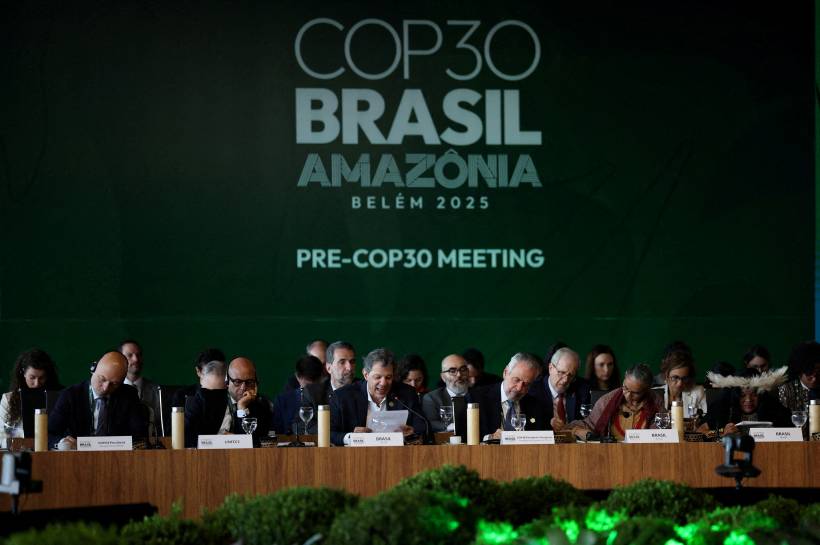
The city of Belém, a gateway to the sprawling Amazon, presents a perfect and painful paradox for the thirtieth Conference of the Parties. Here, at the precipice of the planet’s most vital ecological frontier, the world’s premier climate forum has convened, even as its host nation, Brazil, simultaneously rams a major highway through protected rainforest and champions oil exploration at the mighty river’s mouth. This is not a minor contradiction; it is the emblem of our era. COP30 is not merely a struggling summit—it is a ghost ship, a majestic vessel built for a journey its most powerful passengers have abandoned, now adrift in a sea of geopolitical rivalry and unenforceable promises.
The Geopolitical Funeral
The most telling story of this COP is written in the empty seats. The leaders of China, India, and Japan are absent. Russia is a non-entity. Most decisively, the United States has completed its formal withdrawal from the Paris Agreement, a move that places it in the company of Iran, Libya, and Yemen. This is not simple disengagement; it is the culmination of a calculated geopolitical schism. The world’s superpowers are now locked in a cold war for control of the global energy future, and the UN’s consensus-based forum has become a collateral casualty. As one weary diplomat from a major developed nation whispered, the overriding fear for many is “being seen to criticise Trump.” This chilling effect suffocates ambition in the very halls designed to foster it.
The reality is that the center of gravity for climate action has shifted decisively away from these sprawling multilateral spectacles. The real negotiations now occur in closed-door bilateral deals and regional alliances. The U.S. and China are exporting their competing energy models, one doubling down on fossil-fueled sovereignty, the other on a clean-tech export drive, through trade pacts and infrastructure investments, not UN plenaries. The recent collapse of a landmark global shipping emissions deal, scuttled by U.S. and Saudi opposition, is a case in point. The age of universal, UN-brokered consensus is over, replaced by a fragmented, transactional “minilateralism.”
A Structure Designed for Talk, Not Action
This geopolitical decay is exacerbated by a structural flaw hardwired into the COP process itself. The system was designed for diplomacy, not delivery. It was designed to get parties to the table and secure signatures, not to ensure those signatures translate to plummeting emissions. As Albert Norström of the Stockholm Resilience Centre observes, the COP “gave us the Paris agreement… but the world has moved into the implementation decade, and here the COP is lagging badly.” The consensus model, intended as a great equalizer, has become a weapon of the powerful. It allows well-resourced leviathans like the U.S. and the EU, with delegations of hundreds, to run circles around understaffed teams from nations like Lesotho, whose one or two negotiators must cover everything from finance to adaptation. When a decision is gavelled through against a nation’s will, it is never the will of America or Europe that is overridden; it is the will of Bolivia.
Stay ahead of the geopolitical week.
MD Briefing delivers expert analysis across five global fronts — the Indo-Pacific, energy, geoeconomics, European security, and the Middle East — every Monday morning. Free.
Lobbyists and Logistical Collapse
Into this power vacuum has poured a different kind of delegate. At COP28, nearly 2,500 fossil fuel lobbyists roamed the halls, a presence that dwarfed the combined delegations of the most climate-vulnerable nations. Their sheer numbers transform the summit from a negotiation into a business fair, a forum where the agents of delay outnumber the architects of transition. Ambition is diluted, progress is slowed, and trust—the currency of any negotiation, is systematically undermined. The process is being hollowed out from within.
Meanwhile, the logistical spectacle of the “climate caravan” contradicts its own moral purpose. The noble intention of bringing decision-makers to the Amazon frontlines has buckled under the weight of its own scale. The event has become a prohibitively expensive, logistically nightmarish roadshow for tens of thousands, effectively excluding the very grassroots and Indigenous voices it was meant to elevate. The commitment is performative; the carbon footprint is real.
All of this structural and geopolitical failure constitutes a profound, and potentially fatal, betrayal of trust. For the small island states and Southeast Asian nations in the crosshairs of the climate crisis, the COP process remains a vital, if flawed, lifeline. It is their primary platform to amplify an existential plea and secure the finance that is a matter of survival. They continue to play by the rules of a game that is rigged against them, placing their faith in a system where pledges are voluntary, deadlines are missed, and the 1.5°C target is acknowledged as a soon-to-be-breached threshold. For them, the alternative to this flawed forum is not a more efficient one; it is the unimaginable.
Conclusion: A Call for an Alliance of the Accountable
The question is no longer how to fix the COP, but what we must build from its wreckage. The era of universal, non-binding pledges is conclusively over. The ghost ship of Belem is a monument to its passing. The path forward is not to desperately patch its leaks, but to launch new, more nimble vessels.
The future of credible climate governance lies not in compelling every nation under one big tent, but in forging a coalition of the willing and the accountable, an “Alliance for Implementation.” This alliance would be built on three core principles. First, mandatory participation: members would agree to legally binding, enforceable national targets, moving beyond voluntary contributions. Second, focused membership: it would be open to any nation, from the most vulnerable to the largest economies, that is serious about auditability and consequence, creating a “climate club” with real benefits and responsibilities. Third, an independent accountability mechanism: a technocratic body, insulated from political horse-trading, would monitor progress and levy sanctions for non-compliance.
Let the old COP continue as a global talking shop, a stage for diplomacy and a platform for the vulnerable. But let us stop pretending it is the engine of our salvation. The hard, unglamorous work of cutting emissions must now be undertaken by a different kind of compact—one defined not by the lowest common denominator, but by the highest possible ambition, and the unwavering courage to hold its members to account. The ship of global consensus has foundered. It is time for the lifeboats of determined, accountable action to set sail.
