In the restless waters between Karachi and Kutch, power is no longer measured only in ships or missiles but in narratives. The Arabian Sea, once a quiet flank of the subcontinent’s rivalries, is emerging as a new theater where perception itself is weaponized. Pakistan’s interception of a covert network allegedly linked to Indian intelligence aimed at procuring military uniforms for staged provocations sheds light on how hybrid warfare is reshaping the boundaries of deterrence, deception, and diplomacy in South Asia.
A Maritime Turn in India’s Strategic Signaling
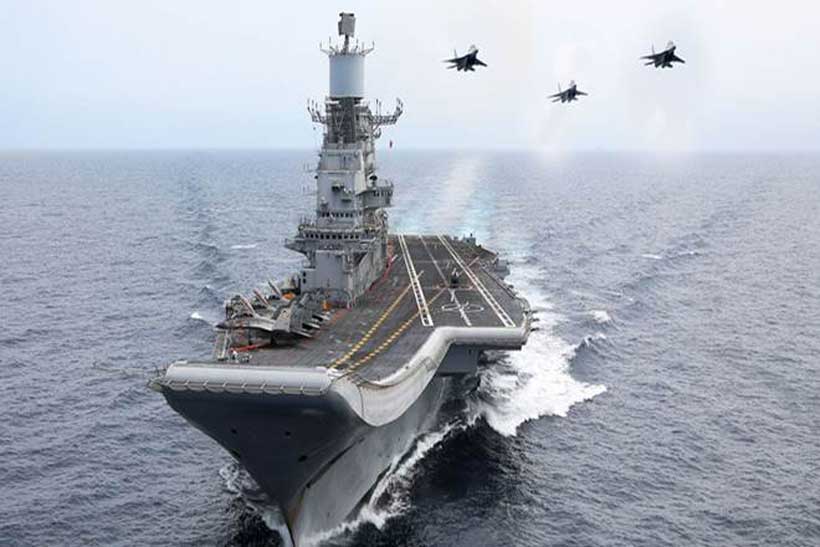
In recent years, New Delhi has deliberately expanded its military discourse from land to sea. Prime Minister Narendra Modi’s address aboard the aircraft carrier INS Vikrant in September 2022 framed the Navy as “the guardian of the Indian Ocean,” underscoring India’s ambition to project maritime dominance beyond the subcontinent.
Days later, Admiral R. Hari Kumar, India’s Chief of Naval Staff, translated that symbolism into operational intent. In a December 2023 interview with India Today, he declared that “if need arises, the opening will be done by the Navy,” a phrase that, in strategic lexicon, implies readiness for first use at sea.
Stay ahead of the geopolitical week.
MD Briefing delivers expert analysis across five global fronts — the Indo-Pacific, energy, geoeconomics, European security, and the Middle East — every Monday morning. Free.
This rhetoric has been matched by practice. Exercise Trishul 2024, a tri-service drill held across Gujarat, Rajasthan, and the Arabian Sea, involved amphibious landings, anti-surface warfare, and joint air–sea maneuvers. The Indian Ministry of Defense described it as a “multi-domain warfighting rehearsal under Southern Command,” confirming the shift toward littoral operations near Pakistan’s maritime frontier.
Defense Minister Rajnath Singh’s remarks in Bhuj, warning that “any misadventure in Sir Creek will meet a firm response” (The Hindu, March 21, 2024), further link land-border flashpoints to a wider naval doctrine that now explicitly includes creek and coastal theaters.
The Mallah Episode and the Anatomy of Deception
This is what makes the Ijaz Mallah case particularly alarming. According to Pakistan’s investigation, the Thatta fisherman was coerced by India’s Research and Analysis Wing (RAW) to acquire genuine Pakistani military attire (Navy, Rangers, and Marines) either to stage an attack using local proxies or to film fabricated footage that could later be released to implicate Pakistan.
Such tactics, while ethically abhorrent, are not novel. Across modern conflicts from Crimea to Syria, false-flag operations have served as tools to blur lines of culpability. By introducing manufactured evidence, uniforms, or digital content, states can manipulate the information domain faster than facts can catch up.
Pakistan’s interception of this network, therefore, is not merely a counterintelligence success; it’s an early disruption of a potential narrative weapon. Had the uniforms crossed the border, they could have been used to create “plausible deniability,” the core ingredient in any staged provocation.
The Economic and Strategic Cost of Escalation
A manufactured maritime clash, even a minor one, would have consequences far beyond Karachi or Kandla. The Arabian Sea handles vital oil and cargo flows linking the Gulf to East Asia. A sudden naval “incident,” say, an attack attributed to “Pakistani elements,” could spike war-risk premiums overnight, reroute shipping, and disrupt energy markets already strained by global volatility.
The logic of hybrid warfare is not always to start a full war but to control the narrative space of one to turn perception into leverage. In such a context, the discovery of Pakistani uniforms and SIM cards in foreign hands becomes not just evidence of espionage but a warning of how storytelling itself has become a weapon.
Counterpoint: India’s Argument of ‘Defensive Modernization’
Critics may argue that India’s exercises and rhetoric are simply expressions of deterrence, a modern navy preparing for contingencies in an uncertain neighborhood. Indian strategists frequently cite China’s expanding naval presence and piracy in the Arabian Sea as justification for their maritime buildup.
But deterrence, by definition, requires clarity of intent. When top Indian officials talk about “opening” at sea, when war games simulate amphibious insertions near Pakistani waters, and when covert assets are found procuring Pakistani military paraphernalia, the line between defense and deception blurs. Deterrence thrives on transparency; manipulation thrives on ambiguity.
The distinction matters because perception in this region escalates faster than fact. South Asia’s nuclear environment cannot afford another Pulwama, let alone a maritime version of it.
Hybrid Warfare: The Invisible Front
Beyond the naval theater lies the hybrid front, a domain where disinformation, cyber intrusion, and proxy networks operate below the threshold of conventional war. India’s cultivation of local intermediaries from Baloch separatist networks to coastal smugglers forms part of a broader attempt to keep Pakistan under strategic pressure without formal confrontation.
The use of media amplification to discredit Pakistan is central to this playbook. Fabricated “Pakistani military” videos or narratives often circulate across digital platforms before official verification can challenge them. By the time truth arrives, the emotional damage is done, internationally and domestically.
Pakistan’s exposure of the Mallah case, therefore, is not merely defensive but preventative: it neutralizes one layer of hybrid preparation before it translates into a geopolitical incident.
The Call for Vigilance and Responsibility
South Asia has seen enough tragedy born of miscalculation. The next one may not begin on land or through the sound of artillery, but through a viral video, a uniform, and a headline. That is the quiet menace of hybrid conflict; it makes fiction operational.
Pakistan’s decision to publicize the details of the Mallah network and to alert the international community is an act of strategic transparency. It signals Islamabad’s awareness of the informational dimension of security and its understanding that stability now depends as much on narrative integrity as on military deterrence.
For the international community, the lesson is clear: when maritime drills, militant proxies, and media manipulation converge, it is not paranoia to demand scrutiny; it is prudence. The Arabian Sea does not need another flashpoint; it needs clarity, verification, and restraint.
In the end, the waters between Karachi and Kutch are not just a frontier; they reflect how South Asia manages truth itself. The question is no longer who commands the sea, but who commands the story.