


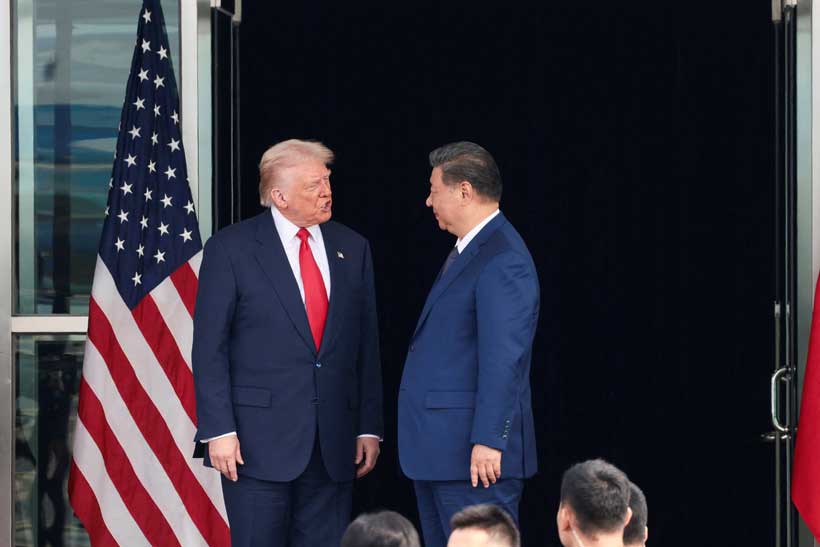
The meeting between Chinese President Xi Jinping and his American counterpart, Donald Trump, in Busan, South Korea, concluded with the announcement of a temporary trade truce between the world’s two largest economies. This resulted in the United States suspending its decision to impose additional tariffs on China until November 10, 2026. During the meeting, President Xi Jinping was careful to demonstrate a symbolic balance between the Chinese Dream and Trump’s Make America Great Again vision, telling Trump that “I believe that China’s rejuvenation must go hand in hand with your vision to make America great again.” Here, at this summit in South Korea with Trump, Beijing succeeded in achieving its long-standing goal of linking national security-based export controls to broader trade negotiations. This was especially true after the concessions made by the United States regarding national security technology controls within the framework of trade negotiations with China. The Trump administration agreed to a one-year suspension of a rule that expanded the number of Chinese companies barred from accessing advanced American technology. It’s worth noting that this American rule, issued just four weeks before the (Trump-Xi Jinping) meeting in South Korea, broadened the list of Chinese entities prohibited from doing business with the US as a type of US trade blacklist targeting foreign companies deemed a threat to US national security.
This American decision to pursue a trade truce with China has several underlying reasons, in addition to its positive impact within China itself. This American decision reflects a growing awareness that China is now capable of reshaping the global economy to serve its interests. With Washington’s options dwindling in the face of Chinese rare earth restrictions and declining US domestic production in some technology industries, American leverage over China has become less effective than it was a decade ago. From the perspective of China and developing countries of the Global South, which view China as their biggest supporter and defender, this US trade truce with China reflects a profound shift in the international landscape. The manifestations of American unilateral hegemony are receding in the face of the rise of a parallel economic system led by Beijing with increasing confidence worldwide through its Belt and Road Initiative.
This prompted a series of official Chinese reactions to the American decision. This new US agreement with China comes as a temporary trade truce following the successful summit between US President Donald Trump and his Chinese counterpart, Xi Jinping, in South Korea. Under this agreement between the US and China, the United States is expected to maintain the suspension of escalating reciprocal tariffs on Chinese imports until November 10, 2026. The US will also reduce tariffs on Chinese fentanyl-related imports by 10 percentage points, effective November 10, 2025, and extend certain tariff exemptions under Section 301 until November 10, 2026.
As for China’s official reaction, it welcomed the suspension of all retaliatory measures and tariffs imposed since last March on US imports, including tariffs on US agricultural products such as soybeans, corn, and meat. China also agreed to take significant measures to curb the flow of fentanyl precursor chemicals to the United States and to lift some restrictions on rare earth exports. This new trade agreement between Washington and Beijing represents a new breakthrough aimed at easing trade tensions between the world’s two largest economies.
Stay ahead of the geopolitical week.
MD Briefing delivers expert analysis across five global fronts — the Indo-Pacific, energy, geoeconomics, European security, and the Middle East — every Monday morning. Free.
Under this agreement, Beijing agreed to suspend blanket controls on a number of rare earth minerals to the United States in exchange for the US agreeing to roll back its expansion of restrictions on Chinese companies. China had used its dominance and influence in rare earth mineral processing as leverage, threatening to restrict their flow to the United States and its allies. Under this agreement, Beijing will issue general licenses valid for the export of rare earth minerals to the United States, such as gallium, germanium, antimony, and graphite, to American suppliers, effectively removing the controls that China imposed in April 2025 and October 2022.
Although this agreement has eased tensions between China and the United States, it is merely a short-term truce in their protracted trade dispute, as the measures are only supposed to last for one year. While some key issues have been addressed after both sides made significant concessions, the agreement fails to comprehensively resolve all the core issues of the US-China trade conflict, as well as other geopolitical flashpoints such as Taiwan and Russia’s war in Ukraine. Despite the truce, tensions persist, particularly in the technology and semiconductor sectors. This truce is considered tactical rather than a structural solution to the trade conflict between the two countries. However, future talks between the two sides are expected to continue to discuss outstanding issues. Presidents Trump and Xi Jinping are expected to meet again in 2026, which could pave the way for a new phase of interaction between the two countries.
