


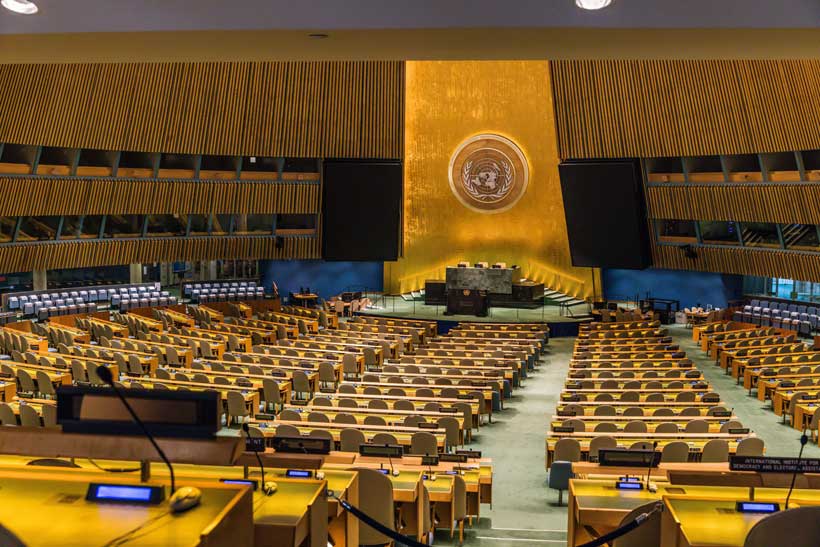
The European Union has issued a clarification regarding United Nations General Assembly Resolution 2758, stressing that the 1971 resolution merely addressed the issue of China’s representation at the UN and did not mention Taiwan. Passed during the Cold War era, the resolution recognized the People’s Republic of China (PRC) as “the only legitimate representative of China to the United Nations,” effectively transferring the seat from the “representatives of Chiang Kai-shek.” However, it made no reference to Taiwan’s sovereignty or international status a point now at the center of growing geopolitical disagreement.
This debate stems from the aftermath of the Chinese Civil War, when the defeated Nationalist government retreated to Taiwan in 1949 and continued to claim to represent all of China under the title “Republic of China.” For more than two decades, Taipei retained the UN seat until the passage of Resolution 2758 shifted recognition to Beijing. Since then, China has interpreted the resolution as confirming that Taiwan is part of the PRC, while Taiwan argues that it only determined who holds China’s seat at the UN not who governs Taiwan.
Why It Matters
The EU’s clarification is significant because it directly challenges Beijing’s longstanding narrative that Resolution 2758 provides international legal grounds for its sovereignty over Taiwan. The statement reaffirms that the resolution contains no language relating to Taiwan, thereby undermining China’s use of the document as justification for its “One-China” principle. This comes amid heightened cross-strait tensions and increasing concern in Western capitals over China’s attempts to reshape global legal and diplomatic interpretations to serve its political aims.
Stay ahead of the geopolitical week.
MD Briefing delivers expert analysis across five global fronts — the Indo-Pacific, energy, geoeconomics, European security, and the Middle East — every Monday morning. Free.
The issue also holds broader implications for the global rules-based order. By emphasizing adherence to the UN Charter and the prohibition of force, the EU signals its opposition to any unilateral change to the status quo in the Taiwan Strait. As Beijing increases diplomatic and military pressure on the island, the debate over how international law is interpreted becomes central to maintaining regional peace and stability.
China remains the primary actor driving this reinterpretation, asserting that Resolution 2758 enshrines its sovereignty over Taiwan and prevents the island from having any independent representation in international organizations. Taiwan, however, accuses Beijing of distorting the resolution for political ends, warning that such “misleading” interpretations could pave the way for future aggression.
The United States and the European Union have emerged as key counterweights to Beijing’s narrative. Washington recently stated that China is “intentionally mischaracterizing” the resolution as part of a coercive campaign to isolate Taiwan, while the EU reiterated that China, as a permanent member of the UN Security Council, must uphold international law and maintain peace. Although no EU member state formally recognizes Taiwan, the island has deepened its informal engagement with Europe its foreign minister visiting the continent twice last month to strengthen political and economic ties.
Future Outlook
The controversy surrounding Resolution 2758 is unlikely to fade soon. As China continues to invoke the resolution to legitimize its claims, Western powers are expected to counter with legal and diplomatic arguments emphasizing its limited scope. The EU’s latest position reflects a growing readiness in Europe to confront Beijing’s revisionist interpretations, even while maintaining formal adherence to the One-China policy.
Looking ahead, the resolution once viewed as a settled procedural matter could increasingly shape the international dialogue on Taiwan’s status and the global balance of power. The dispute exemplifies a broader struggle between competing visions of international order: one based on coercive sovereignty claims, and another rooted in the rule of law and peaceful coexistence.
With information from Reuters.
