



Poverty is perceived to be a plague that slices off the hands of a society, crippling the economy’s ability to grow while also exacerbating inequality and eroding social stability. Henceforth, poverty is far greater than the idea of insufficient incomes; it is rather a state of deprivation with limited access to basic needs of life, namely healthcare, education, and shelter, imprisoning generations in this cycle of misery. Such threatening concerns have a strong chokehold on the Global South, yet still China has emerged as a benchmark for nation-states to follow in regard to poverty alleviation, finding an effective cure to this disastrous plague.
China, crowded with the second largest population of 1.4 billion, has lifted 800 million people out of poverty, making a vital contribution to the cause of poverty alleviation as it sets itself 10 years ahead of the first UN 2030 sustainable development goals (SDGs). This crucial progress towards poverty alleviation exemplifies China’s determination and sense of responsibility to the common prosperity of its nation. General Secretary Xi solemnly declared, “Victory in the battle against poverty is complete, and China completed the arduous task of eliminating extreme poverty.”
Each nation may have set their own criteria for determining the poverty line and counting how many of its people live in poverty. The Washington-based lender, the World Bank, updates the poverty lines based on the headcount of people with consumption below the international line, known as Purchasing Power Parity (PPP).The World Bank has identified the new poverty line at $3 per person, up from $2.15 per person. With this new development the Pakistani population grapples with a 16.5% poverty rate, up from 4.9% under the previous $2.15 threshold. As a lower middle-income country, the poverty line set for Pakistan is $4.20, with the poverty ratio jumping from 39.8% to 44.7%.
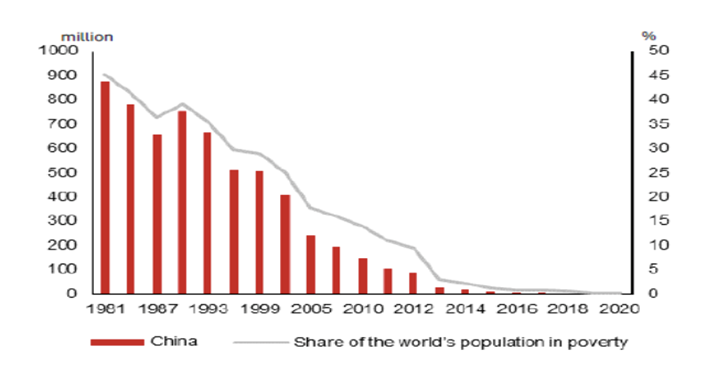
Figure: China’s Population living in poverty
Stay ahead of the geopolitical week.
MD Briefing delivers expert analysis across five global fronts — the Indo-Pacific, energy, geoeconomics, European security, and the Middle East — every Monday morning. Free.
China’s Targeted Alleviation Strategies:
China’s success was not incidental; it was the outcome of targeted policies that employed measures that adjusted to their dire circumstances along with a systematic organizational structure that firmly implemented and monitored the policies. China’s approach to poverty eradication is distributed across two aspects. The initial point raised was achieving overall economic growth that would lead to the creation of economic opportunities and hence raise incomes. The second aspect overlooked was the provision of targeted, tailored alleviation strategies ranging from disadvantaged areas by geography and later to individual households.
The Targeted Alleviation Strategy has been a driver model since 2013, aiming to adopt household-centered policy. It began with grassroots officials identifying the vast majority of the population living in poverty by utilizing time in villages, assessing the growth and causes of the poor population and their poverty, and then finding outcome-oriented solutions with clear lines of accountability. Each government official was given the responsibility of one household to provide tailored intervention, including policies aiming for sustainable economic growth and income generation, relocation and resettlement from inhospitable areas without coercion, ecological protection and compensation, increased accessibility to education, and providing interest-free loans. The progress, therefore, was evaluated through updated databases for transparency and accountability.
Another strategy adopted by the Chinese government is area-based poverty alleviation strategies. The state divided the poor, underdeveloped areas into counties and specifically articulated region-specific policies. The Leading Group for Poverty Reduction and Development determined poor counties, primarily based on county-level average rural per capita income. Adding provincially designated areas, the list reached nearly 700 counties, additionally including mountainous regions. The government then introduced an 8-7 Poverty Reduction Plan, making massive investments in infrastructure development and internet connectivity and providing access to clean drinking water and health care establishments.
Equally important was the establishment of social protection policies with the aim of providing more social protection in rural areas. For underdeveloped areas, China launched the minimum age program Dibao in 2007, which reached 57 beneficiaries in the next three years. Therefore, China expanded its policies to provide rural pension schemes and basic medical insurance to the vulnerable population. Ninety percent of the population by 2020 was enrolled in some basic insurance, while the government’s financial schemes also helped to provide stability to the elderly population. This scheme not only helped China alleviate poverty in the short term, but it was also a rather long-term objective ensuring the sustainability of their policies.
Current Challenges in Pakistan’s Poverty Alleviation Programs:
In the doldrums of Pakistan’s Poverty Alleviation Programs, unemployment emerges as an obstacle countering the abatement of poverty in Pakistan. A study conducted in December 2018, has concluded that government spending in terms of fiscal policy has an inverse relationship with poverty, which proposes that high government spending would lead to lower unemployment figures in the country, which could transcend into the gradual alleviation of poverty in Pakistan
Furthermore, political discontinuity and frequent government changes culminated in an absence of long-term economic planning or its continuation after a government change; if there is continuation of a singular economic policy, it can lead to more stable funding for such projects, as discussed in the book ‘Poverty, Inequality, and Policy’ (edited by Gabriel Ilie Staicu).
A major section of the employed workforce in Pakistan currently operates in the domestic economic sector of the country, partly due to lack of adequate skills or due to cynical unemployment. Minimum wage laws are not applied to the labor working in this industry. which makes it proportionate that the employer would pay the employee according to his will. Therefore, with the inability to provide stable and notable incomes, it locks individuals in a loophole of poverty, even when they are said to be employed.
These factors are majorly connected to the fiscal policy and macroeconomic planning of the government, which is the primary source of configuration for a strategy that can facilitate the other stakeholders to work towards the gradual abatement of poverty in Pakistan.
Policy Recommendations:
While Pakistan’s neighboring country found a cure for this catastrophic plague, Pakistan itself, however, seems to be entrenched in structural crises to effectively combat this dilemma. To begin with, Pakistan must adopt a system of transparency and accountability so that the poverty alleviation strategies being used are effective and sustainable. Hence, policies implemented by the state must be result-driven, tracking each household’s progress through performance indicators, and the governors of the region must be made accountable for the outcomes.
The Government of Pakistan initiated the Benazir Income Support Programme (BISP) in 2008 as its main social safety net program. The aim of the program is to provide interest-free loans to the disadvantaged in the community identified on the basis of a poverty scorecard and would be backed by an exit strategy. Other programs include the Ehsaas Program, with the objectives to shrink wealth and income disparities between the elite and the poor while ensuring that the government provides equal opportunities to all of their citizens along with reliable support systems to the vulnerable Pakistanis. Therefore, such vital incentives should be driven by the desire for sustainable long-term economic empowerment, not only short-term relief. This can be done by conditional cash transfer, such as compulsory skills development courses and acquiring education, which would help Pakistan break the cycle of dependency.
Pakistan, with a population of 247.5 million, among whom 49% are women, must efficiently utilize their human resources by allowing women to be the center of poverty alleviation programs. Special incentives like microfinance must be undertaken with transparency and the exceptional ambition to carry forward in order to make such programs effective in achieving their objectives. A standing example would be Grameen Bank in Bangladesh, which gives out interest-free loans to the women and the weaker section of the community using the power of microfinance to assist women in exceeding the threshold of entrepreneurship and clearing the path to self-sufficiency with a profound grasp on expanding social capital. Replicating such models can uplift future generations and encourage skills development.
Just as important are public-private partnerships that play a fundamental role in the community. Considering a laissez-faire approach with limited government intervention, it would help to create a system of greater efficiency and accountability as seen by organizations like Al Khidmat and Akhuwat while also minimizing the state’s responsibilities. Henceforth, the government should formalize collaborations by offering tax incentives, subsidies, and deregulation, which would help encourage private companies’ investment in rural development.
Conclusion:
As claimed in the brief above, poverty continues to hinder Pakistan’s social and economic development. China, on the other hand, has effectively adapted targeted strategies, identifying its country’s strength and mitigating its weaknesses, creating a strategic mechanism of sustainability, accountability, and transparency. Pakistan must inherit such effective long-term policies to alleviate itself from this threatening crisis.
