


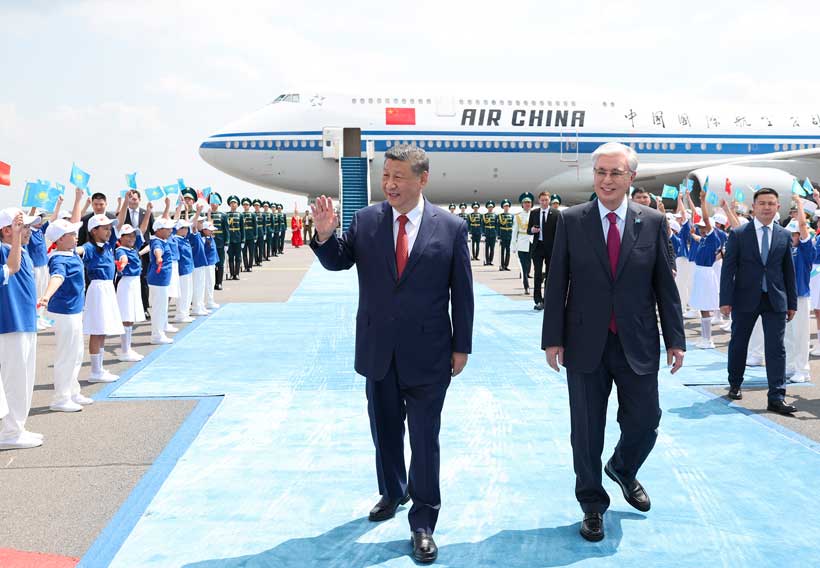
Chinese President XI Jinping and Kazakh President Kassym-Jomart Tokayev met in Astana this June, signaling a boost in their bilateral relations. These two leaders were celebrating the thirtieth anniversary of diplomatic relations, also known as the “Golden Thirty Years,” and they also signed a landmark treaty of “Permanent Good-Neighborhoodliness and Friendship.” In diplomatic terminology, the language underscored that Beijing and Astana intended to strengthen their relations beyond mere transactional cooperation, progressing into a strategic partnership.
Over the past few decades, China and Kazakhstan have deepened their diplomatic ties, a development that was unlikely in the early 1990s. A significant initiative in which Kazakhstan played a pivotal role is China’s Belt and Road Initiative (BRI). The first unveiling of the BRI took place in 2013 in Astana. Tokayev positioned Kazakhstan as a reliable partner to China without appearing subservient, while also maintaining its neutral foreign policy.
With the new treaty established, both sides vow to uphold the treaty’s principle of ‘permanent good neighborliness,” ensuring ongoing cooperation despite changing international circumstances. Xi said, “The new treaty is a milestone that brings together neighboring countries and an innovative endeavor in China’s neighborhood diplomacy, a contribution for our time that benefits generations to come.” The treaty arrives as China seeks to deepen its alliances with neighboring countries, including Kazakhstan, Uzbekistan, Tajikistan, Turkmenistan, and Kyrgyzstan, with a focus on sectors such as infrastructure, mining, and security.
These two countries have resolved their long-standing border disputes, built oil and gas pipelines linking Central Asian fields into western China, and cooperated in cross-border transport infrastructure. In recent years, both nations have utilized soft power to enhance their diplomatic relations through cultural and educational exchanges, including the establishment of Confucius Institutes in Almaty and the growing number of Kazakh students traveling to Beijing.
Stay ahead of the geopolitical week.
MD Briefing delivers expert analysis across five global fronts — the Indo-Pacific, energy, geoeconomics, European security, and the Middle East — every Monday morning. Free.
Soft Power and Cultural Diplomacy
Beyond the arduous landscape of power dynamics, the Xi-Tokayev summit enhances the more delicate fabric of diplomatic relations. The 2024-2025 period was designated the “Year of Kazakhstan-China Tourism,” with a new flight, visa facilitation, and cultural festivals launched to bring ordinary citizens closer together. The Luban workshop vocational institution, funded by China, is situated in Kazakhstan and trains the next generation in technological skills. In China, this soft power is fostering goodwill among Kazakhstan youth while also embedding Chinese standards and expertise in the country’s development trajectory. In Kazakhstan, the exposure provides an opportunity for education and diversification, though it sparks debate about the use of cultural influence and autonomy.
Kazakhstan has also shaped Beijing’s reputation among its citizens. In a January commemorative interview, Tokayev urged Kazakhstanis not to harbor outdated fears of China, praising the country as a highly developed nation and emphasizing the importance of cooperating with China. One viable way for Beijing to improve its reputation in Kazakhstan is through the media. Chinese media have responded to the local Kazakh context by releasing promotional material in Kazakh.
China and Kazakhstan have not adapted each other’s films for their respective audiences; instead, they have collaborated on the production of films. The two governments have recently signed a cultural exchange cooperation agreement and launched the production of the movie “The Composer,” which tells the story of the friendship between the renowned Chinese musician Xian Xinghai and Kazakh composer Bakytzhan Baikadamov, who lived in Kazakhstan during World War II. Along with films, Dimash Kudaibergen, a renowned Kazakhstani singer, has become a powerful cultural ambassador, with Kazakhstani tourism officials using his popularity to promote friendship between Kazakhstan and China through music, tourism initiatives, and cinematic storytelling.
Russia, the West, and the Middle Corridor
The timing of the coalition is strategic, as Russia’s ongoing war with Ukraine has disrupted Central Asia’s geopolitical landscape, forcing several countries to reevaluate their alliance. While Kazakhstan is part of Moscow-led groups like the Collective Security Treaty Organization (CSTO) and the Eurasian Economic Union, it has been quietly adjusting its relationships, cautious of becoming too dependent on Russia. Western governments are adopting a similar strategy in engaging with Astana through new energy initiatives and investment agreements.
China has strengthened its partnership with Kazakhstan, and Beijing has secured more than just a neighbor’s goodwill; it has gained access to critical overland routes that bypass Russian territory. The “Middle Corridor,” linking China through Kazakhstan, the Caspian Sea, and onward to Europe, has gained increased importance as a promising alternative to the Northern Corridor through Russia. The Xi–Tokayev deal has strategic resonance that extends beyond the bilateral ties, redefining Eurasian connectivity in a multipolar world. China is now Kazakhstan’s top financial partner, accounting for 19.2 percent of all Kazakhstani trade, surpassing Russia’s trade deals.
Risks and Realities
While there is a growing connection between the two nations, Kazakhstan is aware of the domestic sensitivities around sovereignty and foreign influence. Chinese investment has been welcomed at the state level, but it has at times sparked local protests due to concerns over land sales and environmental damage. In 2016, a proposed land reform would have allowed foreigners to lease farmland, triggering some of the largest protests since independence, many of which were directed against Chinese buyers. Kazakhstan’s balancing act is delicate. It must carefully manage its relationship with Russia, its traditional security provider, without neglecting Western partners, who are a vital market for its energy exports.
For China, Kazakhstan represents both an opportunity and a challenge. Should Beijing demonstrate that its engagement is respectful, mutually beneficial, and attentive to local concerns, it will enhance its reputation as a constructive regional power. Conversely, if projects generate resentment or are perceived as exploitative, the ideal of “permanent good neighborliness” may remain more aspirational than actual.
A New Era of Change:
If all goes well, the Xi-Tokayev agreement can mark the beginning of a new era in China-Kazakhstan relations, one characterized by more profound interdependence and a more enduring friendship. The evolution reflects a shift in Eurasia. Kazakhstan, characterized by its extensive territories and abundant resources, places multi-sector diplomacy at the core of its transformative initiatives.
For Beijing, elevating ties with Astana is both strategic insurance and an opportunity to shape the region’s geopolitical structure. For Kazakhstan, embracing China is a way to diversify partners while hedging against overreliance on Russia. The “Golden Thirty Years” were only the beginning. The future may be more complex, but the intent, at least on paper, is to forge lasting bonds.
Whether this vision materializes will depend less on lofty treaties than on the lived experiences of ordinary Kazakhs and Chinese. If cross-border cooperation brings tangible benefits, jobs, and trust, the phrase “permanent good-neighborliness” could indeed define a new Eurasian chapter. If not, it risks becoming another rhetorical flourish in a region already crowded with grand strategies.
