


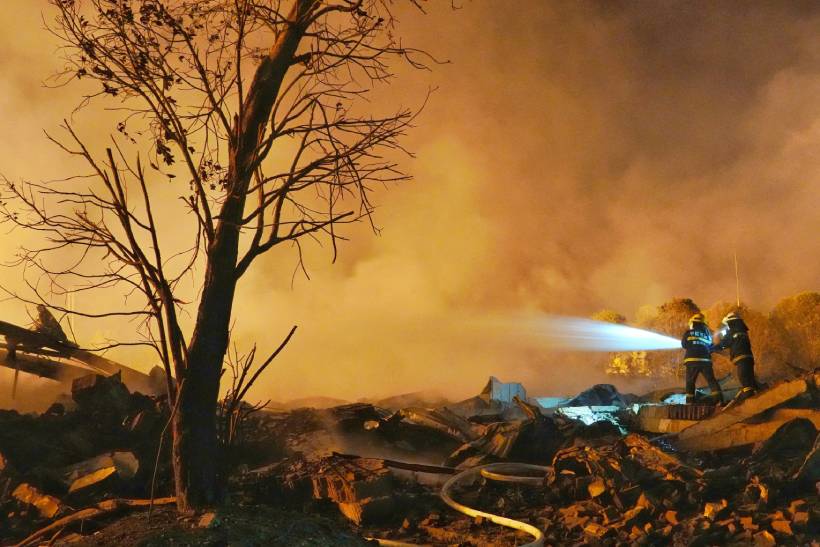
A powerful explosion at a fireworks manufacturing facility in Liuyang has killed at least 26 people and injured dozens more, according to Chinese state media. The blast occurred at a compound operated by Huasheng Fireworks Manufacturing and Display Company, sending shockwaves through nearby communities and triggering a large scale emergency response.
The incident has once again drawn national attention to industrial safety standards in China, where fireworks production remains a major but high risk industry.
Scale of the Disaster
The explosion flattened buildings within the factory complex and produced thick columns of smoke visible from a distance. Emergency teams deployed more than 1,500 personnel, including firefighters, medical workers, police officers, drones, and robotic units to search for survivors and secure the site.
Stay ahead of the geopolitical week.
MD Briefing delivers expert analysis across five global fronts — the Indo-Pacific, energy, geoeconomics, European security, and the Middle East — every Monday morning. Free.
Authorities evacuated surrounding areas due to concerns over remaining highly flammable materials, particularly black powder stored in nearby warehouses.
Government Response and Investigation
Chinese President Xi Jinping ordered a full investigation into the cause of the explosion and called for strict accountability. Local authorities confirmed that the factory owner has been detained while inquiries continue.
Officials in the region issued a rare public apology, expressing deep regret to victims and their families. The municipal government also ordered an immediate suspension of fireworks production across the city pending safety inspections.
A Region Known for Fireworks Production
Liuyang is widely recognized as one of the most important centers of fireworks manufacturing in China. The industry plays a significant economic role in the region, supporting hundreds of companies and contributing heavily to both domestic supply and global exports.
China as a whole dominates the global fireworks market, with exports exceeding one billion dollars annually. However, this industrial strength is paired with recurring safety concerns due to the handling of highly combustible materials.
Pattern of Industrial Accidents
This is not an isolated incident. Similar explosions have occurred in recent years in the same province and other parts of China, often involving fireworks or chemical production facilities. These incidents highlight ongoing risks linked to inadequate safety enforcement, hazardous storage practices, and high production pressure.
Safety Oversight and Political Pressure
Following the disaster, Chinese authorities announced broader safety inspections across multiple industrial sectors. The central government has emphasized strengthening risk monitoring systems and improving emergency preparedness.
Xi has repeatedly issued directives following major accidents, reinforcing a governance approach that places responsibility on local authorities to prevent systemic safety failures. These instructions often come after large scale disasters, reflecting both political accountability and central oversight mechanisms.
Analysis
The Liuyang explosion underscores a recurring tension in China’s industrial development model: rapid economic output versus workplace safety enforcement. Fireworks manufacturing, while economically significant, remains inherently hazardous due to the volatile nature of its materials.
Despite repeated incidents, similar accidents continue to occur, suggesting gaps in regulatory enforcement at the local level. The immediate political response, including detentions and public apologies, reflects a pattern of reactive governance following major disasters.
At a broader level, the tragedy highlights the challenge of maintaining industrial growth while ensuring adequate safety standards in high risk sectors. Without sustained structural improvements, such incidents are likely to recur, particularly in regions where hazardous industries are concentrated.
Ultimately, the explosion serves as a reminder that industrial scale and global market dominance do not eliminate underlying safety vulnerabilities. In sectors where risk is built into production itself, prevention depends not only on technology and regulation, but also on consistent enforcement and accountability.
With information from Reuters.
