


The Alaska Summit between U.S. President Donald Trump and his Russian counterpart Vladimir Putin took place on August 15, 2025. The outcome of the meeting was announced in a “vague” manner, yet it was clear regarding the fate of Ukraine in particular and Europe as a whole. Following the encounter between the Russian and American leaders, European nations held an “emergency” meeting with Ukraine, signaling that the “final glory” of the Old Continent had officially come to an end.
From past glory to present downfall
During their school years, students are thoroughly taught about Europe. The nations in this region were the first to carry out the great geographical discoveries of the 15th and 16th centuries. These voyages of discovery gave them a broader perspective — a global vision. From the 17th century onward, these countries entered their most glorious era, marked by their influence stretching across Asia, the Americas, and Africa. This region was also the stage for the world’s first international order–setting conference, which led to the Peace of Westphalia, ending the Thirty Years’ War that lasted from 1618 to 1648.
However, European nations gradually brought their own glory to a close with harsh realities. In World War I, the belated involvement of the United States helped bring the conflict to an end in favor of the Allied Powers. In World War II, America’s participation once again proved decisive in concluding the global war. Although European countries emerged as victors in both wars, they quickly fell under U.S. influence, as Washington provided them with loans for national reconstruction as well as to cover wartime expenses. This dependence on the United States became even more evident as these nations entered into the ideological confrontation with the Soviet Union and the Eastern Bloc.
After the Cold War, European nations saw their influence seriously weakened as they became America’s “supporters” in the war in Afghanistan. In 2015, the migration crisis erupted, exposing sharp disagreements over the admission of people fleeing humanitarian crises triggered by ethnic and religious conflicts in the Middle East and Africa. In 2016, the crisis reached its peak when the United Kingdom left the European Union in the Brexit event, marking clear divisions among member states. During the years of the Covid-19 pandemic, many European countries ranked among those with the highest death tolls worldwide. The defense industry, once considered the “backbone” of nations in the region through the development of various weapons and equipment widely used in wars and conflicts both regionally and globally, also suffered setbacks and has since been unable to recover its former strength.
Stay ahead of the geopolitical week.
MD Briefing delivers expert analysis across five global fronts — the Indo-Pacific, energy, geoeconomics, European security, and the Middle East — every Monday morning. Free.
After five centuries of development, Europe is closing the chapter on its past “glory.” The nations of the region are increasingly divided internally due to disagreements over their developmental direction. The first term of President Donald Trump, from 2016 to 2020, revealed the passivity of these countries. Trump’s imposition of tariffs on many European goods served as a wake-up call for these nations regarding their long-standing ally.
Trump–Putin Talks in Alaska: Europe Officially Reduced to a Supporting Role
Donald Trump’s return to the White House for a second term has left European leaders pessimistic about the prospects of future cooperation with the United States. Following his election victory, Trump declared that the central focus of his second term would be to end the Russia–Ukraine conflict, which he argued had wasted America’s resources under his predecessor, Joe Biden. Russia has long been a primary concern for both European nations and the United States due to its vast territorial size and global influence, particularly as the continent’s heating energy supply largely originates from Moscow. Military power is another major source of concern, as Russia remains one of the world’s leading holders of nuclear warheads.
On August 15, 2025, the meeting between Donald Trump and his Russian counterpart Vladimir Putin took place. This encounter between the two leaders can be seen as the final punctuation mark ending five centuries of European glory, as these nations were reduced to supporting actors on their very own “home stage.” The ambiguity surrounding the outcome of Trump’s agreement also unsettled European countries, as Trump in the past had been known for his shocking and blunt statements—at times so uncompromising that even partners and allies could not accept them.
Prior to this, European nations had attempted to increase their influence in Ukraine by providing financial aid and modern weaponry, and by establishing a “Coalition of the Willing” to bolster the legitimacy of their involvement in the Ukrainian situation. Yet the creation of this “Coalition of the Willing” was nothing more than a fragile and feeble signal of Europe’s efforts to defend its “home turf.” In parallel, these nations also turned toward China, America’s foremost rival.
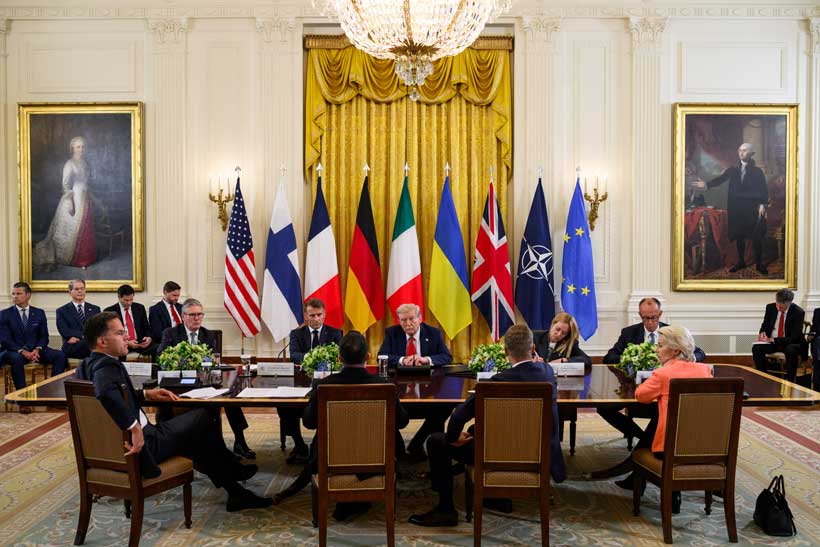
On August 18, 2025, local time, Ukrainian President Volodymyr Zelensky met with his counterpart Donald Trump in Washington, D.C. Many European leaders also “rallied” alongside Zelensky in the United States in an effort to pressure Trump. During the talks, President Trump unexpectedly halted the meeting to hold a phone call with Russian President Vladimir Putin. Beyond the security commitments for Ukraine and other related issues, this U.S.–Russia conversation marked the moment Europe lost its standing as a player in the regional and global political chessboard.
It is evident that Europe has gradually lost its position as a leader of the global order. Five centuries of development have been replaced by a continent marked by instability and division. European nations no longer hold true autonomy and are likely to continue sliding deeper into internal crises. Reform—beginning with a shift in mindset—must be the foremost priority in any transformation, enabling European countries to reposition their development strategies and foreign policies in the face of a new international order that is steadily taking shape.
