

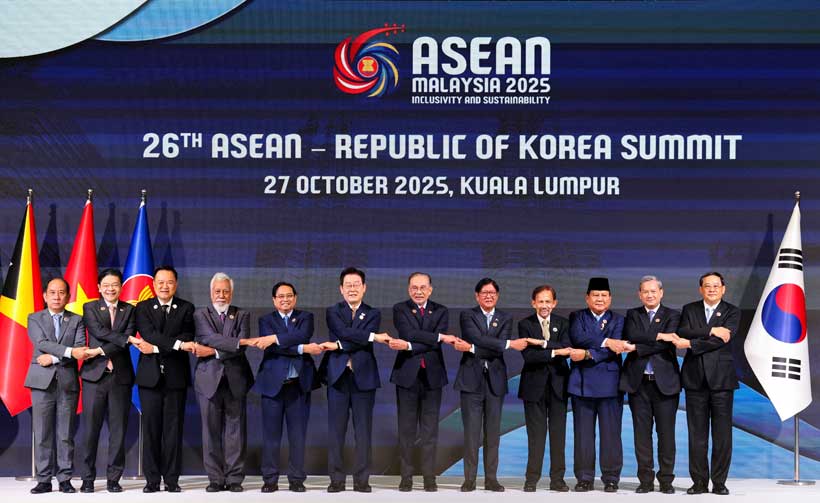
The Association of Southeast Asian Nations (ASEAN) Summit that opened in the Philippines on 7 May 2026 placed energy security at the center of the regional agenda. With oil flows through the Strait of Hormuz still disrupted by the Iran war, leaders pushed for faster ratification of the ASEAN Petroleum Security Agreement and renewed calls for the long-promised ASEAN Power Grid (APG). For more than two decades, the ASEAN Plan of Action for Energy Cooperation (APAEC) has carried the same message. Integration is the answer to insecurity. Yet a closer reading of how member states are actually behaving on the energy file points in the opposite direction. The renewable transition, far from binding the region together, is quietly pulling it apart.
The integrationist case has been made for half a century. Brunei’s oil, Myanmar’s gas, and Indonesia’s coal flow across borders because reserves and demand centers rarely sit in the same place. Renewables, the argument goes, deepen this logic. Solar irradiance is uneven, wind regimes are seasonal, and balancing a high-renewables grid demands geographic diversity. Singapore alone now plans to import around 6 gigawatts (GW) of low-carbon electricity by 2035, up from an earlier target of 4 GW. Phase 2 of the multilateral power integration project linking Lao PDR, Thailand, Malaysia, and Singapore (LTMS-PIP) doubled trading capacity to 200 megawatts (MW) in September 2024. These are real projects with real megawatts. They are also, on close inspection, telling a different story from the one being told above them.
Renewables are not behaving like fossil fuels. They are modular, divisible, and, crucially, manufacturable. A country that lacks gas reserves cannot will them into existence. A country that lacks solar panels can build a factory. The political economy of clean energy, therefore, points in two directions at once. It pulls towards integration where geography demands it, but towards autonomy wherever it does not. Across Southeast Asia, governments are increasingly choosing the latter.
Indonesia shows the pattern most clearly. Under the Local Content Requirement regime known as Tingkat Komponen Dalam Negeri (TKDN), Jakarta has steadily tightened the rules on what counts as an Indonesian solar module. Solar TKDN achievement rose from 47.28 percent in 2023 to 86.81 percent in 2024, with a mandated threshold of 60 percent from 2025. As the Institute for Essential Services Reform (IESR) noted at the Indonesia Solar Summit in September 2025, the country’s solar module production capacity has reached roughly 11.7 GWp per year. The numbers have already reshaped corporate behavior. In June 2025, China’s LONGi, the world’s largest solar module manufacturer, opened a 1.6 GW production facility in West Java with state-owned Pertamina New Renewable Energy, in part because importing finished modules into Indonesia had become commercially unworkable. Even the planned 3.4 GW renewable electricity export from Indonesia to Singapore, the most-cited symbol of regional integration in 2025, is being designed with the 60 percent TKDN requirement built in. What is being negotiated, in effect, is the price of sovereignty.
A defender of the integrationist view will reach for LTMS-PIP and the eleven cross-border import projects that Singapore has approved from Australia, Cambodia, Indonesia, Vietnam, and Sarawak. The transactions are real. So is the political logic underneath them. Each exporting jurisdiction is using these deals to anchor domestic processing capacity, local content rules, or state-owned utility ownership. Sarawak Energy is structuring its proposed 1 GW Singapore export around its own hydroelectric assets. Vietnam is conditioning its planned export on domestic equipment. The pattern is not the absence of integration. It is integration shaped, line by line, by sovereign preference.
Three deeper pressures are driving this re-bordering, and they reinforce each other. The first is technological. Rooftop solar, behind-the-meter storage, and decentralized micro-grids are reshaping the very unit of energy planning, and as global solar module prices fell by more than half between 2022 and 2024, the opportunity cost of cross-border dependence has risen fast. A megawatt of imported electricity is fungible with a megawatt generated on a Jakarta rooftop, but it carries political costs the latter does not, including exposure to a foreign supplier, pricing in a foreign currency, and vulnerability to a transit state. Industrial policy compounds the effect, because the clean transition is also a manufacturing race in which ASEAN states are competing rather than coordinating. Vietnam’s solar push, Malaysia’s electric-vehicle (EV) battery ambitions, Thailand’s tax breaks for green tech, and Indonesia’s TKDN regime are not complementary. Each capital is chasing the same value chains.
Behind both lies a third force, resource nationalism. The materials underpinning the transition, including nickel, copper, and rare earths, have moved to the center of national-security planning across the region. Indonesia’s 2020 ban on raw nickel exports, designed to force investment into domestic processing, was the template, and the Philippines has tightened its mining permit regime since. The International Energy Agency (IEA) projects mineral demand for clean-energy technologies to quadruple by 2040. As demand surges, more states will treat domestic processing as a precondition of export. None of this is integration logic.
The diagnosis matters because it implies the policy response is misdirected. Most ASEAN energy diplomacy still invests its political capital in physical infrastructure, including cables, pipelines, and interconnectors. These are slow, expensive, and politically vulnerable. They assume a willingness to lock in dependence that several capitals no longer possess. Even with LTMS-PIP doubled, the project still moves only 200 MW in a region whose peak demand is measured in hundreds of gigawatts. The financing burden is also formidable. The ASEAN Center for Energy estimates the APG alone will require around USD 21 billion in annual investment between 2026 and 2030. There is no realistic appetite for that, especially in a fiscal environment shaped by post-pandemic debt and the Iran-driven oil shock.
The real frontier of integration is regulatory, and ASEAN is barely engaged in it. Green-electricity certificates, carbon-accounting interoperability, mutual recognition of renewable-energy guarantees of origin, and harmonized standards for battery materials and grid-scale storage are all areas where European and Northeast Asian frameworks are racing ahead. If ASEAN does not move soon, its members will integrate not with each other but with whichever external standard-setter moves first. Brussels is already building that dependence through the Carbon Border Adjustment Mechanism (CBAM). Tokyo is doing it through its Asia Zero Emission Community (AZEC). Beijing is doing it through its expanding green-finance taxonomy. Regional integration would then become, paradoxically, an instrument of external dependence.
None of this argues against the ASEAN Power Grid. Where geography is decisive, such as in the Mekong hydro corridor, the Borneo to Peninsula linkage, or the Indonesia and Singapore renewables trade, physical integration remains valuable. But it should be pursued as a complement to, not a substitute for, regulatory integration. A practical agenda for the next ASEAN Energy Ministers Meeting (AMEM) would include three items. The first is a regional renewable-energy certificate scheme that is technically interoperable with Europe’s I-REC framework and Japan’s J-Credit system. The second is a common methodology for tracing the carbon content of cross-border electricity, which would let CBAM-exposed exporters in Vietnam and Indonesia avoid duplicating compliance. The third is mutual recognition of critical minerals certification, so that Indonesian nickel does not face one set of standards in Tokyo and another in Brussels. None of these requires a single new pylon, and each is compatible with the sovereignty instinct now driving regional capitals. Together, they would let countries integrate markets without surrendering grids.
The choice the region faces is not between integration and fragmentation, but between two kinds of integration. The first is a steel-and-concrete model that asks states to surrender energy sovereignty. The second is a standards-and-protocols model that lets them keep it. The first is what ASEAN keeps promising at its summits. The second is what its members are already building through their domestic policies, whether by design or by default. The Manila gathering will not resolve this gap. Recognizing that it exists, however, and closing it deliberately rather than by drift, is the energy diplomacy challenge of the next decade for Southeast Asia.