



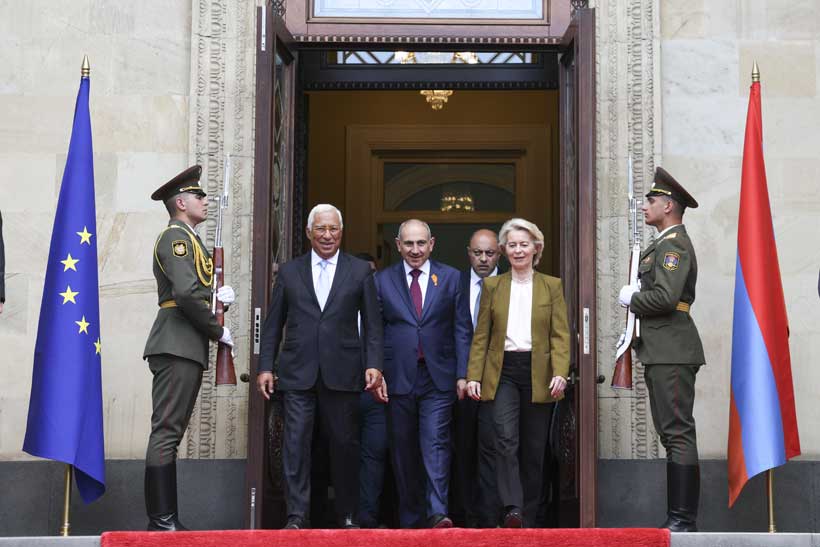
Much has been said about France’s engagement in Armenia, and for good reason. Paris has been one of the most visible European actors in the South Caucasus and has clearly positioned itself as a key supporter of Armenia within Europe.
But if we want to understand where European foreign policy is really heading, it is not enough to focus only on the most visible players. The European Political Community summit in Yerevan offered a broader and more revealing picture.
One of the more interesting interventions came from Italian Prime Minister Giorgia Meloni. Not because Italy is trying to compete with France in the region, but because of the way she framed Europe’s current challenges.
These summits matter for that reason. They are not just diplomatic gatherings. They show how European leaders interpret global instability, how they connect domestic priorities with foreign policy, and how different strategic instincts coexist within the same European framework.
Meloni’s central concept was Europe’s “polycrisis”—the idea that the continent is not dealing with separate problems but with crises that are deeply connected.
Migration, security, energy dependence, economic competitiveness, and democratic resilience cannot, in her view, be treated as separate policy areas.
That argument matters because Europe has traditionally treated them as separate files. Migration was seen as border control. Energy as an economic issue. Democracy as an institutional question. Technology as a digital or innovative debate.
But the reality, increasingly, is that these issues interact.
Migration pressures can quickly turn into security concerns. Security instability weakens economic confidence. Economic pressure fuels political frustration. That frustration then erodes trust in institutions, creating space for further instability, including through new technological tools.
What stands out in the Italian approach is this more integrated way of looking at vulnerability. Italy’s emphasis on a “360-degree approach”—combining security, development, and energy cooperation with neighboring regions—is not new, but it was clearly reinforced in Yerevan.
Meloni also noted that Europe may need to strengthen its own defense capabilities, particularly if the United States adjusts its military presence in Europe. In that context, regions like the South Caucasus are increasingly seen not just through a diplomatic lens, but also in terms of energy diversification and long-term stability.
This is where Italy’s perspective differs slightly from France’s. France has tended to take a more direct political and security-driven approach in Armenia, with strong symbolic engagement. Italy’s framing is broader and more structural, linking regional stability to energy security, resilience, and Europe’s wider strategic position.
Both approaches are significant. Together, they show how European foreign policy is shaped not by a single vision, but by different national strategic cultures operating side by side.
Meloni’s comments on European defense reinforced that point. She spoke about the need to strengthen Europe’s capabilities and strategic autonomy, especially if the United States recalibrates its military role in Europe.
At the same time, she was careful to restate Italy’s commitment to NATO and the transatlantic alliance. That balance reflects a wider European position: building more capacity within Europe without breaking away from the United States.
The Yerevan summit was a reminder that European foreign policy does not come from one center. It is built through the interaction of different national perspectives, shaped by history, geography, and domestic politics.
Understanding where Europe is going means paying attention to all of them—not only the most prominent voices, but also the quieter shifts in how countries like Italy are beginning to frame the world.
