


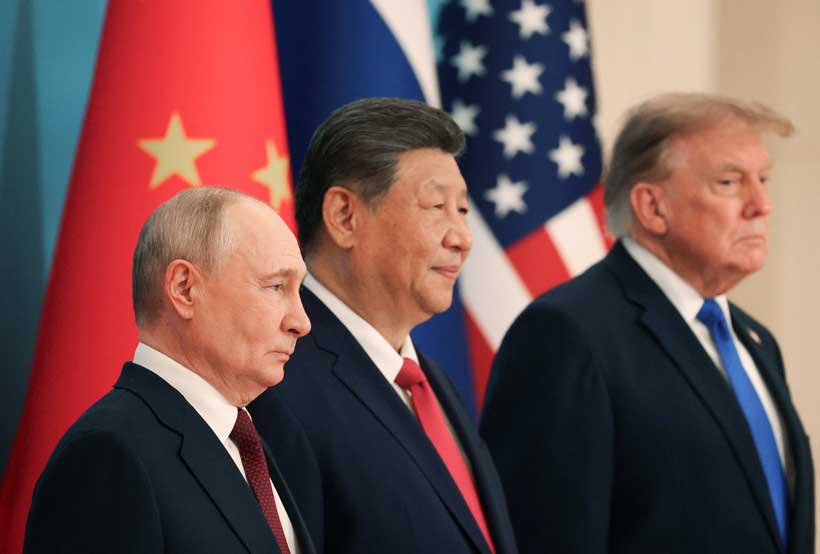
US President Donald Trump, Chinese President Xi Jinping and Russian President Vladimir Putin have agreed to a joint peace declaration following an unprecedented trilateral meeting in China’s southern city of Shenzhen, pledging to prevent nuclear war and strengthen international cooperation.
The declaration, released by China’s state news agency Xinhua and the Kremlin, outlines commitments to nuclear restraint, reforms of the United Nations, increased supplies of refined petroleum products and the protection of state officials’ immunity in international courts.
The agreement marks a significant diplomatic moment, bringing together the leaders of the world’s three largest nuclear powers. However, deep disagreements over Ukraine, Iran, trade and military competition raise questions about whether the declaration will translate into lasting cooperation.
Three Leaders Pledge to Prevent Nuclear War
The declaration’s most significant commitment concerns nuclear weapons, with the three leaders reaffirming that a nuclear war should never be fought.
Stay ahead of the geopolitical week.
MD Briefing delivers expert analysis across five global fronts — the Indo-Pacific, energy, geoeconomics, European security, and the Middle East — every Monday morning. Free.
Nuclear arms control was among Trump’s priorities for the meeting, although China has repeatedly resisted joining negotiations with Washington and Moscow, whose nuclear arsenals are considerably larger.
Speaking at the beginning of the trilateral meeting, Trump acknowledged the difficulty of nuclear disarmament, telling Xi and Putin that giving up nuclear weapons was not an easy undertaking.
The declaration also commits the three countries to encouraging political and diplomatic solutions to international conflicts.
Xi emphasised that major powers should maintain peaceful relations, arguing that cooperation among powerful states contributes to international stability, while confrontation risks broader turmoil.
UN Reforms and International Legal Immunity
Beyond nuclear security, the declaration includes commitments to advancing reforms of the United Nations and increasing the availability of refined petroleum products to countries worldwide.
The leaders also pledged to uphold the immunity enjoyed by state officials in international courts, an issue with significant implications for international law and relations between governments.
These commitments reflect shared interests in maintaining state sovereignty and influencing the rules governing international institutions.
However, the declaration does not eliminate differences over how international law should be applied or how global institutions should respond to conflicts involving major powers.
Ukraine and Iran Expose Differences Among the Three Powers
Despite the declaration’s emphasis on peace, the three governments remain divided over several major international conflicts.
Putin referred directly to Ukraine, saying the three countries shared numerous interests in resolving regional conflicts, including the war involving Russia.
Xi avoided directly mentioning Ukraine, while emphasising the importance of cooperation among major powers.
The differences are significant. Washington and Moscow remain divided over the conditions for ending the war, while Beijing has maintained close relations with Russia without joining Western sanctions.
Iran also presents a difficult issue. Trump said he and Xi shared concerns about maintaining the flow of oil through the Strait of Hormuz, which has been disrupted by the conflict.
However, Xi did not directly address Iran in his public remarks.
He instead called on the three countries to encourage parties involved in conflicts to pursue negotiations and resolve disputes through diplomatic means.
The declaration therefore establishes a broad commitment to dialogue without demonstrating that the three powers have reached common positions on individual conflicts.
Taiwan and Japan Complicate China’s Regional Security Agenda
The summit also unfolded against growing tensions in East Asia, particularly over Taiwan and China’s deteriorating relations with Japan.
Japanese Prime Minister Sanae Takaichi attended the APEC gathering but appeared diplomatically isolated compared with the attention given to Trump.
Relations between Tokyo and Beijing have deteriorated since Takaichi’s 2025 remarks suggesting Japan could deploy its military if a Chinese move against Taiwan threatened Japanese territory.
Takaichi maintained that Japan’s position on Taiwan had not changed since 1972.
Meanwhile, Japan and Taiwan reported Russian military aircraft incursions during the week, highlighting Moscow’s continuing ability to project military power in the region despite its involvement in Ukraine.
During his meeting with Trump, Xi also urged Washington to handle the Taiwan issue carefully to avoid damaging bilateral relations.
These developments demonstrate that the summit’s emphasis on cooperation among major powers exists alongside unresolved regional security tensions.
Trade and Technology Competition Remain Major Obstacles
Economic competition also remains a significant source of disagreement between Washington and Beijing.
The trilateral meeting followed an extension of the US-China trade truce, but tensions persist over American restrictions on advanced semiconductor exports and allegations that Nvidia chips have been diverted to China through Southeast Asian countries.
The issue raises questions about the effectiveness of Washington’s export controls and Beijing’s access to advanced computing technology.
Earlier at the Asia-Pacific Economic Cooperation summit, Xi criticised Western protectionism and called for free and open trade. Putin also condemned Western sanctions, emphasising Russia’s contribution to regional food and energy security.
The United States and its Western partners, meanwhile, continue to argue that China’s industrial policies contribute to global trade imbalances.
These competing economic priorities could limit the scope of cooperation despite the leaders’ public commitment to improved relations.
What the Peace Declaration Means for the International Order
The declaration represents an important diplomatic development because it brings together three governments with considerable influence over global security, nuclear deterrence, energy markets and international institutions.
For Trump, the agreement offers an opportunity to demonstrate diplomatic engagement with both Beijing and Moscow. Xi gains an opportunity to reinforce China’s position in international diplomacy, while Putin benefits from a high-profile engagement that challenges perceptions of Russia’s diplomatic isolation.
However, the declaration’s broader significance will depend on whether its commitments lead to practical cooperation.
Its emphasis on nuclear restraint, UN reform and diplomatic conflict resolution provides a framework for engagement, but the three countries continue to hold fundamentally different positions on several major international issues.
The agreement therefore marks a diplomatic opening rather than evidence of a new strategic alliance.
Ultimately, the central question is whether Washington, Beijing and Moscow can translate their shared commitment to preventing global instability into concrete action, particularly when their own security and economic interests collide.
With information from Reuters.
