


Qatar’s decision to secure long-term supplies of liquefied natural gas (LNG) from the United States signals a significant shift in global energy markets. The world’s second-largest LNG exporter is increasingly looking beyond its own production capacity to protect itself against geopolitical instability in the Gulf, particularly the risks associated with the Strait of Hormuz.
QatarEnergy last week signed a 20-year agreement to purchase 3 million metric tons per year (mtpa) of LNG from Woodside Energy’s facilities in Louisiana. The deal followed earlier agreements with US producer Cheniere Energy for up to 4 mtpa from its Sabine Pass and Corpus Christi facilities through 2054.
Deliveries under the contracts are expected to begin in 2030 and 2031. Together, the agreements will make Qatar the largest buyer of US LNG.
QatarEnergy chief executive Saad al-Kaabi has also indicated that the company expects to sign further supply agreements with US and other international producers this year, potentially securing millions of tons of LNG from overseas sources for decades.
Stay ahead of the geopolitical week.
MD Briefing delivers expert analysis across five global fronts — the Indo-Pacific, energy, geoeconomics, European security, and the Middle East — every Monday morning. Free.
Qatar had already been expanding its international investments before the US-Iran war began on February 28. The state-owned energy company was acquiring stakes in LNG projects across North America and Africa to diversify its trading portfolio and improve its flexibility.
The latest agreements, however, reflect a deeper strategic calculation. Qatar is not simply expanding its international business. It is seeking protection against disruptions to its own exports by securing access to production facilities outside the Gulf.
The shift also highlights how the United States has emerged as a major beneficiary of changing perceptions of Middle Eastern energy security.
Bob McNally, founder and president of Rapidan Energy Group and a former White House energy adviser under President George W. Bush, recalled that US officials once worried about Washington becoming as dependent on Qatar for LNG as it was on OPEC for oil.
The shale revolution and the Iran war have dramatically changed that relationship. Qatar, once seen as a potential supplier on which the United States might depend, is now purchasing American gas.
US LNG becomes an insurance policy against Hormuz disruption
The Strait of Hormuz has become central to Qatar’s energy security calculations as Washington and Tehran continue to dispute the future of the strategic waterway.
Before the war, roughly one-fifth of global energy supplies passed through the strait. Its vulnerability has prompted Gulf producers to reconsider how they transport energy to international markets.
Saudi Arabia and the United Arab Emirates are expanding or preparing to expand pipeline networks that allow them to export crude oil and refined fuels without relying entirely on Hormuz.
Qatar faces a considerably more difficult challenge because it has no viable alternative route for exporting LNG.
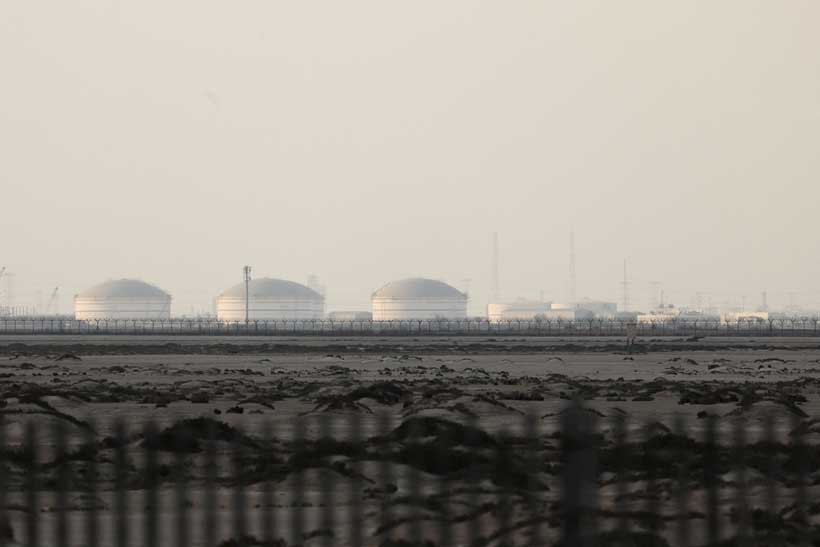
The country’s entire LNG industry is concentrated at the enormous Ras Laffan facility, where gas extracted from the North Field is processed before being shipped to customers worldwide. This concentration makes Qatar’s export capacity particularly vulnerable to disruptions in the Gulf.
The risks became clear in March, when an Iranian missile damaged two of QatarEnergy’s 14 LNG production trains at Ras Laffan. The damage removed approximately 17% of the country’s export capacity.
QatarEnergy estimated that the disruption would cost around $20 billion annually in lost revenue, with repairs expected to take approximately three years.
Developing alternative export infrastructure would require tens of billions of dollars in investment in pipelines and liquefaction facilities. Even such an expansion would not necessarily eliminate security risks, since additional energy infrastructure could itself become a target during future conflicts.
Qatar’s decision to secure overseas supplies therefore offers a different approach. Instead of relying exclusively on building more infrastructure at home, the country is diversifying the geography of its energy production and supply.
Qatar and the United States face a growing LNG rivalry
The timing of Qatar’s agreements is particularly significant because the country is preparing for its largest expansion of LNG production in decades.
The International Energy Agency estimates that approximately 300 billion cubic metres of new LNG export capacity will become available globally between 2025 and 2030, increasing total supply capacity by around 50%.
The United States is expected to account for more than half of this expansion, while Qatar is projected to contribute roughly another quarter.
This will place the two countries at the centre of the next phase of global LNG trade, intensifying competition for international customers and market share.
Qatar retains an important competitive advantage in production costs. Industry estimates put its LNG production costs at approximately $3 to $5 per million British thermal units, around half the cost of many US projects.
However, the United States has a different advantage: its LNG exports are not dependent on the Strait of Hormuz. For buyers increasingly concerned about geopolitical disruption, that distinction is becoming more important.
Energy markets have traditionally placed considerable emphasis on price and production costs. The Iran war has demonstrated that the security of supply can be just as important when countries make long-term purchasing decisions.
Consequently, US LNG may become more attractive to buyers seeking to reduce exposure to geopolitical risks, even when alternative suppliers offer lower production costs.
Can Qatar protect its LNG expansion from regional instability?
Qatar’s international purchasing strategy comes as it prepares to nearly double its LNG production capacity by 2030. The first new production trains are expected to begin operating early next year.
The central challenge is no longer simply whether Qatar can achieve its expansion targets. It is whether the country can maintain reliable operations and deliver its growing LNG volumes in an increasingly unstable regional environment.
Even if Washington and Tehran eventually reach a sustainable agreement, the Iran war may have permanently changed how energy markets assess the Strait of Hormuz. The assumption that the waterway will always provide reliable access to international markets has become much harder to maintain.
For Qatar, this creates a difficult strategic position. It remains one of the world’s most cost-competitive LNG producers and is preparing to expand its production substantially. Yet its dependence on a single export route exposes it to risks that additional domestic production alone cannot resolve.
Purchasing US LNG provides a way to maintain access to international supply networks while reducing dependence on facilities and shipping routes exposed to Gulf instability. It also gives Qatar an opportunity to benefit from growing demand for energy supplies perceived as more secure.
The wider implications extend beyond Qatar’s commercial strategy. The Iran conflict has accelerated a shift in global energy calculations, strengthening the position of the United States as a major LNG supplier while forcing Gulf producers to reconsider their exposure to regional security threats.
Qatar’s decision to buy gas from its growing competitor is therefore more than a commercial arrangement. It reflects an emerging energy order in which geographic diversification and security of supply are becoming as important as production capacity and price.
With information from Reuters.
