


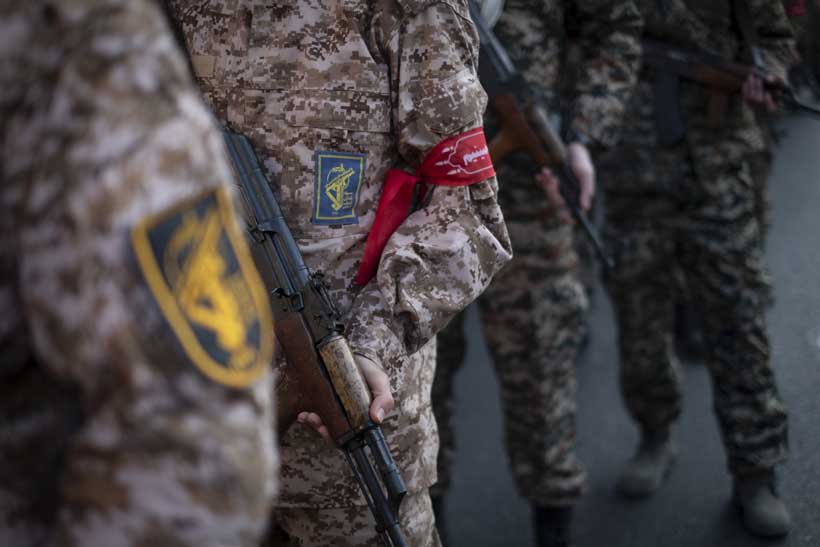
The United States military launched a two-hour operation against dozens of Islamic Revolutionary Guard Corps (IRGC) targets across Iran early Thursday, marking another significant escalation in the expanding Middle East conflict.
According to U.S. Central Command (CENTCOM), the strikes targeted military command centres, drone facilities, and other strategic assets after Iran fired ballistic missiles at U.S. forces stationed in Jordan. Washington said the operation was intended to reduce threats posed by Iran and its regional allies to American personnel, commercial shipping, and Gulf states.
Iranian state media reported that at least three people were killed in the attacks on Qeshm Island, while Jordan confirmed it intercepted five Iranian missiles aimed at its territory.
Regional Conflict Expands
The latest strikes followed joint U.S.-Saudi military operations against Iran-backed armed groups in eastern Iraq. The attacks were launched in response to drone strikes on Saudi oil infrastructure and marked the first publicly acknowledged military operation conducted jointly by Washington and Riyadh during the conflict.
Stay ahead of the geopolitical week.
MD Briefing delivers expert analysis across five global fronts — the Indo-Pacific, energy, geoeconomics, European security, and the Middle East — every Monday morning. Free.
Elsewhere, a fire broke out aboard a U.S.-owned gas storage tanker at Egypt’s Mediterranean port of Damietta after what British maritime security firm Ambrey assessed as a drone strike. Egyptian authorities confirmed the fire but did not identify its cause.
These incidents indicate that the conflict is increasingly spreading beyond Iran and Israel, drawing additional regional actors into an already volatile security environment.
Hormuz Remains the Main Flashpoint
The Strait of Hormuz continues to be the central source of confrontation between Iran and the United States.
Iran has maintained that it controls the strategic waterway and confirmed it targeted three commercial tankers attempting to transit what it described as an unauthorized route. Tehran also rejected an Omani proposal backed by Gulf states to establish a joint management mechanism for the strait.
With roughly one-fifth of global oil and liquefied natural gas shipments historically passing through Hormuz, uncertainty surrounding maritime security continues to influence global energy markets.
Oil prices surged more than 8% on Wednesday before easing slightly on Thursday, reflecting investor concerns over potential supply disruptions.
Iraq Condemns Military Operations
In Iraq, Iran-backed Popular Mobilisation Forces reported that at least 20 fighters were killed and dozens wounded in the U.S.-Saudi strikes. Demonstrators chanted anti-American slogans while carrying the bodies of those killed.
The Iraqi presidency condemned the attacks as a violation of Iraqi sovereignty while simultaneously calling for armed groups to halt attacks against neighboring countries.
Reports from Iranian media also suggested that several Revolutionary Guard advisers were killed during the strikes in Iraq.
Diplomatic Efforts Continue
Despite the military escalation, President Donald Trump has maintained that the United States remains interested in pursuing a negotiated settlement with Iran.
Saudi officials reportedly urged the Trump administration to avoid widening the conflict further by targeting Yemen’s Houthis or launching additional attacks against Iran-backed militias, warning that further escalation could trigger broader regional instability.
Analysis
The latest U.S. strikes demonstrate that Washington is shifting from defensive interception to sustained military pressure against Iran’s military infrastructure and regional proxy network. Rather than remaining confined to Iran itself, the conflict now spans Iraq, Jordan, the Gulf, and key maritime routes, increasing the risk of a wider regional confrontation.
The Strait of Hormuz remains the strategic center of the crisis. As long as Iran continues to challenge freedom of navigation and rejects compromise proposals, global energy markets are likely to remain volatile. Meanwhile, the unprecedented public participation of Saudi Arabia in joint military operations signals a deeper regional alignment against Iranian influence.
Although diplomatic channels remain formally open, repeated cycles of retaliation suggest that negotiations are increasingly being overshadowed by military developments. Unless both sides reach a compromise over maritime security and regional proxy activities, the conflict risks evolving into a prolonged regional security crisis with significant geopolitical and economic consequences.
With information from Reuters.
