


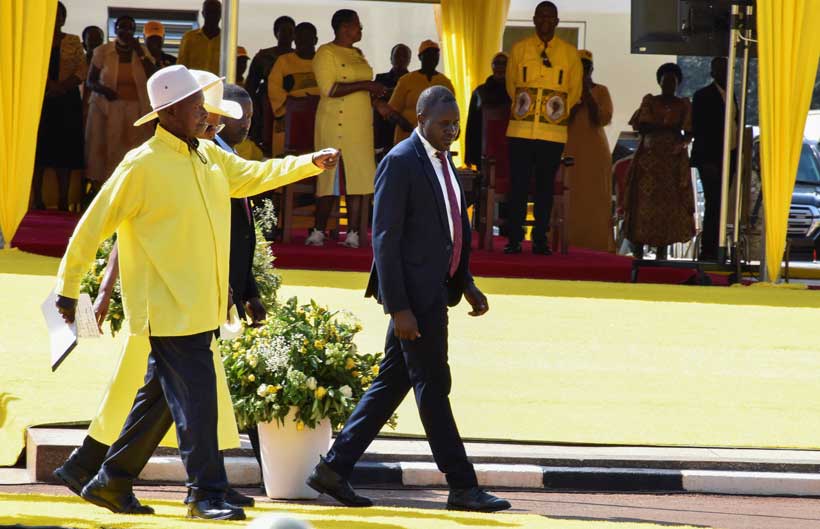
Yoweri Museveni has signed a controversial new law aimed at restricting foreign influence in Uganda, despite warnings from economic institutions and international organizations about potential risks to investment and development funding.
The legislation, known as the Protection of Sovereignty law, introduces strict rules on foreign linked activities, requiring individuals and organizations acting on behalf of external interests to register with authorities. It also criminalizes actions seen as promoting foreign interests over national priorities.
The law includes penalties of up to ten years in prison and significant financial fines for violations.
Key Provisions of the Law
The new legal framework targets a wide range of activities involving foreign influence. It restricts participation in policy development by individuals or groups linked to external interests unless they have government approval.
Stay ahead of the geopolitical week.
MD Briefing delivers expert analysis across five global fronts — the Indo-Pacific, energy, geoeconomics, European security, and the Middle East — every Monday morning. Free.
It also requires mandatory registration for foreign agents and places legal limits on advocacy or policy work connected to international organizations or donors.
Critics argue that the language of the law is broad and could be applied to routine development, humanitarian, or governance support activities.
Economic and Institutional Concerns
Uganda’s central bank governor, Michael Atingi Ego, has warned that the law could reduce foreign financial inflows and weaken the country’s foreign exchange position.
He described the potential outcome as an economic disaster scenario if donor funding, investment, and development support are significantly reduced.
The World Bank has also raised concerns, stating that the law could expose a wide range of development work to criminal liability and create uncertainty for international partners.
Political Context
President Museveni, who has ruled Uganda since 1986, has frequently criticized what he describes as foreign interference in domestic politics.
Supporters of the law argue it is intended to strengthen national sovereignty and reduce external political pressure. However, opposition figures and civil society groups see it as part of a broader effort to tighten political control.
Analysis
The law reflects a growing global trend where governments are reasserting control over foreign funded political and development activity under the framework of sovereignty and national security.
While such measures may strengthen state authority, they also risk discouraging foreign investment, reducing aid flows, and increasing regulatory uncertainty for international organizations operating in the country.
For Uganda, the key challenge will be balancing political control with economic dependence on external financing. If foreign capital and development support decline, the law could have unintended consequences for growth, fiscal stability, and long term development planning.
The broader implication is a tightening global environment for cross border influence, where political sovereignty concerns are increasingly shaping economic policy decisions.
With information from Reuters.
