


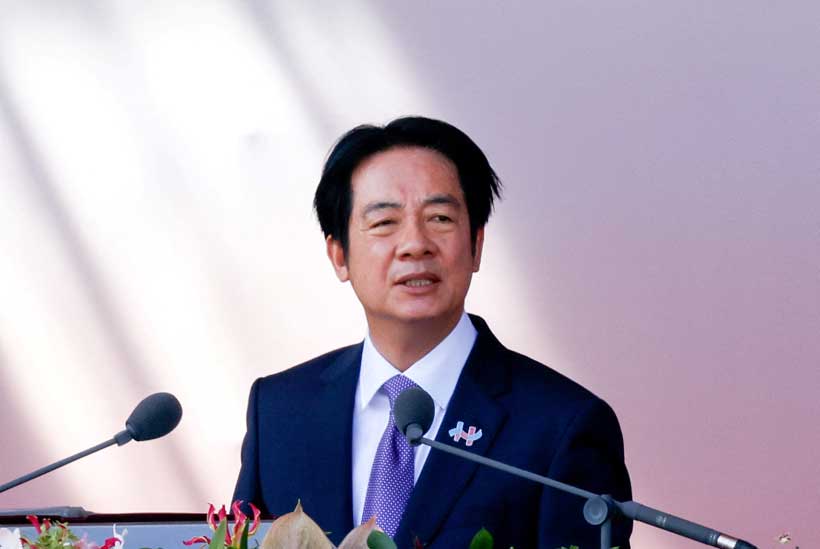
Taiwan has expressed openness to a direct conversation between US President Donald Trump and Taiwanese President Lai Ching te, following heightened diplomatic attention after Trump’s recent summit with Chinese leader Xi Jinping in Beijing.
The discussion comes amid renewed sensitivity over Taiwan’s political status and security, an issue that remains one of the most contested points in US China relations. During the summit, Taiwan was reportedly discussed, with Xi warning of potential conflict if the issue is not handled carefully.
Trump made several public comments on Taiwan following the meeting, including uncertainty over future arms sales and remarks interpreted as cautious on Taiwan independence.
Why the Issue Matters Now
A direct call between a US president and Taiwan’s leader would be highly significant, as no such conversation has taken place since Washington switched diplomatic recognition from Taipei to Beijing in 1979.
Stay ahead of the geopolitical week.
MD Briefing delivers expert analysis across five global fronts — the Indo-Pacific, energy, geoeconomics, European security, and the Middle East — every Monday morning. Free.
Taiwan relies heavily on the United States for security support and arms supplies, making US political signaling on the issue highly consequential for regional stability.
Taiwanese officials said recent remarks had created some uncertainty domestically, even as the government maintains that its core policy position has not changed.
Taiwan Diplomatic Position
Taiwan’s foreign ministry indicated that it would welcome a direct conversation if the opportunity arises, while also seeking clarity on Washington’s intentions.
Officials emphasized that Taiwan continues to view its relationship with the United States as stable, even amid shifting rhetoric following high level US China engagement.
Taipei reiterated that its political future must be determined by its own population, rejecting Beijing’s sovereignty claims.
US China Taiwan Triangle
The situation reflects the broader strategic competition between United States and China, where Taiwan remains a central geopolitical flashpoint.
Beijing considers Taiwan part of its territory, while Washington maintains a policy of strategic ambiguity, supporting Taiwan’s defense capabilities without formally recognizing it as an independent state.
Analysis
The possibility of direct engagement between Trump and Lai would represent a notable diplomatic signal, even if symbolic in nature. It would likely be interpreted differently by Washington, Taipei, and Beijing, each of which assigns distinct strategic meaning to Taiwan related communication.
For Taiwan, such contact would reinforce political visibility and strengthen informal ties with its key security partner. For the United States, it could serve as a calibrated message of support while still avoiding formal diplomatic recognition.
However, it also carries escalation risks. Any perceived shift in US Taiwan engagement often triggers strong reactions from Beijing, increasing regional tension.
Overall, the development highlights how Taiwan remains a central pressure point in US China relations, where even limited diplomatic gestures can have outsized geopolitical impact.
With information from Reuters.
