


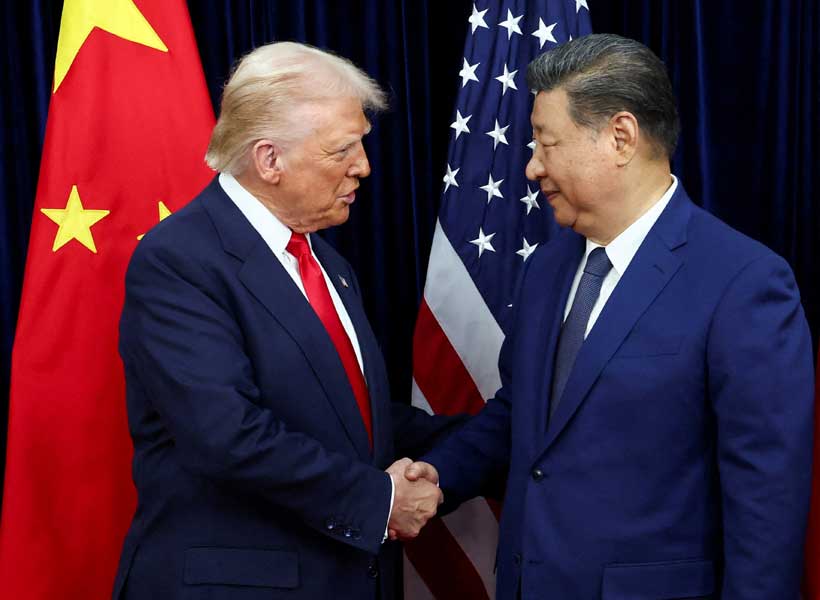
The meeting between U.S. President Donald Trump and Chinese President Xi Jinping in Beijing comes at a time of growing strategic rivalry between the world’s two largest powers.
Although the summit may reduce tensions temporarily, analysts say the broader competition between Washington and Beijing is likely to continue for years across military, economic, technological, and ideological fronts.
The central challenge facing both countries is whether they can manage that rivalry peacefully without allowing it to escalate into direct conflict.
Taiwan Remains the Greatest Flashpoint
The issue of Taiwan continues to represent the most dangerous point of tension in U.S. China relations.
Stay ahead of the geopolitical week.
MD Briefing delivers expert analysis across five global fronts — the Indo-Pacific, energy, geoeconomics, European security, and the Middle East — every Monday morning. Free.
China views Taiwan as a core sovereignty issue and strongly opposes any move toward formal independence. The United States, meanwhile, sees Taiwan as critical to regional stability and its credibility as a security partner in the Indo Pacific.
Both governments claim they are defending the existing balance, yet both accuse the other of undermining stability through military activity and political signaling.
Analysts argue that reducing risks will require mutual restraint rather than unilateral concessions. China could lower military pressure around Taiwan, while the United States could avoid actions that appear to support formal Taiwanese independence.
Military Competition Needs Clear Boundaries
Experts warn that deterrence can easily become dangerous if both sides misread each other’s intentions.
They argue that Washington and Beijing need stronger mechanisms to manage competition, including clearer communication about red lines, regular dialogue, and crisis management frameworks designed to prevent accidental escalation.
The article compares the situation to the Cold War, when the United States and the Soviet Union eventually established safeguards to reduce the risks of confrontation despite deep rivalry.
According to analysts, the United States and China have not yet developed similar strategic guardrails.
Economic and Institutional Rivalry Seen as Safer
Competition between the two powers is increasingly taking place through global institutions, trade initiatives, and economic influence rather than direct military confrontation.
The United States has strengthened partnerships such as the Quad and AUKUS, while China has expanded its role through organizations including BRICS and the Shanghai Cooperation Organisation.
Infrastructure and development projects have also become a major area of competition. China’s Belt and Road Initiative has prompted counter initiatives from the United States and its allies, giving developing countries more investment options.
Analysts argue that this form of rivalry can be less dangerous because it encourages competition through economic development, technology, and public investment rather than military force.
Economic Ties Still Act as a Stabilizer
Despite rising tensions, the United States and China remain deeply economically interconnected.
Experts caution that a broad economic decoupling between the two economies could remove one of the few remaining stabilizing factors in the relationship. Ongoing trade and investment links create incentives for both countries to avoid major conflict that could damage their economies.
While restrictions in sensitive sectors such as advanced technology may continue, analysts say completely severing economic ties would increase global instability.
Ideology Risks Deepening Divisions
The rivalry is also shaped by competing political narratives and ideological differences.
American leaders often frame the competition as a struggle between democracy and authoritarianism, while Chinese officials present it as resistance against foreign containment and interference.
Analysts warn that ideological confrontation becomes more dangerous when each side treats compromise as weakness or views coexistence as impossible.
They argue that both countries should focus on demonstrating the strengths of their own systems through governance and economic performance rather than trying to impose ideological models on others.
Analysis
The Trump Xi summit reflects the reality that the U.S. China rivalry is no longer a temporary dispute but a long term structural competition that will shape global politics for decades.
The greatest danger lies not simply in military buildup but in miscalculation, mistrust, and increasingly hostile political narratives. Taiwan remains the most immediate flashpoint because both sides see the issue as tied directly to national credibility and security.
At the same time, the relationship contains stabilizing elements. Deep trade ties, institutional competition, and ongoing diplomatic engagement provide alternatives to direct confrontation and create incentives for restraint.
The article suggests that peaceful coexistence will depend less on trust and more on disciplined management of rivalry. Clear communication, strategic restraint, and continued engagement may not eliminate tensions, but they could prevent competition from turning into open conflict.
Ultimately, the realistic goal for Washington and Beijing may not be partnership or reconciliation, but maintaining a stable rivalry where both powers compete intensely without triggering a catastrophic war.
With information from Reuters.
