


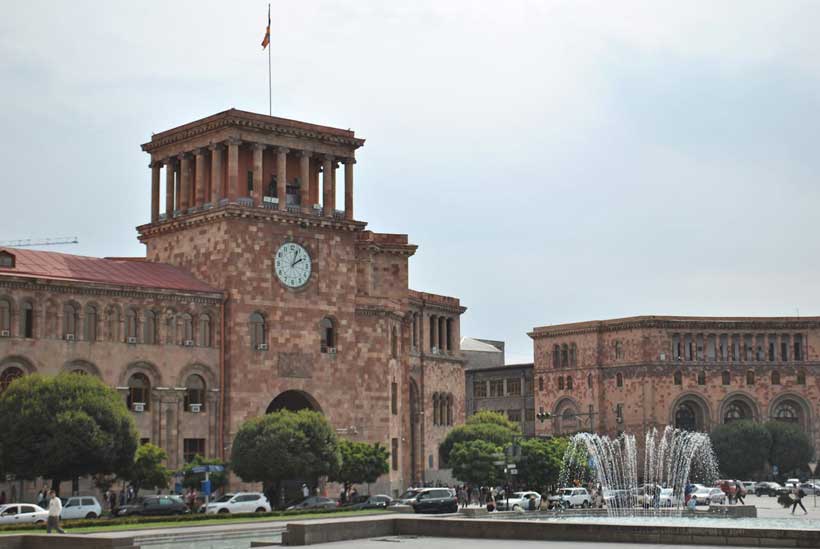
The European Political Community (EPC) meeting in Yerevan is being framed as another milestone in Europe’s post-Ukraine diplomatic architecture. It is a stress test. That is precisely why it matters.
The European Political Community (EPC), created in 2022 after Russia’s invasion of Ukraine, was designed to solve a structural problem: Europe had geopolitical responsibility without geopolitical architecture. Too many crises, too few instruments.
It therefore invented a deliberately undefined format—neither enlargement process nor treaty system, neither alliance nor institution. A political space allowing coordination without structural commitment. Since then, it has met seven times. The next summit is scheduled in Ireland in November 2026 (European Council EPC framework and summit calendar). But the real question in Yerevan is whether the EPC can produce anything beyond political statements.
From the courtyard of Yerevan State University, where I teach and observe Armenia’s constant recalibration between security dependency and strategic reinvention, the European Union appears less like a coherent actor and more like a set of overlapping intentions that occasionally align but rarely accumulate into continuity.
This is the real story of the EPC. It reveals Europe’s preferred mode of governance: episodic convergence. Europe converges under pressure and disperses when pressure fades. Ukraine proved the first part; everything since has confirmed the second.
Stay ahead of the geopolitical week.
MD Briefing delivers expert analysis across five global fronts — the Indo-Pacific, energy, geoeconomics, European security, and the Middle East — every Monday morning. Free.
The EPC can be understood as a political prototype put into circulation before Europe has decided what it actually wants it to become. Its strength is breadth—it gathers almost the entire European political space in one room. But breadth is not capability. What is missing is the internal wiring that turns presence into action: shared mechanisms, binding follow-up, and continuity between meetings. The result is something unusual in European governance: maximum visibility with minimum operational density. This is why it still feels like an experiment rather than an instrument. It is not failing, but it is also not stabilizing into a system. Europe is still testing whether political proximity alone can generate strategic output. And that is the core tension: the EPC brings Europe together easily, but it does not yet make Europe act together reliably.
Hosting the EPC in Armenia reflects a shift in Europe’s geopolitical perimeter. Armenia sits in a structurally unstable environment shaped by three forces: Russia’s declining role as a security guarantor, Türkiye’s expanding regional influence, and the EU’s incomplete geopolitical presence.
In this context, Europe is not a fixed reference point but a contested space of alignment. Yerevan matters because it is where Europe’s external commitments meet local security reality.
From Dialogue to Delivery: Operationalizing the EPC in Yerevan
The EPC now faces a clear test: converting high-level political dialogue into tangible results. With Armenia hosting the next summit, the focus must shift from broad declarations to concrete cooperation in the South Caucasus. Four high-priority themes emerge.
1. Regional connectivity and the Middle Corridor
The diversification of connectivity corridors between Europe, the South Caucasus, and Central Asia continues to be essential strategically. The priority here should be the development of rail, road, energy, and digital connections via the Trans-Caspian corridor, such as the Trans-Caspian International Transport Route (TITR), without reliance on any chokepoints. The EU Global Gateway initiative would offer a suitable funding mechanism for this, yet greater synchronization would need to occur between EPC member countries, export credit agencies, and regional actors.
Goal: Drafting an EPC connectivity strategy with pilot projects and financing identified.
2. Hybrid threats and democratic resilience
Increasingly, the security environment in Armenia is faced with threats of disinformation, cybersecurity risks, and political manipulation. While the EUMA monitors this situation, its mandate is still limited.
EPC members should consider more structured support for resilience, especially ahead of elections, including cooperation on cyber defense, information integrity, and institutional safeguards.
Target outcome: A voluntary “Resilience Compact” coordinating cyber security, electoral integrity, and counter-disinformation efforts.
3. Energy security and diversification
Weaknesses remain within the energy sector of the region. Despite the fact that Armenia is not a key transit state, it may be helpful for overall integration between the Black Sea, the Caucasus, and Central Asia regions. Key areas include power transmission networks and hydrogen.
Target outcome: Negotiation of EPC-backed interconnection initiatives in accordance with diversification objectives.
4. Continuity between summits
The EPC’s structural weakness is the gap between meetings. Without creating heavy institutions, continuity can still be improved through light mechanisms: early selection of future hosts, time-bound thematic working groups, and designated lead countries for key files such as connectivity and resilience. These measures would preserve flexibility while improving operational continuity.
The EPC was never designed to replace EU enlargement or accession processes. Its value lies in its flexibility: a parallel political space that accelerates reform, reinforces convergence, and strengthens alignment for partners such as Armenia, Georgia, Moldova, and Ukraine.
But summits do not become systems unless they are anchored by mechanisms that survive between them. Without that, political proximity becomes ceremonial: visible, regular, but strategically thin.
A format that continues to exist, convene, and issue statements, yet gradually loses its ability to shape outcomes—not because it is rejected, but because it becomes routine. This is the deeper contradiction Yerevan exposes. Europe still behaves as if institutional presence equals geopolitical capacity. But presence is not capacity. The EPC guarantees visibility. It does not yet guarantee impact.
Conclusion: Europe’s perimeter is now political.
For Armenia and similar partners, the EPC is not judged by symbolism but by predictability. Can Europe be relied upon as a strategic actor in environments where security conditions are unstable and external guarantees have proven fragile? This is a question of credibility. Credibility is not built through communiqués but through consistency over time. The EPC is now part of that test.
Europe is no longer defined only by its institutional center. It is increasingly shaped at its perimeter—where security, infrastructure, and political alignment intersect under pressure. Yerevan is one of those points. The EPC will not be judged by attendance or declarations. It will be judged by whether it can translate political proximity into coordinated action where Europe’s credibility is tested. The question now is no longer whether Europe can speak collectively. It is whether it can act coherently where it matters most.
