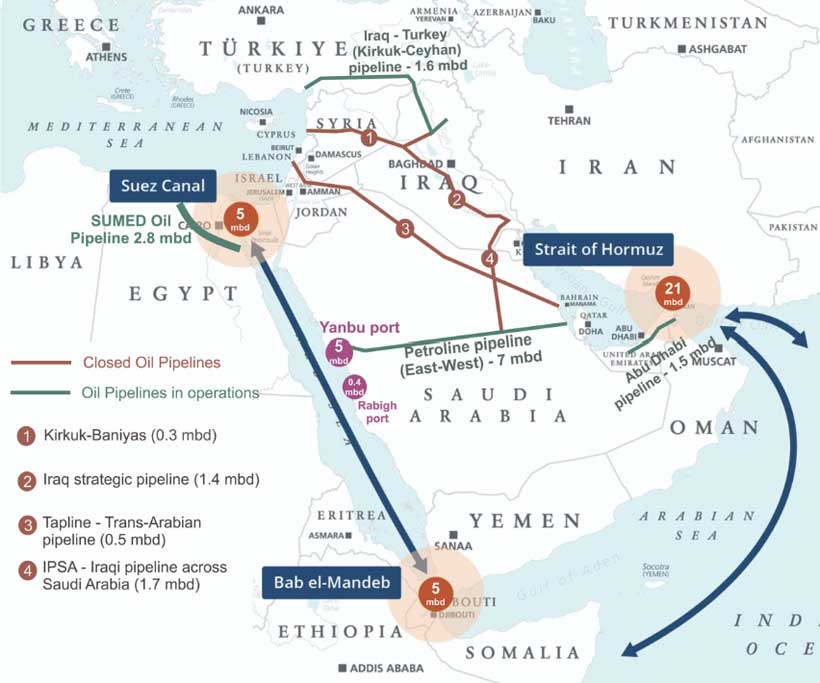
The U. S.-Israeli war with Iran has significantly disrupted oil shipping through the Strait of Hormuz, a key route for oil exports, making it the largest supply disruption on record according to the International Energy Agency (IEA). This disruption exceeds the oil crises of the 1970s and the impact from the loss of Russian gas after Ukraine’s invasion.
Several existing pipelines allow bypassing the Strait of Hormuz. The East–West pipeline in Saudi Arabia is 1,200 km long and can transport 7 million barrels per day (bpd), with effective exports at about 4.5 million bpd. It connects to the Red Sea for further shipments to Europe or Asia, facing risks from Houthi militants. The Habshan–Fujairah pipeline in the UAE has a capacity of 1.5–1.8 million bpd but has faced issues from drone attacks. Iraq’s Kirkuk-Ceyhan pipeline to Turkey restarted last September, currently pumping 170,000 bpd with plans to reach 250,000 bpd after contracts were signed. Iran may also use the Goreh-Jask pipeline, which can transport 1 million bpd, bypassing Hormuz.
Possible future alternatives include an Iraq-Oman pipeline to Duqm, which is still conceptual, and a Jordan pipeline to Aqaba aiming to bypass Hormuz, facing multiple hurdles. A canal project to connect the Gulf and the Sea of Oman remains purely theoretical due to extreme engineering challenges and high costs.
With information from Reuters