


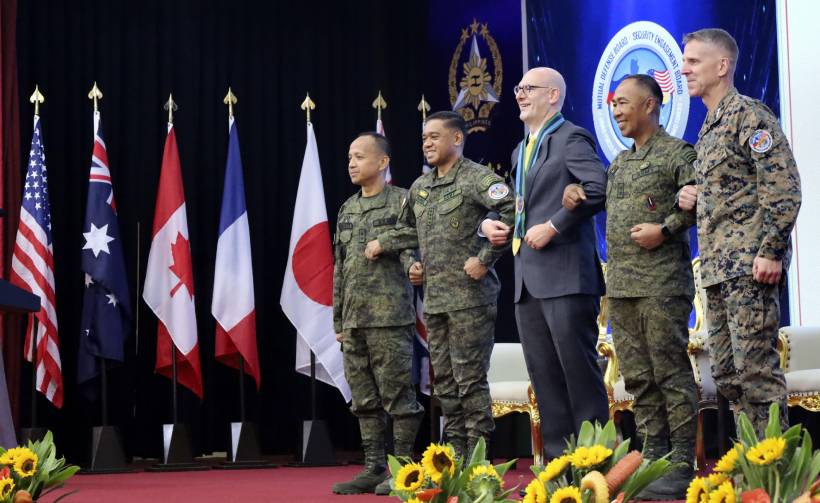
The Philippines and the United States, together with several allied nations, have begun their annual “Balikatan” military exercises, marking the largest iteration of the drills to date. Running from April 20 to May 8, the exercises are designed to test combat readiness under what officials describe as “real world conditions,” at a time of rising geopolitical tension in the Indo-Pacific.
The drills come as regional security dynamics intensify, particularly around the South China Sea and Taiwan, both of which remain flashpoints in broader US China strategic competition.
Scale and Participation
This year’s exercises involve more than 17,000 troops, including approximately 10,000 from the United States. The expansion of participating nations is notable, with Australia returning and Canada, France, New Zealand, and Japan joining as active participants for the first time.
Military officials say the broadened participation reflects a growing network of defence partnerships aimed at improving interoperability and collective readiness.
Stay ahead of the geopolitical week.
MD Briefing delivers expert analysis across five global fronts — the Indo-Pacific, energy, geoeconomics, European security, and the Middle East — every Monday morning. Free.
What the Exercises Involve
The drills include a wide range of military operations, such as maritime strike exercises, integrated air and missile defence, counter landing operations, and live fire drills. These activities are designed to simulate complex combat scenarios across air, land, and sea domains.
One of the key features is a live fire sinking exercise using newly acquired and allied weapon systems, including Philippine BrahMos missile systems and Japan’s Type 88 anti ship missiles.
Strategic Locations
Several exercises are being conducted in strategically sensitive areas. One set of drills is taking place in northern Philippine waters near Itbayat, close to Taiwan, highlighting the geographic proximity to a potential regional flashpoint.
Another major component is being held in Zambales province along the South China Sea, near disputed maritime areas including Scarborough Shoal, which remains a long standing point of tension between the Philippines and China.
Regional Tensions
China has repeatedly criticized such military exercises, arguing that they contribute to regional instability and external interference in Asia Pacific security affairs. Beijing maintains that Taiwan is part of its territory and opposes any military activity it views as linked to support for Taiwan or containment strategies.
In response to the drills, Chinese officials have warned against what they describe as bloc based security arrangements, stating that such alignments risk escalating confrontation in the region.
The United States and its partners, however, maintain that the exercises are defensive in nature and aimed at strengthening regional stability and deterrence.
Official Position
U.S. military leadership has emphasized that the exercises are not directed at any specific country. Instead, they are framed as part of broader efforts to enhance preparedness, interoperability, and crisis response capabilities among allied forces.
Outlook
The Balikatan exercises underscore the growing militarization and strategic competition in the Indo Pacific region. While officially described as routine and defensive, their scale, location, and participation reflect deeper shifts in regional security architecture.
As tensions continue to build around Taiwan and the South China Sea, such exercises are likely to remain a recurring point of friction between China and US aligned partners, even as they are presented as stabilizing measures.
With information from Reuters.
