


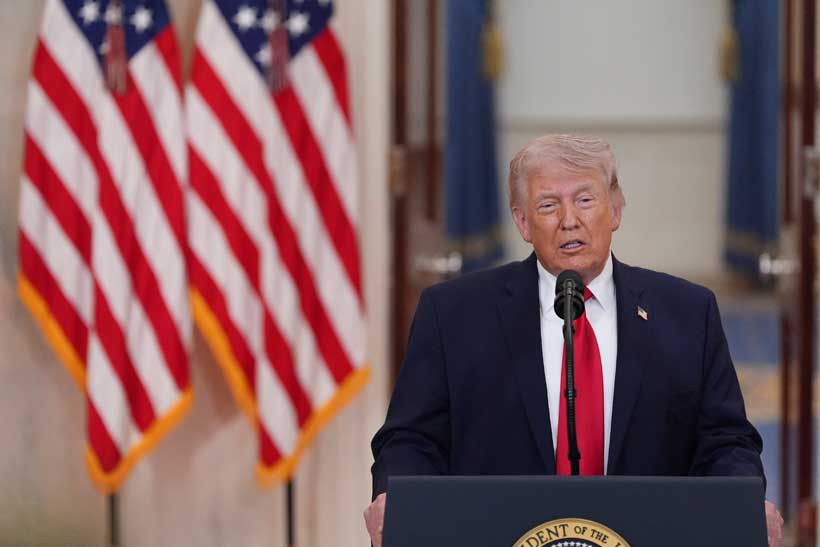
Donald Trump has threatened to impose sweeping 50 percent tariffs on any country supplying weapons to Iran, signaling a shift from direct military confrontation to economic coercion.
The warning came just hours after a fragile ceasefire, underscoring the volatility of US strategy. While no countries were explicitly named, the move is widely interpreted as targeting China and Russia, both accused by Washington of supporting Iran’s military capabilities.
From Military Conflict to Economic Warfare
After weeks of direct strikes, the United States appears to be pivoting toward economic tools to maintain pressure without escalating into full scale war.
Tariffs are being reframed as a deterrence mechanism, aimed at cutting off Iran’s access to external military support by raising the cost for third party suppliers.
Stay ahead of the geopolitical week.
MD Briefing delivers expert analysis across five global fronts — the Indo-Pacific, energy, geoeconomics, European security, and the Middle East — every Monday morning. Free.
This reflects a broader strategy of indirect containment, where the US targets networks rather than engaging solely with Iran itself.
Legal and Institutional Constraints
Trump’s threat faces significant domestic legal hurdles. The US Supreme Court has already limited his ability to impose sweeping tariffs under emergency powers.
This means any new tariffs would likely need to rely on slower, more targeted mechanisms such as:
- Section 301 actions tied to unfair trade practices
- Section 232 measures justified on national security grounds
These tools are narrower in scope and slower to implement, reducing the immediacy of Trump’s threat.
China in the Crosshairs
Although not explicitly named, China is the primary focus of the warning.
US officials have raised concerns about Chinese entities supplying:
- Missile related technologies
- Semiconductor equipment
- Dual use components for drones and defense systems
Beijing has denied all such allegations, maintaining that it supports diplomacy and stability. However, even the perception of Chinese involvement makes this a key flashpoint in US China relations.
Russia’s Secondary Role
Russia remains another potential target, though its economic exposure to US tariffs is limited due to existing sanctions and reduced trade flows.
Still, Russian military technology transfers to Iran remain a concern for Washington, particularly in areas such as missile systems and air defense.
Strategic Contradiction in US Policy
Trump’s tariff threat highlights a core contradiction:
- On one hand, the US is seeking de escalation through ceasefire
- On the other, it is introducing new economic threats that could provoke further tensions
This dual approach reflects an attempt to balance domestic political pressures with strategic objectives, but risks undermining both.
Implications for Global Trade and Geopolitics
If implemented, the tariffs could have far reaching consequences:
- Escalation of trade tensions, particularly with China
- Disruption of global supply chains
- Retaliatory measures from affected countries
- Further fragmentation of the global trading system
The move would also blur the line between economic policy and national security, reinforcing a trend toward weaponised interdependence.
Credibility and Signalling
A key question is whether the threat is credible.
Analysts suggest Trump may be using tariffs primarily as a signalling tool rather than an immediate policy action. Imposing such measures, especially against China, could derail broader diplomatic and economic objectives, including high level talks.
This creates a gap between rhetoric and likely implementation, potentially weakening deterrence if other states perceive the threat as unlikely to materialise.
Analysis
Trump’s tariff warning represents an evolution in US strategy from direct military engagement to economic coercion, but it also exposes the limits of that approach.
By targeting third party suppliers, the US is attempting to isolate Iran without re entering large scale conflict. However, this strategy risks expanding the confrontation beyond the Middle East into the global economic system.
At the same time, legal constraints and geopolitical realities limit Washington’s ability to act decisively. This suggests the tariffs function more as leverage in negotiations than as a concrete policy shift.
Ultimately, the move reflects a broader pattern: the integration of trade, security, and diplomacy into a single arena of competition. While this may increase short term pressure on adversaries, it also raises the risk of wider systemic instability.
With information from Reuters.
