


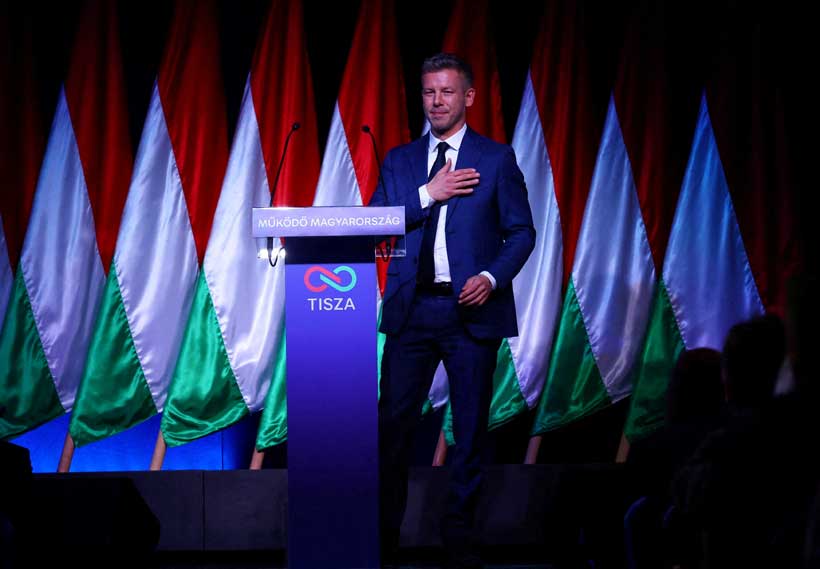
JD Vance landed in Budapest on Tuesday to address a campaign rally for Viktor Orbán ahead of Hungary’s parliamentary elections on Sunday, April 12. First US Vice President to set foot in Hungary since 1991. That alone tells you how much Washington has riding on what happens Sunday — and how worried Orbán’s allies are that it might not go their way.
The man who has run Hungary for sixteen years, who turned a mid-sized Central European country into a blueprint for every aspiring authoritarian in the West, is trailing in the polls. Not slightly. The latest surveys show Tisza, the opposition party led by Péter Magyar, with 56% support among decided voters, against 37% for Fidesz. One polling firm puts the gap at 23 points. If those numbers hold on Sunday, Orbán is done.
Who Is Péter Magyar, and Why Is He Different?
Every Hungarian election since 2010 has had an opposition. None of them came anywhere close to winning. What makes this one different is not just the numbers, it is who is doing the challenging.
Magyar is a former high-ranking Fidesz official who walked away from the party two years ago. Not quietly. He went on Facebook, said the whole “national, sovereign, bourgeois Hungary” project was a political product designed to hide corruption and wealth transfers to the well-connected, and then stepped into the street. His campaign since has focused on exactly that: corruption, crumbling public services, a stagnant economy, and an Orbán government that has treated EU membership as a cash machine while treating EU values as a punching bag.
Stay ahead of the geopolitical week.
MD Briefing delivers expert analysis across five global fronts — the Indo-Pacific, energy, geoeconomics, European security, and the Middle East — every Monday morning. Free.
He is not an outsider attacking the system. He knows the system from the inside, and that is precisely what makes him dangerous. At a march that drew tens of thousands of younger Hungarians into Budapest’s streets, he told the crowd: “Viktor Orbán is a traitor who betrayed our common future. He did not build a country, but his own dominion.” Lines like that land differently when the person saying them used to work for the man he is describing.
Magyar also changed how opposition politics is done in Hungary. He travels to rural strongholds that previous opposition candidates did not dare enter. He does town halls, not rallies. He shakes hands with people in villages that have voted for Fidesz for fifteen years. Meanwhile, almost every minor opposition party has stepped aside to clear the lane — the Momentum Movement, three others, all announcing within days of each other in January that they would not contest the election. The fragmented opposition that Orbán has reliably carved up and discarded for years has, for the first time, become one thing.
The Cracks in Orbán’s Armor
Sixteen years is a long time. The things that kept Orbán in power across four previous elections are not holding the way they once did.
The economy is the sharpest problem. Hungary’s cost of living crisis, the state of its healthcare, the condition of its schools, these have reached a point where the old Fidesz answer is not landing anymore. That answer has always been some version of: the real danger is out there. Ukraine. Brussels. George Soros. Look at the threat, not at your paycheck. It worked for a long time. Orbán’s campaign is still running it — framing Sunday as a binary choice between his steady hand and being dragged into a war with Russia. His core voters buy it. But there are signs that Fidesz supporters who previously accepted that framing without question are tired of it. When a historian who published a biography on Orbán tells reporters that crowds at his rallies are showing up “like in a movie, just to see what happens,” something has changed.
Then there is the corruption question, which has moved from background noise to the front page in the final weeks. A police whistleblower gave investigative outlet Direkt36 evidence alleging that Hungary’s security services were used to spy on and disrupt Tisza’s campaign. A documentary released in late March alleged mass voter intimidation in poor rural communities; cash, firewood, drugs, rides to polling stations, all in exchange for the right to vote. Sixteen years of accumulated allegations are arriving at once, and there is no longer a crisis big enough to drown them out.
Three Things Still Working in His Favor
None of this means Sunday is settled. Orbán has survived worse-looking situations. He has three advantages that polling numbers do not fully show.
The first is the electoral architecture. Orbán rebuilt Hungary’s electoral law in 2010, designing it around Fidesz’s geographic strength in rural areas. The constituency map, the vote thresholds, the allocation formula, all of it was engineered to convert a geographic advantage into parliamentary dominance. Even if Tisza wins the popular vote, Fidesz’s rural depth could translate into enough seats to block effective governance.
The second is mobilization. Fidesz turnout jumped from 86% to 92% after the Peace March on March 15. Tisza’s voters were already at 98%. Both sides are showing up at levels not seen in over a decade, mass rallies on both sides, record political engagement, a country that feels like it is voting for something rather than just against someone. That energy does not automatically help the challenger. In a system designed the way Hungary’s is, it matters enormously where the votes come from, not just how many there are.
The third is the international scaffolding, which is where Vance comes in.
What Washington Loses if Orbán Falls
Trump endorsed Orbán in February. Rubio flew to Budapest and told him “your success is our success.” Now Vance has appeared on stage at his campaign rally, the highest-ranking American official to visit Hungary in twenty years. The level of open US involvement in a foreign election is striking even by the standards of the current administration.
The reason is not complicated. Orbán is not just a conservative ally to the Trump orbit, he is the working proof of concept. The demonstration that you can systematically dismantle liberal democratic institutions from inside a Western alliance, keep winning elections, and face no permanent consequences. If he loses that argument on Sunday, the argument weakens everywhere. Marine Le Pen is watching. So is Giorgia Meloni. So is every far-right movement that has been pointing at Budapest and saying: look, it can be done.
There is also the practical function Orbán serves inside the EU. He has been the lone veto on Ukraine aid packages. The single NATO member that has kept Russia at cordial arm’s length. The government that blocked sanctions and delayed support at key moments. A Magyar government, even a cautious one, does not do that job. The German Marshall Fund’s analysis is blunt: Magyar’s premiership would likely bring Hungary closer to its Western allies in Ukraine. That shift has consequences for how the EU functions, for how Washington uses Budapest as a lever, for the war.
Whether Vance’s visit moves a single Hungarian voter is genuinely uncertain. One analyst put it clearly: “One wonders whether Vance’s visit will boost or set back Orbán’s chances. More and more, America First isn’t playing well with European nationalism.” Magyar’s answer from the campaign trail was sharp: “No foreign country may interfere in Hungarian elections. This is our country. Hungarian history is not written in Washington, Moscow, or Brussels — it is written in Hungary’s streets and squares.”
Brussels Wants Him Out, But at What Cost?
Washington gets the headlines, but Brussels has to live with the result. For sixteen years, EU officials have fined Hungary, frozen billions in cohesion funds, and launched Article 7 proceedings, the procedural nuclear option. The reasons are no secret: Orbán refuses to fall in line on Ukraine, keeps Moscow close in a way that looks a lot like friendship, and has built a culture war around issues that make Brussels see red. Every rebuke, Orbán turned into a campaign ad. See, they hate us because we won’t bow. That strategy has run its course.
But here is what keeps EU diplomats up at night: a Magyar victory is not a clean fix. Orbán spent sixteen years hollowing out the judiciary, capturing public media, stacking oversight bodies, rewriting the constitution. Even with a two-thirds majority, Magyar walks into a state that was deliberately built to resist reform from the inside. Brussels wants Orbán gone, for the war, for the Russian ties, for the values. It is quietly terrified that he built his dominion too well to be unmade.
Orbán’s Hungary, or Magyar’s Reckoning. No Third Option.
The polls say Orbán is losing. The electoral system says it might not matter as much as the polls suggest. The corruption, the economic discontent, the historic consolidation of the opposition behind Magyar, all of it points one way. The gerrymandered map, the captured media, sixteen years of machinery, that points to another.
If the polling firm Median is right, and it was the only firm that called the 2022 Fidesz victory accurately, within 0.1%, Magyar wins a two-thirds constitutional majority. Enough to begin dismantling the system Orbán built. That would be one of the most consequential political outcomes in Europe in a decade.
If Orbán wins, the model survives. The illiberal international gets its proof of concept back. Washington gets its man inside EU institutions for another term. And somewhere in Budapest, a system designed to outlast its creator keeps running.
Either way, Sunday matters — well beyond Hungary’s borders.
