


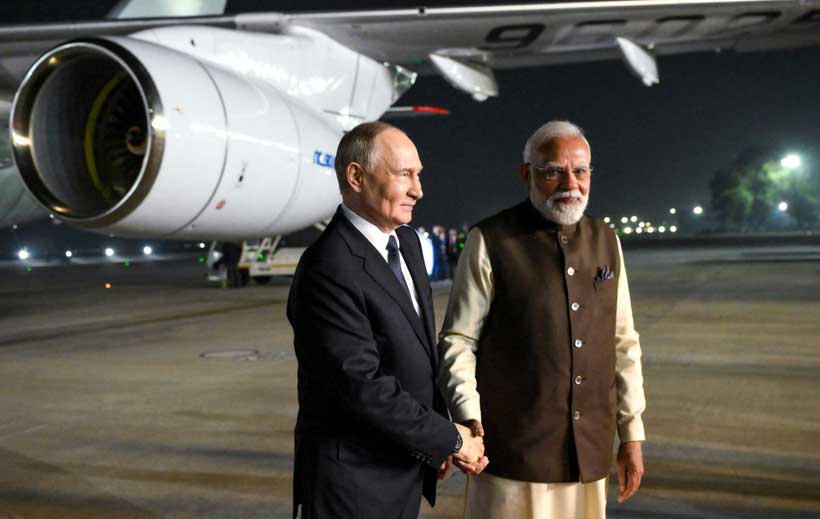
Russia and India, amid the radical changes and political pressure emerging from the Western Hemisphere, cautiously reviewed their current bilateral relations during the 2nd International Conference Russia and India: Towards a New Agenda for Bilateral Relations, on March 23, and underlined the emerging steps necessary for sustaining policy measures in the coming couple of years. Held under the auspices of the Russian International Affairs Council, a non-government organization specializing in Russia’s policy with the external countries, it brought together representatives of Russian and Indian academic, expert, and diplomatic communities for a substantive discussion of key bilateral issues and an exchange of views on pressing regional and international matters.
Themes dominating the discussions included policy perspectives in the context of radical transformation, especially the United States-Israeli war with Iran in the Middle East and its global implications; the impact on economic architecture; and possible measures that are needed to adopt in order to maintain some level of security stability with support from geopolitical compatriots.
It is worthy to underline that Russia and India have forged cooperation spanning diverse spheres and operated mutually in a number of associations, the most frequently featured in the media being BRICS+, where both are founding members, aside from the tripartite RIC (Russia, India, and China) that formed the basic foundations for the BRICS+ association.
Significance of the meeting
Stay ahead of the geopolitical week.
MD Briefing delivers expert analysis across five global fronts — the Indo-Pacific, energy, geoeconomics, European security, and the Middle East — every Monday morning. Free.
i) Strengthening the strategic partnership with New Delhi remains among the unconditional foreign policy priorities, as both highly appreciate that this approach is fully shared in their friendship. New Delhi’s steadfast pursuit of an independent foreign policy, within the framework of its course towards strategic autonomy, and its consistent prioritization of national interests command the deepest respect. As a result, India’s influence continues to grow steadily in the emerging multipolar world as one of the leading global political and economic centers, a distinct civilization, and a great power of the 21st century.
ii) The time-tested friendship between Russia and India stands as a model of how interstate relations should be built—on equality, mutual trust and respect, and due regard for each other’s interests. In this context, the role of a trust-based dialogue at the highest level is difficult to overstate.
Following President Vladimir Putin’s visit to New Delhi in December 2025, the alignment of Russia’s and India’s strategic objectives was reaffirmed, and a substantial package of documents, including policy documents, was signed. The Kremlin is feverishly looking forward to welcoming Prime Minister Narendra Modi to Russia in 2026.
iii) Trade and economic cooperation. Active joint efforts continue to strengthen the material foundation of Russian-Indian relations. In 2025, bilateral trade reached approximately $60 billion. The leaders have reaffirmed the goal of reaching $100 billion by 2030. In an effort to fulfill their instructions, Russia and India are taking steps to deepen cooperation in logistics, technology, and investment, including through the development of the International North-South Transport Corridor and the Northern Sea Route. As further measures to fortify relations, Russia and India continue to improve the system of direct settlements: as of today, 96 percent of trade is conducted in national currencies.
iv) Anti-Western hegemony. Both have close foreign policy coordination, which has major significance amid current geopolitical turbulence, including the acute military and political crisis in the Persian Gulf, provoked by the United States and Israel. Moscow and New Delhi are committed to the democratization of international relations on the basis of universally recognized norms of international law, above all the principles of the UN Charter in their entirety, interconnection, and indivisibility.
v) Future coordination on regional and international platforms. Cooperation in multilateral formats is on the rise within the United Nations, BRICS, the SCO, and the G20. This year, India holds the BRICS chairmanship under the motto: Strengthening Resilience, Innovation, Cooperation, and Stability. Russia, unreservedly, stands ready to provide comprehensive support to India throughout the BRICS+ chairmanship in 2026.
In mutual summary, the implementation of the extensive and multifaceted Russian-Indian agenda requires expert and analytical support for the efforts of foreign ministries, other government bodies, and the business community. At the end of the meeting, both sincerely pledged to contribute to further strengthening cooperation between Russia and India and to deepening mutual understanding in moving ahead into the future.
