


Anyone familiar with the Melian Conference or Melian Dialogue—one chapter of The History of the Peloponnesian War by the famed Thucydides from 431 BC—will recognize the primacy of military power over morality in international relations.
The neutrality of Melos’ officials in the midst of the war between the Delian League led by Athens and the Peloponnesian League led by Sparta, along with their arguments about justice and collective security, ultimately confronted the military strength of Athens and its navy. From that meeting, Melos—betting on victory by hoping for divine assistance in the struggle between justice and injustice—was defeated by the stronger Athenian forces.
This chapter of Thucydides’ work introduces a realist perspective in international relations that had already emerged in the classical era, specifically in ancient Greece. John Mearsheimer (2001), in The Tragedy of Great Power Politics, quoting Edward Hallett Carr, explains that a state’s power is a factor that cannot be ignored. Therefore, a wise state must face that reality and adapt to it in conducting relations among nations.
In the Melian Dialogue, this understanding appears in the statement of the Athenian representatives sent to negotiate with Melos: “The strong do what they can and the weak suffer what they must.” Thus, neutrality based on moral arguments such as justice could not stop Athens’ military power from invading and conquering the island of Melos and enslaving its population.
Stay ahead of the geopolitical week.
MD Briefing delivers expert analysis across five global fronts — the Indo-Pacific, energy, geoeconomics, European security, and the Middle East — every Monday morning. Free.
The Melos Trap
This topic was studied by Neville Morley (2019) in “Escaping the Thucydides Trap in political commentary.” He addresses the “Thucydides Trap,” widely discussed due to rising tensions between the United States and China today. Referring to Harvard political scientist Graham Allison, Morley explains that the Peloponnesian War occurred because Sparta grew worried about the increasingly powerful Athens in ancient Greece. War, therefore, becomes more likely when an “established” power feels threatened by a “rising” power.
Furthermore, Morley explains that Athens, in Thucydides’ historical account, sought to expand its power and assert its presence by subjugating the island of Melos.
“The strong do what they can and the weak suffer what they must” became the basis for Athens’ conquest. Meanwhile, the inhabitants and officials of Melos were trapped in the belief that justice and regional peace would allow them to remain neutral, even in the face of stronger Athenian forces—until they were invaded and enslaved.
The Emergence of Conflicts
Many countries today occupy a position similar to Melos. Indonesia itself demonstrates neutrality amid an increasingly turbulent world. Like Melos, many states base their stance on moral principles. For Indonesia, the legacy of the Non-Aligned Movement, the Bandung Asian-African Conference of 1955, the “free and active” foreign policy, and favourable references to international institutions such as the United Nations and the rules-based international order form the foundation for neutrality.
If the inhabitants of Melos remained neutral during the Athens-Sparta conflict, Indonesia demonstrates neutrality amid rising tensions in its own region. Tensions between the United States and China—stemming from trade wars, disputes over Taiwan, and competition for influence in the Asia-Pacific—continue to escalate.
In some cases, the parties involved have demonstrated military force. At the end of 2025, China conducted one of its largest military exercises around Taiwan. The exercise, using live ammunition, simulated a blockade of the island (DW, 2025). Although the U.S. intelligence community predicts that China will not invade Taiwan before 2027, the risk of escalation between the United States and China remains palpable (NBC News, 2026).
Indonesia also uphold its neutrality amid conflicts happening elsewhere. The latest confrontation between the U.S.-Israel coalition and Iran in the Middle East is particularly alarming. What began with missile strikes against Iran at the end of February has evolved into a prolonged conflict. Retaliatory attacks followed, Iran’s Supreme Leader Ali Khamenei was killed and replaced by Mojtaba Khamenei, and escalation intensified.
Although the conflict involves the U.S.-Israel coalition and Iran, it has affected other states—especially Gulf countries such as Kuwait, Bahrain, Qatar, the United Arab Emirates, and Saudi Arabia—which find themselves in the middle of the battlefield. Missiles from both sides have crossed their airspace (Al-Jazeera, 2026). The existence of U.S. bases in Saudi Arabia, Kuwait, and Qatar have also made those countries targets. Reports indicate Iran fired more missiles at Gulf states than at Israel (TRT World, 2026).
This is not the first time Gulf states have been caught in such crossfire. In 2024, Iran launched missiles after Israeli strikes killed leaders of Iran’s Islamic Revolutionary Guard (IRGC) and allied groups (Al-Jazeera, 2026). Throughout the current conflict, missiles struck oil and gas facilities in Qatar, airports in the UAE and Erbil in Iraq, as well as hotels and residential areas in Bahrain and the UAE (Al-Jazeera, 2026).
These Gulf states face a situation similar to Melos: caught in the spillover of great-power conflict despite attempting neutrality. Saudi Foreign Minister Faisal bin Farhan’s statement that his country would use all means to stop the conflict reflects reluctance to be drawn in (The National, 2026). Yet these states did not rely solely on neutrality—they strengthened air defences, deployed military systems, and acquired weapons from partners including France, Australia, and Ukraine. The UAE also developed domestic air-defence capabilities (IISS, 2026).
Indonesia at a Crossroads
The Gulf states defending their airspace demonstrate that neutrality alone is insufficient. They acknowledge military realities and prepare for worst-case scenarios. Missile threats are countered not only with principles and rhetoric, but with concrete plans and state of the art defensive systems.
Indonesia now stands at a crossroads. Traditionally, Indonesia has taken a pacifist stance in an increasingly conflict-prone world. The legacy of the Non-Aligned Movement, Bandung Conference, and the “free and active” foreign policy has emphasized diplomacy over military projection.
However, this stance is becoming harder to sustain. In the Asia-Pacific, China may gain strategic advantage as the United States becomes more engaged in Middle Eastern conflicts. The redeployment of U.S. weapons from allies such as South Korea to the Middle East could weaken American presence and create opportunities for China regarding Taiwan (SCMP, 2026).
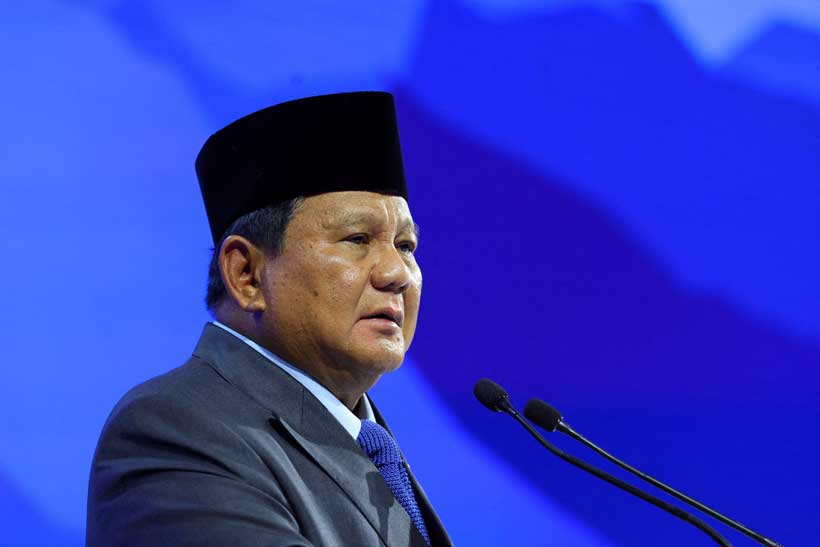
Indonesia could still escape the “Melos Trap.” President Prabowo Subianto has shown awareness of realism in international relations, acknowledging military power as a factor that cannot be ignored. On several occasions including his first speech to the United Nations General Assembly, he has quoted: “The strong do what they can and the weak suffer what they must,” showing familiarity to the potency of state power as a factor that could not be ignored (Antara, 2025). If this perspective is implemented in policy, Indonesia could strengthen national defence while maintaining neutrality. Neutrality backed by strength—rather than weakness—would reduce vulnerability to great-power conflict spillovers. Though this departs from traditional Indonesian foreign policy, it answers contemporary demand from a conflicted world—reflected in the phrase often associated with U.S. President Donald Trump: “Peace through strength
