


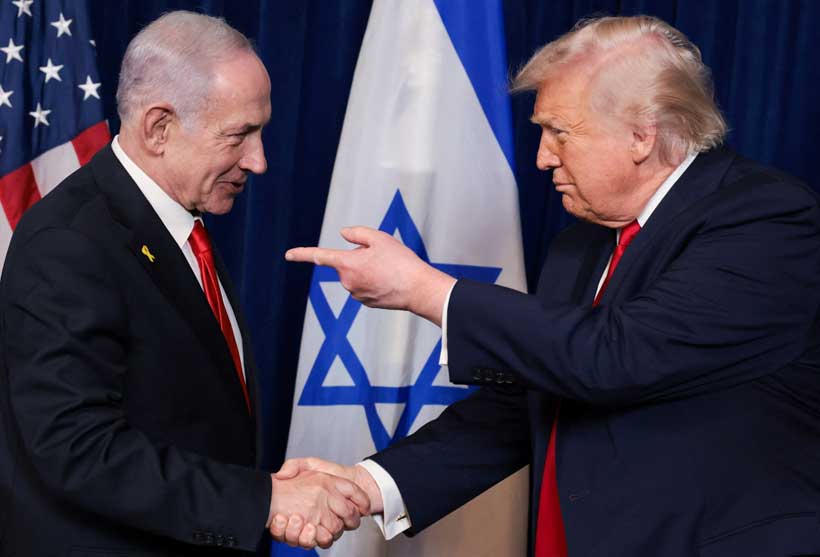
Donald Trump said Israel will not strike Iran’s key gas infrastructure again unless Tehran retaliates, after what he described as a furious escalation that has pushed the conflict into a direct confrontation over global energy supply.
His remarks came after an Israeli strike on the South Pars Gas Field, the world’s largest natural gas reservoir, triggered a wave of retaliation from Iran across the Gulf. The attack marked a turning point in the war, shifting it decisively toward energy infrastructure, the backbone of the global economy.
Trump framed Israel’s move as an emotional but contained response, saying it had “violently lashed out” but would now stand down from further strikes on the field unless provoked. At the same time, his warning to Iran was explicit and sweeping, threatening overwhelming force if Tehran escalates further, underscoring how quickly deterrence is giving way to brinkmanship.
Energy Infrastructure Becomes the Battlefield
Stay ahead of the geopolitical week.
MD Briefing delivers expert analysis across five global fronts — the Indo-Pacific, energy, geoeconomics, European security, and the Middle East — every Monday morning. Free.
Iran’s response has widened the conflict geographically and strategically. Missile strikes have targeted Qatar and Saudi Arabia, including facilities linked to liquefied natural gas exports and critical processing hubs. Damage at Ras Laffan, a central node in global gas supply chains, signals that no major energy asset in the Gulf is now beyond reach.
The conflict has effectively turned the region’s energy grid into an active war zone. The targeting of shared infrastructure, particularly South Pars, which Iran co-develops with Qatar, introduces a new level of complexity. It entangles neutral or allied states and raises the risk of miscalculation, as attacks ripple across interconnected systems of production and export.
The consequences are already visible in markets. Oil and gas prices have surged sharply, reflecting fears not just of supply disruption but of systemic breakdown. The Gulf accounts for a substantial share of global energy flows, and sustained attacks on infrastructure threaten to choke supply far beyond the immediate region.
Strait of Hormuz Emerges as the Central Pressure Point
At the heart of the crisis lies the Strait of Hormuz, a narrow maritime corridor through which roughly a fifth of the world’s oil passes. Iran’s effective closure or disruption of this route has amplified the shock, driving up prices and rattling governments already grappling with inflation.
Trump’s consideration of deploying additional U.S. troops reflects the strategic importance of reopening this passage. Yet allies have shown reluctance to join such efforts, exposing limits to international coordination even as the stakes escalate. Without a secure Hormuz, energy markets remain vulnerable to further shocks, and military involvement risks deepening the conflict.
Regional Spillover and Strategic Signalling
The war is no longer confined to Iran and Israel. Saudi Arabia has intercepted incoming missiles over Riyadh, while the United Arab Emirates has shut down key gas facilities following attacks. Iran has issued warnings to energy sites across multiple Gulf states, signaling an intent to broaden the cost of the conflict.
At the same time, diplomatic responses are hardening. A coalition of Muslim-majority countries has condemned Iran’s strikes on civilian and energy infrastructure, while Saudi officials have signaled readiness to respond militarily if necessary. These statements suggest a gradual alignment against Tehran, though not yet a unified front.
Contradictions and Credibility Risks
Trump’s assertion that the United States had no prior knowledge of Israel’s strike sits uneasily alongside reports suggesting otherwise. This ambiguity reflects a broader challenge for Washington: maintaining strategic ambiguity while preserving credibility with allies and adversaries alike.
His messaging attempts to balance de-escalation with deterrence, promising restraint while issuing maximal threats. But such dual signalling carries risks. If either side misreads intent, the conflict could spiral further, particularly given the speed and scale at which energy infrastructure is now being targeted.
A War Redefining Global Risk
The shift toward attacking energy assets marks a profound escalation in the nature of the conflict. Unlike conventional military targets, these facilities are deeply embedded in the global economy. Damage to them reverberates instantly through prices, trade flows, and political stability far beyond the Middle East.
With no clear off-ramp and retaliatory cycles intensifying, the war is increasingly defined not just by territorial or military objectives, but by control over energy and its global consequences. In that sense, the battlefield has expanded far beyond the region, drawing in markets, governments, and consumers worldwide.
With information from Reuters.
