


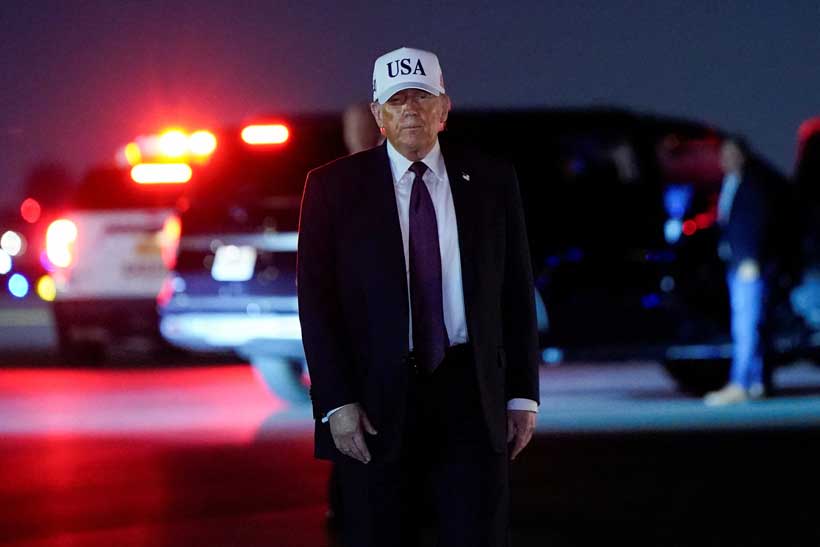
President Donald Trump has been aggressively pushing the SAVE America Act, a proposal that would require all Americans to prove citizenship using either a valid U.S. passport or birth certificate in order to register to vote. Trump has framed the legislation as a “guaranteed” path to Republican victories in the upcoming midterm elections, arguing that it would prevent non-citizens from influencing U.S. elections. Critics, however, point out that federal law already bars non-citizens from voting, and independent analyses suggest the law may create more problems than it solves.
The legislation has passed the House of Representatives, but faces an uphill battle in the Senate. Democratic opposition is strong, and Trump’s push to change Senate filibuster rules in order to pass the bill with a simple majority has yet to gain sufficient Republican support. This leaves the bill’s prospects uncertain, even as Trump continues to pressure Republican lawmakers.
Impact on Trump’s own supporters
Although intended to consolidate support for Trump, the legislation could unintentionally disenfranchise a significant portion of his base. About 21 million eligible voters across the United States do not have easy access to documents proving citizenship, according to the University of Maryland Center for Democracy and Civic Engagement.
Stay ahead of the geopolitical week.
MD Briefing delivers expert analysis across five global fronts — the Indo-Pacific, energy, geoeconomics, European security, and the Middle East — every Monday morning. Free.
Data suggest that Republican voters are less likely than the general population to hold a passport, one of the few documents the bill accepts for voter registration. Moreover, married voters especially women who have changed their last names might face mismatches between their birth certificates and current identification, potentially complicating or delaying registration.
Rural voters are particularly vulnerable. Many live far from election offices, meaning in-person registration requirements would be difficult and costly to meet. In Alaska, for instance, one-fifth of residents live off the road system, meaning they might have to fly to a county election office just to register. States with low passport ownership, including much of the rural Midwest and South, tend to lean heavily Republican, raising the possibility that the law could disproportionately affect Trump’s supporters in these regions.
Education and socio-economic factors
Passport ownership also correlates with higher education levels. In 2024, Trump dominated among voters with a high school education or less, whereas Democratic nominee Kamala Harris performed better among college-educated voters who were more likely to have passports. This mismatch suggests that many of Trump’s key supporters could face additional hurdles to registering under the SAVE Act.
Married women are another group that could be affected. A 2023 Pew Research Center study found that Democratic women are twice as likely as Republican women to retain their last names after marriage. Republican women who change their last names may face bureaucratic issues when trying to match their birth certificates to current documentation. Although the White House argues the impact on married women would be minimal, the administrative burden remains a real concern.
Election administration and nationwide implications
The SAVE Act would create sweeping challenges for election administrators nationwide. Between 2022 and 2024, over 100 million Americans either submitted new voter registrations or updated existing records, highlighting the scale of potential disruption. Local and state election offices would need to verify citizenship documents, potentially delaying registrations and slowing voter roll updates, particularly in states with large rural populations or limited administrative resources.
Even beyond direct voter impacts, the legislation could have wider effects on public confidence in the electoral system. Complicated registration procedures may discourage turnout and create the perception that the process is intentionally burdensome, which could depress participation among voters who are supposed to be Trump’s natural supporters.
Analysis
The SAVE America Act illustrates a classic case of unintended consequences in policy-making. While intended to secure Republican electoral advantage, the legislation risks disproportionately affecting the very voters who are most likely to support Trump rural voters, those with lower educational attainment, and married women in certain states.
Trump’s effort also underscores the tension between political strategy and practical implementation. By requiring documents that many Americans do not possess or cannot easily access, the bill could create barriers to participation rather than ensuring a “guaranteed” Republican advantage. These barriers may also introduce administrative headaches for state election offices, slow down registration processing, and raise legal challenges.
Even if passed, the law may function as a double-edged sword. While it may tighten control over some segments of the electorate, it could also suppress turnout among the Republican base, particularly in areas critical to winning midterm races. In this context, Trump’s push for the SAVE Act represents a high-stakes gamble that could hurt his own supporters more than it helps them, raising serious questions about whether the political risk is worth the intended reward.
With information from Reuters.
