


The United States is rapidly exhausting the tools it has to cushion global oil markets from the shock caused by the Iran war, raising fears that a sustained disruption to Middle Eastern exports could trigger a deeper global economic slowdown.
As the conflict enters its third week, roughly 15% of the world’s oil supply remains effectively trapped in the Gulf following the closure of the Strait of Hormuz, one of the most important maritime chokepoints for global energy trade.
The disruption has forced major Gulf producers to scramble for alternatives. Saudi Arabia is diverting as much as five million barrels per day of crude to its Red Sea export terminal at Yanbu, while the United Arab Emirates is rerouting additional shipments through the Fujairah terminal outside the Gulf.
Even with those adjustments, roughly 15 million barrels per day of Middle Eastern crude remain effectively locked out of international markets, a supply shock without precedent in the post-World War II oil system.
Stay ahead of the geopolitical week.
MD Briefing delivers expert analysis across five global fronts — the Indo-Pacific, energy, geoeconomics, European security, and the Middle East — every Monday morning. Free.
The market response has been swift. Benchmark crude prices have surged, with Brent crude climbing above $100 per barrel, while prices for refined fuels such as diesel and jet fuel have jumped even more sharply amid fears of prolonged shortages.
Iran keeps pressure on global energy flows
Iran’s new supreme leader, Mojtaba Khamenei, has indicated that the strait will remain closed as Tehran seeks to exert strategic pressure on the United States and Israel.
While Iranian authorities have suggested that individual countries could potentially coordinate shipping movements with Iran’s navy, the uncertainty surrounding such arrangements has deterred most commercial shipping companies.
Washington has acknowledged that the United States Navy currently lacks the ability to forcibly reopen the waterway, highlighting the difficulty of restoring normal shipping operations in the short term.
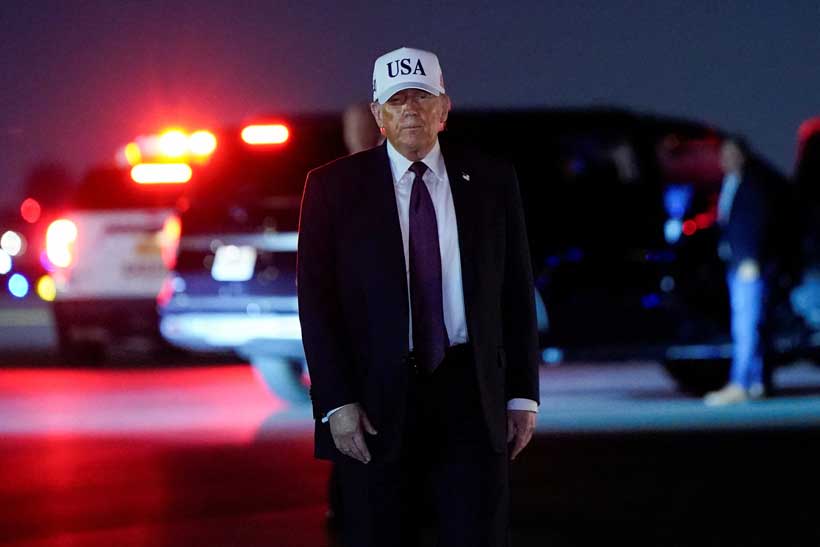
President Donald Trump has called on allies to deploy naval forces to help secure the strait, but any coordinated military operation to reopen it would likely take weeks to organise.
Spare oil capacity offers little relief
In previous supply disruptions, global markets have relied on spare production capacity from members of the OPEC+ to stabilise prices.
But this crisis has exposed the limits of that mechanism.
According to the International Energy Agency, global spare capacity before the war stood at about 3.9 million barrels per day most of it located in the Middle East itself. Saudi Arabia alone accounted for roughly 1.7 million barrels per day.
With the region’s export routes disrupted, much of that spare capacity cannot easily reach global markets.
Washington deploys emergency measures
Facing rising political pressure from soaring fuel prices, the Trump administration has spent the past two weeks deploying nearly every available policy lever to ease market pressure.
Washington has issued temporary waivers allowing countries to purchase sanctioned Russian crude currently at sea. A separate waiver was granted specifically for India, enabling refiners to access Russian cargoes despite sanctions.
According to shipping analytics firm Kpler, tankers carrying Russian crude and refined products held about 245 million barrels as of mid-March roughly comparable to the volume of Middle Eastern oil lost since the strait’s closure.
However, the real impact may be smaller than the headline figures suggest. Countries such as China, India and Turkey were already purchasing large volumes of Russian oil despite Western sanctions, meaning the waivers are unlikely to release significant new supply onto global markets.
Strategic reserves tapped at record levels
Another major response has come from coordinated emergency stockpile releases.
The International Energy Agency announced plans for its member countries to release 400 million barrels from strategic petroleum reserves, the largest drawdown in the agency’s history.
The United States will contribute the largest share 172 million barrels from its Strategic Petroleum Reserve. That move will leave Washington with only about 100 million barrels readily accessible due to technical and operational constraints.
Additional measures under consideration include temporarily suspending the century-old Jones Act, which would allow foreign-flagged vessels to transport fuel between U.S. ports, easing regional distribution bottlenecks.
Other ideas—such as allowing winter-grade gasoline sales during the summer or cutting fuel taxes—are also being examined, though their direct effect on crude prices would likely be limited.
Demand destruction looms
Taken together, the emergency measures highlight a stark reality: the United States has few remaining tools capable of offsetting the massive supply shock created by the Hormuz closure.
When supply disruptions cannot be fully replaced, higher prices typically lead to lower consumption a phenomenon known as demand destruction.
Asia is expected to bear the brunt of the impact. The region imports roughly 60% of its crude oil from the Middle East, making it highly vulnerable to disruptions in Gulf exports.
Because tanker journeys from the Gulf to Asia typically take about a month, the most severe shortages may only begin to emerge in the coming weeks as cargo flows dwindle.
Governments across the region are already taking precautionary measures. Countries including Japan, India, Thailand and Vietnam have begun cutting refinery operating rates or introducing policies aimed at reducing fuel consumption.
Some governments are encouraging remote work, reducing electricity use in public spaces and suspending fuel taxes to soften the blow for consumers.
Analysis: A global oil system under strain
The current crisis reveals how fragile the global oil system remains despite decades of efforts to diversify supply.
For years, strategic reserves and spare production capacity served as buffers against sudden disruptions. But the closure of the Strait of Hormuz a chokepoint through which a fifth of global oil flows has overwhelmed those safeguards.
Even the unprecedented release of emergency stockpiles may only buy time rather than solve the underlying supply gap.
If the disruption persists, the world may face a classic oil-shock scenario in which rising prices slow economic activity and force governments to ration fuel consumption.
For Washington, the political stakes are particularly high. Rising gasoline prices have historically carried heavy domestic consequences for U.S. administrations, and the shrinking list of policy options leaves the White House increasingly exposed to the global energy turmoil triggered by the war.
With information from Reuters.
