


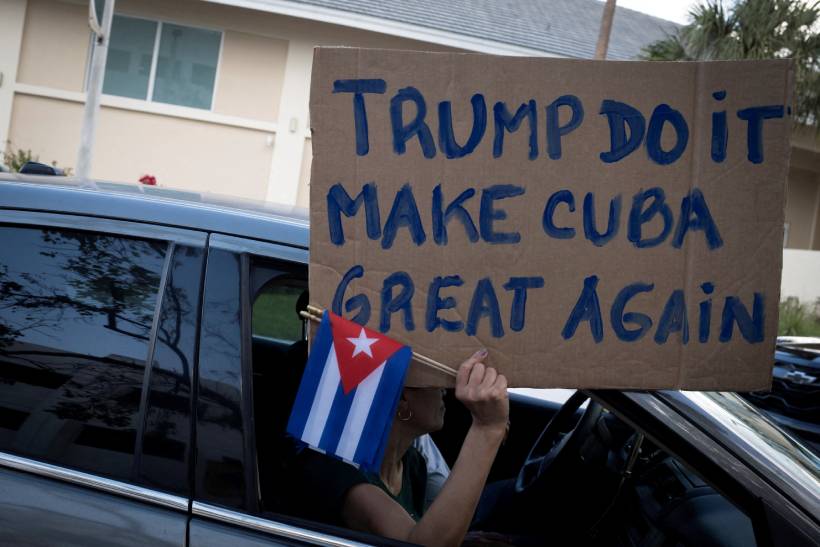
Donald Trump has repeatedly said the United States is holding talks with high-level Cuban representatives to ease tensions between the two longtime adversaries. According to Trump, Havana is eager to reach an agreement as the island grapples with one of the worst economic crises in decades.
However, the government of Cuba insists no official negotiations are underway. The denial has not stopped speculation that Washington may be engaging in back-channel diplomacy with figures close to the island’s most powerful political family.
Reports in U.S. media suggest American officials have held discussions with Raul Guillermo Rodriguez Castro the grandson of revolutionary leader Raúl Castro a figure deeply embedded within Cuba’s political and economic elite.
The alleged talks come at a particularly tense moment in regional politics, following Washington’s tightening sanctions on Cuba and the dramatic capture of Nicolás Maduro earlier this year, removing one of Havana’s key allies.
Stay ahead of the geopolitical week.
MD Briefing delivers expert analysis across five global fronts — the Indo-Pacific, energy, geoeconomics, European security, and the Middle East — every Monday morning. Free.
Raul Castro’s Enduring Influence
Even though Raúl Castro stepped down as Cuba’s president in 2018 and relinquished leadership of the ruling party in 2021, the former revolutionary leader remains an influential figure within the Cuban system.
Raúl fought alongside his brother Fidel Castro during the 1959 revolution that overthrew the U.S.-backed government of Fulgencio Batista. He later served as defense minister for decades before taking over the presidency when Fidel fell ill in 2006.
Although he now holds the honorary rank of army general, Raúl continues to exert influence over major political decisions. In late 2025, for example, he successfully proposed postponing a crucial Communist Party congress amid Cuba’s deepening economic crisis a move approved unanimously by party leaders.
That level of authority means anyone close to him can wield considerable informal power within Havana’s political system.
The Rise of Raul Guillermo Rodriguez Castro
Raúl Castro’s grandson, Raul Guillermo Rodriguez Castro, has attracted attention as a possible intermediary with Washington.
Nicknamed “El Cangrejo” (“The Crab”) because of a physical characteristic in his hand, the 41-year-old Rodriguez Castro has spent years within his grandfather’s inner circle. He reportedly served as Raúl Castro’s bodyguard during the latter’s presidency and is believed to hold the rank of lieutenant colonel.
His family connections place him at the center of Cuba’s political and economic elite.
Rodriguez Castro’s father, the late Luis Alberto Rodriguez Lopez-Calleja, headed the powerful military-run conglomerate GAESA, which controls major sectors of Cuba’s economy including tourism, logistics, banking and retail.
GAESA became the dominant economic institution in Cuba during Raúl Castro’s presidency, meaning the younger Rodriguez Castro may also have influence within the island’s key commercial networks.
Despite his powerful lineage, he has maintained an extremely low public profile and has never given interviews.
Reports of Secret Meetings
U.S. media outlets have reported that Rodriguez Castro may have participated in quiet meetings with American officials.
According to reports, contacts linked to Marco Rubio met Rodriguez Castro during a regional summit in Saint Kitts and Nevis earlier this year.
Other U.S. lawmakers, including Mario Díaz-Balart, have said the Trump administration is holding discussions with figures within Raúl Castro’s inner circle.
The approach mirrors Washington’s earlier back-channel engagement with Venezuelan elites prior to the operation that resulted in Maduro’s capture.
Another Possible Intermediary
Rodriguez Castro would not be the first member of the Castro family to serve as a discreet diplomatic channel.
His uncle, Alejandro Castro Espin Raúl Castro’s son reportedly played a key role in secret negotiations with the United States during the presidency of Barack Obama that ultimately led to the restoration of diplomatic relations between Washington and Havana in 2014.
Alejandro Castro Espin, a longtime security official, has since faded from the public spotlight but is believed to retain connections within the Cuban security establishment.
Analysis: Family Networks as Diplomatic Channels
If talks are indeed taking place, the choice of intermediaries highlights how Cuban politics often operates through personal networks rather than formal diplomatic channels.
Members of the Castro family remain deeply embedded within the country’s political, military and economic institutions. That makes them natural conduits for sensitive negotiations that might be politically difficult to conduct openly.
For Washington, engaging someone like Rodriguez Castro could provide a discreet way to test potential agreements without directly negotiating with the Cuban government.
For Havana, using trusted family members allows the leadership to explore diplomatic options while maintaining public deniability.
Whether these contacts evolve into formal negotiations remains uncertain. But the reports suggest that even decades after the Cold War, the Castro family continues to play a central role in shaping Cuba’s relationship with the United States.
With information from Reuters.
