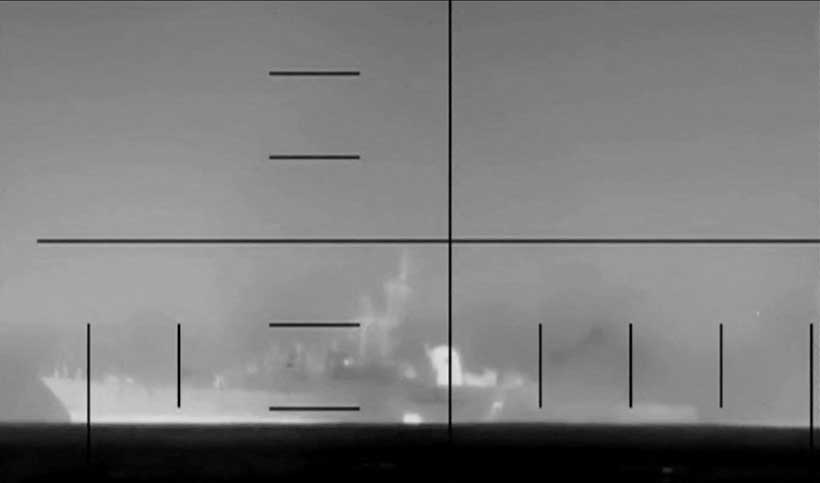
Four days after the launch of Operation Epic Fury, the U.S. torpedoed an Iranian frigate off Sri Lanka’s coast, killing at least 87 Iranian sailors. The warship was en route home after a multilateral naval exercise in India. What are the implications of this reckless U.S. action? The incident has also put the Indian Ocean Region and its major players in the spotlight.
The context
Negotiations between Iranian and U.S. diplomats were making progress when Tehran sent a contingent of three warships—IRIS Dena, IRIS Lavan, and IRIS Bushehr—with more than 500 sailors on board altogether, to the port of Vishakhapatnam along India’s eastern coast for an International Fleet Review and the 13th edition of the biennial Exercise MILAN, hosted by the Indian Navy. The event took place from February 15 to 25 and saw the participation of 74 friendly navies and 18 warships. The Commander of the Iranian Navy, Admiral Shahram Irani, was also present in India for an international naval symposium happening on the sidelines.
Two days after the Iranian warships left India’s shores, after the event’s conclusion, on February 28, the U.S. unilaterally sabotaged the negotiations that were underway, even as both sides were inching closer to a deal, and heedlessly joined hands with Israel to launch Operation Epic Fury against Iran that led to the targeted assassination of Supreme Leader Khamenei, along with several military officials and civilians, including the tragic killing of over 160 schoolchildren. In the week that followed, the United States hit over 3000 Iranian targets and dramatically escalated and widened the theater of conflict from the Persian Gulf to as far as the eastern Mediterranean and the Indian Ocean regions.
Stay ahead of the geopolitical week.
MD Briefing delivers expert analysis across five global fronts — the Indo-Pacific, energy, geoeconomics, European security, and the Middle East — every Monday morning. Free.
IRIS Dena, commissioned in 2021, was capable of carrying surface-to-air missiles, anti-ship missiles and torpedoes. With the conclusion of war games off India’s coast in February 25, this Iranian frigate, along with two other naval vessels, were returning home via the Indian Ocean. En route, a state of war ensued between Tehran and Washington. As the Iranian vessels came as ‘guests’ for a friendly exercise in a friendly country, their ‘level of readiness’ for a real combat scenario was presumably low.
The prospect of a torpedo attack from a U.S. submarine was nowhere on the horizon, as the last time the U.S. Navy resorted to that option was during World War II against the Imperial Japanese Navy. In the 81 years since then, there were only two confirmed instances of torpedo strikes launched from submarines in active combat—the first was the Pakistani Navy’s PNS Hangor against India’s INS Khukri during the War of 1971 in the Arabian Sea, and the other was the UK Royal Navy’s HMS Conqueror against Argentina’s ARA General Belgrano during the Falklands War of 1982 in the South Atlantic Ocean.
US recklessness on display
44 years later, on 04 March 2026, amid repeated changes of rationales and mixed domestic messaging on the Iran strikes, a U.S. nuclear-powered attack submarine operating in the Indian Ocean Region (IOR) reportedly fired a Mk-48 torpedo against the gravely unprepared IRIS Dena with 130 sailors on board. The incident happened about 40 nautical miles off the coast of Sri Lanka near Galle, and there were no warnings issued. The impacted frigate was nearly 2,000 miles away from Iran’s shores, where most of the combat operations and tit-for-tat strikes were unfolding.
Upon receiving distress calls, the Sri Lankan Navy initiated search and rescue operations, soon joined by India. At least 87 Iranian sailors were killed, 32 rescued, and the remaining disappeared. Responding to the incident, Iranian Foreign Minister Abbas Araghchi warned that the U.S. will “bitterly regret the precedent” it has set. Meanwhile, the other two accompanying Iranian ships, IRIS Lavan with 183 sailors on board and IRIS Bushehr with 204 sailors, were granted safe harbor in India and Sri Lanka, respectively.
While the Pentagon released visuals of the attack, U.S. Secretary of War Pete Hegseth described the submarine’s sinking as “quiet death.” In the early days of war, Mr. Hegseth boasted in plain warmongering language, smeared with brazen disregard for international law, “No more stupid rules of engagement … no politically correct wars … we fight to win and we don’t waste time or lives,” something which resonated in the Indian Ocean.
Some analysts also point to a social media post by U.S. President Donald Trump as the basis of Washington’s justification for sinking the vessel, which read, inter alia, “no matter what, the United States will ensure the free flow of energy to the world.” However, firing at a defenseless, non-threatening ship returning from a non-combat exercise in international waters is nothing but reckless chest-thumping, as U.S.-Israeli “decapitation” air strikes in Iran failed to bring about the regime change as expected.
India’s predicament
The sinking of the Iranian frigatetook place nearly 250 nautical miles away from India’s coast in the international waters, close to Sri Lanka and its designated Search and Rescue Zone. But it cast a shadow on India’s image as a respected regional power. It puts the Narendra Modi-led government on the defensive with the onus of a credible explanation to the questions raised by the strategic community, the political opposition, and citizens at large. New Delhi’s vision of positioning itself as a ‘preferred security partner’ in the IOR rests on its ability to not only muster cooperation among regional actors but also maintain regional stability and security.
It is understandable that New Delhi cannot guarantee the safety of every single vessel in its ‘backyard.’ Unlike surface-level warships, the stealthy nature of underwater submarine operations makes it difficult to be detected by surveillance platforms and maritime domain awareness initiatives such as the Information Fusion Centre for the Indian Ocean Region (IFC-IOR) in Gurugram, India. However, being a respected regional power, the very fact that the incident happened in India’s backyard, that too to a ‘guest navy,’ was subjected to much criticism within India, pointing fingers at India’s role as a ‘net security provider’ and ‘first responder’ to disasters in the region.
New Delhi also had to confront and clear the air on unsubstantiated reports that appeared in the media of the possibility of India “assisting” the U.S. in light of the logistical interoperability pacts that it has signed with the tri-ocean naval superpower between 2002 and 2020, viz. GSOMIA, LEMOA, COMCASA, and BECA. New Delhi clarified that these pacts “do not automatically apply” to wartime operations and that it has not received any request seeking logistical assistance from Washington in this case.
Speaking at a geopolitical conference in New Delhi in early March, India’s external affairs minister, Dr. S. Jaishankar, spelt out the complexities entailed in the incident by recalling that a longstanding foreign military presence in the IOR is “the reality” of the Indian Ocean. “Diego Garcia has been in the Indian Ocean for the last five decades. The fact that there are foreign forces based in Djibouti happened in the early first decade of this century. Hambantota (Sri Lanka) came up during this period…,” he added.
The Indian Ocean is bordered by nearly three dozen countries, spanning the continents of Africa, Asia, and Oceania. In spite of the shady U.S. military presence in Diego Garcia and friendly French presence in its overseas departments of Réunion and Mayotte, the IOR is generally accepted as New Delhi’s natural “sphere of influence,” just like the Indian Subcontinent, with the Indian Navy having a significant blue water presence in the crucial maritime highway.
Although IRIS Dena never sought protection from the Indian Navy after departure from its territorial waters, a section of Indian geopolitical commentators referred to the sinking incident as a “strategic embarrassment” for India. Former Indian Foreign Secretary Kanwal Sibal opined, “The attack by the US submarine was premeditated as the US was aware of the Iranian ship’s presence in the exercise to which the US Navy was invited but withdrew from participation at the last minute, presumably with this operation in mind. The US has ignored India’s sensitivities … We are far from politically or militarily responsible for the US attack. Our responsibility is at a moral and human plane.” Another expert, Brahma Chellaney, wrote on X, “In one torpedo strike, American hard power has punctured India’s carefully cultivated soft power.”
Other strategic realities
Notably, India happens to be a partner in the U.S.-led, four-nation Quad grouping, in which Japan and Australia are also members, and is expected to host the Quad Summit later in 2026, in which the U.S. President is expected to attend among other leaders. Coming to Australia, a fellow Quad partner, Prime Minister Anthony Albanese, confirmed that three Australian defense personnel were on board the U.S. submarine that sank the Iranian warship while denying any offensive role. He clarified that they were part of a routine training under the AUKUS defense pact signed between Australia, the U.S., and the U.K. in 2021, under the Biden presidency, which aims to build nuclear-powered submarines for Canberra. Unlike India, both Australia and Japan are formal treaty allies of the U.S.
The comeback of torpedoes in naval warfare signifies that even relatively peaceful international waters are not immune to future conflicts. It also puts seafaring nations, particularly the U.S. and its allies, in a vulnerable position for retaliatory, or even erroneous, strikes from Iran and its proxy militias, including by the prospect of asymmetrical warfare. It could also embolden similar misadventures by other revisionist actors elsewhere. For India and other middle powers, the geopolitical chessboard is getting increasingly complex, and their strategic prudence in engaging mutual adversaries is being tested with one incident after the other. Unpredictability and unilateralism are rapidly evolving as norms to reckon with, apparently as a direct consequence of the weakening of the rules-based international order.