


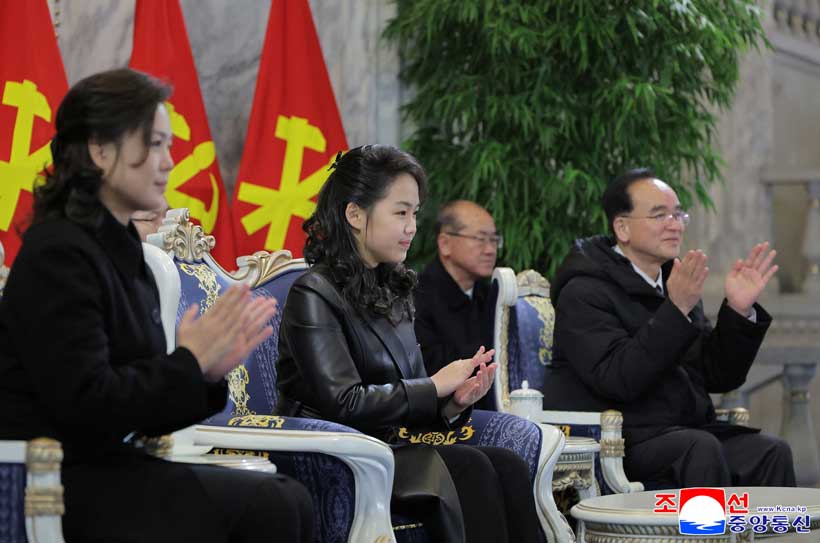
The succession question of North Korea has come up often after the report of Kim Jong Un’s deteriorating health a few years ago. Recent reports even suggest that Kim Ju Ae, Kim Jong Un’s daughter, has been chosen as the heir. Indeed, the consistent portrayal of her as the “dear daughter” of the supreme leader and the rumor that she has been appointed as the missile general director likely indicate the high potential for Kim Ju Ae’s future role in the Kim regime.
Yet, in a very large sense, the statement is an exaggeration. South Korean intelligence has very little information on its northern neighbor, and they also have to change the girl’s name to Kim Ju Hae. Nevertheless, many reasons indicate Kim Jong Un’s daughter is far from becoming the next North Korean leader. Given her and her father’s age, the definition of the Paektu Mount bloodline, and the role of women in society, Kim Ju Ae is not the heir right now, nor will she be in the future.
The most obvious element is Kim Ju Ae’s age. She is 13 or 14 years old, which also means that there were still many changes in her status, even as a potential heir apparent. Looking into North Korean history, the heir is only established later. Kim Jong Il, for example, became the heir in the 1970s. As for Kim Jong Un, his status as the heir was only secured around 2009, after his two older brothers were deemed unfit to lead. Since she has other siblings, even if Kim Jong Un has other children, Kim Ju Ae’s position as an alleged heir is not secure.
Also, the Paektu bloodline has blocked Kim Ju Ae’s path to becoming the future leader. In North Korea’s official definition, the Paektu bloodline refers to the descendants of Kim Il Sung. Despite the North Korean state media having defined Kim Ju Ae as the descendant of the Paektu bloodline, her succession could still trigger a crack in North Korean ideology and the “purity” of the Paektu bloodline. If Kim Ju Ae becomes the next supreme leader, will the supreme leader after her still be considered part of the Paektu bloodline, even without the surname Kim? Even if that’s the case, will her grandchildren be seen as the carriers of the Paektu bloodline? Considering the importance of the Paektu bloodline and its central role in shaping the personality cult of the three generations of Kims, the risk is too high to have created a crack in the system. It makes Kim Ju Ae no longer appealing to be the heir.
Stay ahead of the geopolitical week.
MD Briefing delivers expert analysis across five global fronts — the Indo-Pacific, energy, geoeconomics, European security, and the Middle East — every Monday morning. Free.
Suppose Kim Jong Un did widen the Mount Paektu bloodline, and Kim Ju Ae becomes the next supreme leader; it also means that other members of the Kim family could become potential competitors for the supreme leadership. With the widening of the definition of the Paektu bloodline, there could be foreign challengers who raise their claims against the DPRK leadership. Kim Jong Un’s older brother, Kim Jong Nam, for example, lived abroad until his assassination, and at least one of his children lives abroad. This move could allow foreign powers to use these Kim family members living abroad to influence North Korean affairs. Kim Jong Un must consider the challenges facing the future of the DPRK regime should the definition of the Paektu bloodline shift.
The additional challenge to Kim Ju Ae’s succession would be the DPRK’s long-standing male-dominated tradition. It will still make a hostile environment for a potential female leader. North Korea. This is still a very male-dominated society, with the highest positions being held entirely by men. Although Kim Jong Un may want to introduce reform, the role of women in society cannot be changed immediately. In the recent 9th Party Congress of the Korean Workers’ Party, there were only two women in the Politburo: Choe Son Hui, the foreign minister of North Korea, and Kim Yo Jong, Kim Jong Un’s younger sister. Kim Yo Jong is even an alternative member of the Politburo, further indicating her position in the KWP. While there are women in the party and in the country’s leadership, it is still hard for a woman to reach higher positions in North Korea, making Kim Ju Ae’s succession much more difficult.
At the same time, women in the Kim family have played a more supportive role in the regime in the past years. Kim Kyong-hui, Kim Jong Il’s sister, played a key supporting role in Kim Jong Il’s government, especially in the economically related areas. Kim Yo Jong has been an active member of the North Korean diplomatic engagement. Both Kim Yo Jong and Kim Kyong-hui held senior positions within the KWP as department directors but did not reach the center of power. It is still very likely that the son could become the next leader while Kim Ju Ae, like her aunt and great-aunt, plays a vital supporting role to the regime.
However, the question remains: why is Kim Ju Ae seen in public with Kim Jong Un on multiple occasions? The North Korean media coverage on Kim Ju Ae’s activity remains on the portrayal of the big family of North Korea and the ever-lasting legacy of the North Korean revolution. This is also part of Kim Jong Un’s approach in portraying North Korea’s next generation to indicate the longevity of the regime. Similarly, Kim Ju Ae’s presence on other occasions, such as missile testing, indicates the continuation of the “legacy” of the “revolution.” Even the South Koreans cannot overlook this point. The South Korean government has interpreted Kim Ju Ae’s center position in the photo of the New Year’s visit to Kumsusan Palace of the Sun, Kim Il Sung’s mausoleum, as the everlasting North Korean regime and the whole society as one big family.
The heir to the Kim regime has always drawn worldwide attention, and the story of Kim Ju Ae is just the latest episode. However, despite the fascination, Kim Ju Ae will still not become the next supreme leader. Her age meant there were still many changes ahead. The definition of the Mount Paektu bloodline and the role of women in North Korean society make it even harder for her to become the next leader. It is very unlikely that Kim Ju Ae will become the heir of the North Korean regime.
