


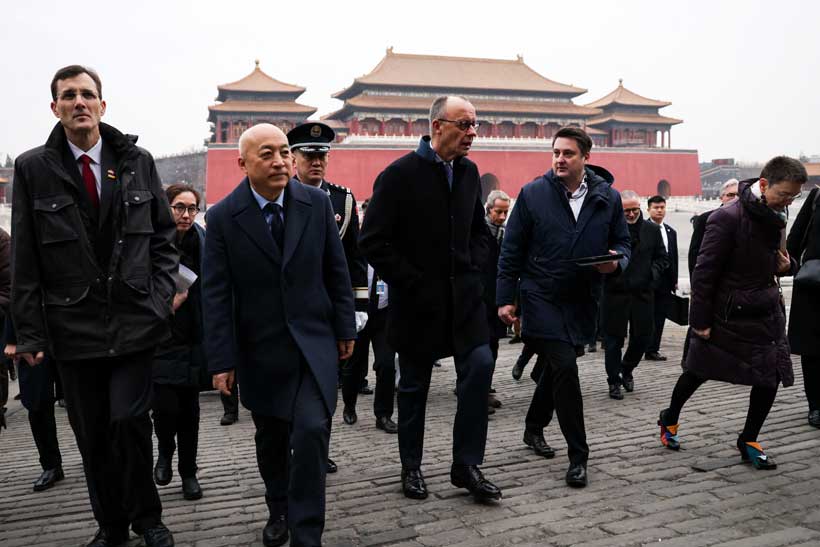
German Chancellor “Friedrich Merz” paid an official visit to China in February 2026, meeting with Chinese President “Xi Jinping” in Beijing. This was his first visit to China since taking office. The visit aimed primarily to “reset” relations between Berlin and Beijing and open a new chapter of equitable economic cooperation. This visit came at a time when Germany was seeking to balance its strategic relationship with the United States and its substantial economic interests with China. Chancellor Merz’s visit to China (he had recently assumed office in 2025/2026) carried a number of important strategic and economic messages, aimed at reshaping the relationship between Berlin and Beijing amidst major geopolitical shifts. However, the timing and economic objectives of Chancellor Merz’s visit to China in February 2026 raised concerns in Washington, as they could conflict with the escalating US trade war strategy against Beijing.
German Chancellor Friedrich Merz’s visit included a number of economic talks, including discussions with Chinese Premier “Li Keqiang,” aimed at strengthening mutual trust and deepening economic and diplomatic exchanges between the two countries. Chancellor Merz’s visit also included several field trips, including a cultural component, such as a tour of the Forbidden City in Beijing on the second day of his trip. Among the most prominent issues discussed were the trade balance. Chancellor “Merz” sought to address the growing trade imbalance between the two countries, urging Beijing to ensure fair economic cooperation. The German chancellor expressed his country’s welcome of Chinese investments, emphasizing the importance of continued open dialogue. Several geopolitical issues were also discussed: Chancellor “Merz” called on the Chinese leadership to use its influence with Russia to help end the war in Ukraine. During the meeting, Chinese President Xi Jinping noted that the world is witnessing the most profound changes since World War II, stressing the importance of stable relations between major powers. The most prominent messages and implications of the German Chancellor’s visit to China include the demand for economic “fairness”: This was evident in Chancellor Merz’s clear call for a more equitable and just economic relationship and his emphasis on the need for fair competition for German companies in Chinese markets. He also presented practical ideas for addressing the trade deficit with China: Here, the visit carried a strong message about the necessity of reducing Germany’s large trade deficit with China, as “Merz” secured Chinese commitments to import more high-quality German goods. Furthermore, there was a (joint Chinese-German commitment to opening a new chapter): The visit aimed to give “new impetus” to the comprehensive strategic partnership while emphasizing the principles of mutual respect and open dialogue despite existing differences.
German Chancellor Friedrich Merz’s visit to China also reflects a kind of strategic independence in the “Trump era.” This visit demonstrates Germany’s awareness of the need to adopt flexible policies to protect supply chains, especially given the anticipated unpredictability of US policies under the Trump administration. With the German-Chinese agreement to support major manufacturers, Merz brought a delegation of approximately 30 CEOs from leading companies, such as Mercedes-Benz and BMW, sending a message that China remains a vital and indispensable market for German industry. Both the Chinese and German sides emphasized cooperation on global challenges, stressing the importance of joint action to address international issues and announcing a new round of government consultations in 2026 to deepen this coordination.
Official circles in Washington expressed concern over German Chancellor Friedrich Merz’s visit to China. The main points of American apprehension are as follows: (Undermining the policy of sanctions and tariffs): The Trump administration fears that Chancellor Merz’s efforts to deepen relations with China will weaken the unified Western pressure front that Washington is trying to lead through the imposition of stringent tariffs. Furthermore, the German Chancellor’s desire to save German industry at the expense of dependence on Washington: The visit (accompanied by some 30 CEOs of major companies such as Mercedes and BMW) aims to “save German industry” by opening up Chinese markets, which Washington sees as deepening economic dependence on a strategic rival like Beijing. With (Germany’s attempt to strike a balance between Washington and Beijing): Here, Germany, under Merz’s leadership, seeks to play a “balancing” role. Chancellor Merz refuses to fully side with Washington in its trade war, preferring instead to pursue “fair competition” that ensures the continuation of massive German exports to China.
Stay ahead of the geopolitical week.
MD Briefing delivers expert analysis across five global fronts — the Indo-Pacific, energy, geoeconomics, European security, and the Middle East — every Monday morning. Free.
Hence the American apprehension regarding China’s potential exploitation of the visit. The US administration fears that Beijing will use this visit (the first by a major Western leader in 2026) as evidence of the failure of the isolation America is attempting to impose on it and to demonstrate a “new chapter” in relations with Germany, Europe’s leading economic power. This is especially significant given that the visit comes at a highly sensitive time, as China has surpassed the United States as Germany’s primary trading partner, forcing Berlin to safeguard its economic interests in Beijing, even if this causes tension with its security ally in Washington.
Here, American concerns regarding the rapprochement between Germany and China revolve around several strategic and economic points. Washington views Beijing as a “geopolitical competitor” that threatens the international order, while Berlin considers it an indispensable trading partner. The most prominent points of American concern are, as follows: (American apprehension about German economic dependence on China and Beijing’s growing influence): The United States fears that Germany’s (Europe’s largest economy) reliance on the Chinese market, exports, and raw materials will grant Beijing “political influence” within the European Union. Furthermore, there is growing American concern about China’s dominance of technological supply chains linked to the European economy and sensitive technologies, which, from the American perspective, could jeopardize American national security, particularly in the areas of dual-use technologies and cyber infrastructure.
Washington believes that Germany’s insistence on strengthening its relations with China, despite American warnings, weakens Western cohesion and undermines the united front against what it describes as China’s “unfair trade practices.” Furthermore, it sees Germany as challenging the policy of “decoupling” from China. While Washington pushes for reduced dependence on China, Germany adopts a strategy of “de-risking” instead of a complete break from Beijing, which the United States considers insufficient to counter the rising Chinese challenge.
From the preceding analysis, we understand the extent of American concern regarding the increasing German-Chinese engagement, as well as the growing American pressure on Berlin. Germany is currently navigating a difficult balancing act between its strategic alliance with Washington and its deepening economic partnership with Beijing, especially given the escalating US-China rivalry.
