


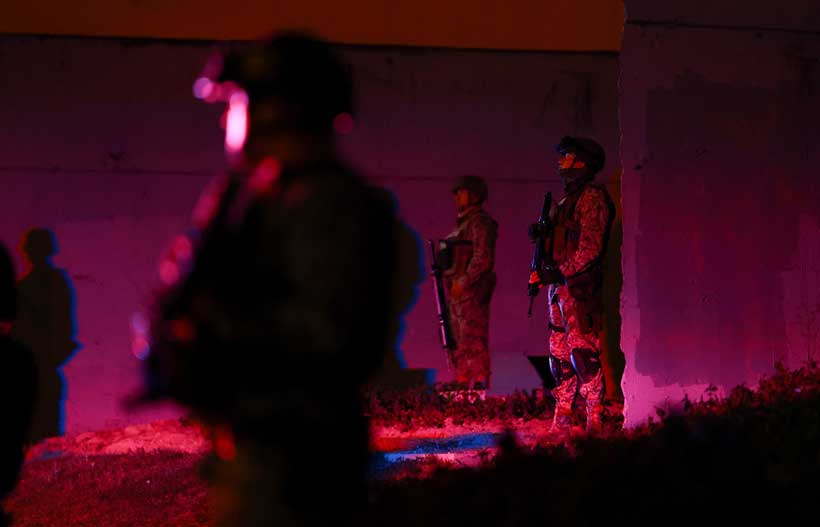
In 2026, the world will witness the grand event of the 2026 FIFA World Cup which for the first time is jointly organised by three North American countries (United States, Mexico, and Canada). But behind the global euphoria, the death of the leader of the Cartel de Jalisco Nueva Generacion (CJNG), Nemesio Oseguera Cervantes or better known as El Mencho who was killed in a military operation, triggered a wave of violence in several regions of Mexico. (CNN World, 2026)
Military operations took place in Tapalpa. It is located only 130 km or about 2 hours drive from Guadalajara. A big city that will be one of the hosts of the 2026 World Cup. A few hours after El Mencho’s death, cartel members launched a counter-attack. The incident turned the atmosphere of the security operation into panic that was felt directly by civilians. (Grant, 2026)
According to research related to the Leadership Decapitation Strategy in armed conflict, it shows that when a central figure is eliminated, the previously consolidated network structure can break down into factions that are more difficult to control and will give rise to a large-scale chaos response. (Johnston et al., 2012) Counter-terrorism studies have found that killing or arresting the leader of an armed group does not necessarily reduce violence. Decapitation strategy does not always reduce violence. The death of a leader often creates a power vacuum. A power vacuum can trigger greater fragmentation. This phenomenon is known as the decapitation paradox effect.(Johnston et al., 2012)
The escalation between the state and drug cartels in Mexico is not a new phenomenon. In 2006, President Felipe Calderon launched the “wars on drugs” discourse with a militarized approach. This conflict then turned into a national security issue. 10 years have passed, military operations continue, cartel leaders arrested and disabled, but the violence has not completely disappeared. On the contrary, group fragmentation creates to new actors. The Cartel de Jalisco Nueva Generacion (CJNG) is one of the most powerful and expansive narcotics cartels in Mexico today, with an estimated membership of around ±15,000 to ±20,000 people and generating billions of dollars in revenue each year. (Correa-cabrera et al., 2007)
Stay ahead of the geopolitical week.
MD Briefing delivers expert analysis across five global fronts — the Indo-Pacific, energy, geoeconomics, European security, and the Middle East — every Monday morning. Free.
Max Weber defined the state as an entity that holds a monopoly on the lawful use of force within a territory. (Weber, 1919) But the existence of narcotics cartels in Mexico often defies this definition. Cartels are no longer just criminal networks operating in the shadows, but rather as non-state actors with armed capabilities, military movements, and control over territory. When such a group is able to create insecurities that are no longer just a violation of the law, but a struggle for authority. (Correa-cabrera et al., 2007)
The dimension that makes this case even more complex is pressure from the United States. In recent years, Mexican cartels have been considered a serious threat to U.S. domestic security, especially related to fentanyl trafficking and illegal migration. In essence, this case is a domestic Mexican issue. However, once the United States framed drug cartel violence as an existential threat to its national security, the issue underwent a securitization process.
El Mencho’s death and the wave of violence that followed can be read as a reputational shock for Mexico. The momentum of the security stability narrative that is being built ahead of the 2026 FIFA World Cup suddenly clashes with the reality of security escalation. In the study of international relations, the reputation of a state is understood as a strategic asset that shapes the credibility and perception of the state’s capacity in the international system. (Mercer, 1996)
Interestingly, this phenomenon raises questions about the timing and political calculations behind the Mexican military operation decisions. Why did the Mexican government take such a big step at such a sensitive moment domestically and internationally?
Under the leadership of President Claudia Sheinbaum, El Mencho’s death was a symbolic and strategic victory for the Mexican government. This move has the potential to reduce pressure from US President Donald Trump who has threatened to carry out attacks in Mexico. This is explained in the two-level game theory introduced by Robert Putnam which states that the leader of the country always negotiates in two arenas at once, namely domestic and international. (Putnam, 2006)
In the domestic arena, a leader must consider public opinion, internal political pressures, government legitimacy, and national security stability. In this case the Mexican government faces public demands to show control over its territory. Meanwhile, in the international arena, leaders face pressure from other countries that have strategic interests. The United States’ discourse in this case burdens the Mexican government by categorising drug cartels as terrorist organisations, so that if the United States feels that Mexico is not firm enough, the legitimacy of intervention will be deployed.
In other words, this operation can be considered rational as a diplomatic signal. As a form of bargaining power, Mexico is considered to still be able to control its territory and does not require external intervention. Meanwhile, making the 2026 World Cup an instrument of soft power by co-hosting it is also an opportunity for Mexico to improve its image that has often been associated with cartel violence.
During these dynamics, the presence of the 2026 World Cup essentially accelerates the urgency of this issue. Global mega-events create political deadlines. Furthermore, the question of whether the operation against El Mencho is part of the calculation of the reputation of winning the 2026 FIFA World Cup?
This question becomes relevant when looking at how a number of arguments about the Olympic Games and World Cup show the phenomenon where the host country often Over-securitizes or Pre-emptive Celansing Strategies ahead of the event. (Giulianotti & Klauser, n.d.) However, the findings also suggest that violence does not always disappear but moves geographically. This means that security diplomacy works at the level of global perception with the management of conflict stability. (Svitkova, 2014)
The world will monitor the security readiness of the three host countries. There is no guarantee that the violence will immediately subside. If the violence continues to escalate, the reputation of not only Mexico but also the credibility of the North American trilateral organizers will be affected.
This phenomenon can then also be understood as the blurring boundary conflict which explains the existence of domestic conflicts with international systemic consequences. (Shirk, n.d.) Drug cartels are domestic non-state actors, but their operations are transnational. Further, the state’s response is internal, but the implications are external. Foreign pressure also complicates the status of sovereignty. (Wiliams, 2006) Mexico today faces the reality that its domestic security is an issue of international security diplomacy.
